Your Labrador Retriever just knocked over your coffee. Again.
She’s currently chewing the corner of your couch cushion while simultaneously ignoring the $40 chew toy you bought specifically to prevent this exact scenario. Yesterday she dragged you three blocks down the street when she spotted a squirrel. Last night she counter-surfed an entire stick of butter and ate it wrapper and all.
And through it all, you’re staring at this beautiful, chaotic, tail-wagging tornado thinking: I love you so much, but I have absolutely no idea what I’m doing.
Sound familiar? You’re not alone. And you’re definitely not failing.
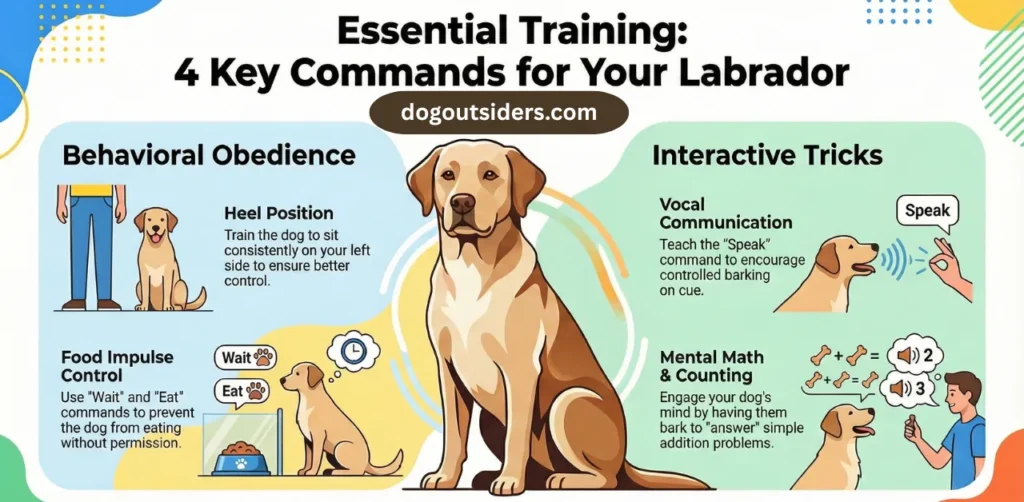
As a certified dog trainer with over 12 years of experience specializing in sporting breeds — Labrador Retrievers being the number one breed I work with — I can tell you that this exact moment of overwhelmed panic is where most Lab owners find me. They’re exhausted. They’re questioning whether they made a mistake. And they desperately want someone to just tell them: “Start here. Do this first.”
That’s exactly what this article does.
These are the 9 essential commands to teach your Labrador Retriever first — listed in a specific, intentional order that builds on each skill sequentially. This isn’t a random list. It’s the same progression I use with every single Labrador puppy and adult dog that comes through my training program, refined over a decade and hundreds of Labs.
Each command includes:
- Why it matters specifically for Labrador Retrievers
- Step-by-step instructions you can follow today
- Pro tips from real training sessions
By the end, you’ll have a clear, actionable roadmap that replaces the chaos with confidence.
Let’s turn your wild Lab into the good dog you know is in there.
Why Training Order Matters for Labrador Retrievers
Here’s something most generic “dog commands” articles won’t tell you: the order in which you teach commands matters enormously — and it matters especially for Labs.
Why? Because each command in this sequence builds a cognitive foundation for the next one. “Sit” teaches your Lab to offer a behavior on cue. “Down” builds on “Sit” by adding duration and impulse control. “Stay” builds on “Down” by adding distance. “Come” requires the impulse control learned in “Stay.”
Skip ahead — or teach them randomly — and you’ll hit walls. Your Lab will “know” commands in isolation but fall apart in real-world situations.
How Labs Learn Differently Than Other Breeds
Labrador Retrievers are consistently ranked among the top 7 most intelligent dog breeds by the American Kennel Club. They were originally bred as working retrievers — which means they’re hardwired for two things: cooperating with humans and using their mouths.
This breed-specific dog training understanding shapes everything:
- Labs are incredibly food-motivated. This makes positive reinforcement dog training exceptionally effective — arguably more effective with Labs than with almost any other breed.
- Labs have high energy and low impulse control as puppies. Training sessions need to be short, high-reward, and built on progressively harder challenges.
- Labs mature slowly. According to a 2019 study published in Scientific Reports, large-breed dogs like Labradors don’t reach full behavioral maturity until 2–3 years of age. That means patience isn’t optional — it’s the strategy.
- Labs are mouthy. Commands like “Leave It” and “Drop It” aren’t optional for this breed — they’re survival skills.
Understanding the Labrador Retriever temperament isn’t just interesting background. It’s the reason these 9 commands are chosen, and why they’re in this order.
Related reading: The Complete Labrador Retriever Puppy Training Schedule (Week by Week)
Before You Start: Training Fundamentals Every Lab Owner Needs
Before we dive into the 9 commands, let’s establish three non-negotiable training fundamentals. Skip these, and even the best commands will fail.
Positive Reinforcement — The Only Method You Should Use
Every command in this guide uses positive reinforcement training — meaning you reward the behavior you want rather than punishing the behavior you don’t want.
This isn’t just a “nicer” approach. The science is definitive. A landmark 2020 study from the University of Porto found that dogs trained with aversive methods (corrections, leash pops, e-collars) showed significantly higher stress behaviors and lower welfare scores compared to dogs trained with positive reinforcement. For Labs — a breed whose entire working history is built on wanting to please you — corrections actively undermine the cooperative relationship that makes training work.
Use treats, praise, play, or a clicker/marker word (“yes!”) to mark and reward correct behavior. That’s it. That’s the method.
Related reading: Positive Reinforcement vs. Correction-Based Training: What Works Best for Labs
Session Length, Treats & Timing
- Session length: 5–10 minutes maximum for puppies under 6 months. 10–15 minutes for adolescent and adult Labs. Multiple short sessions per day beat one long one.
- Treats: Use small, soft, high-value dog training treats (pea-sized). Labs are food-motivated — use that. But don’t use their regular kibble; it’s not exciting enough.
- Timing: Mark the correct behavior within 1–2 seconds. Late rewards confuse the dog. A clicker training approach or a sharp “yes!” followed by a treat is the gold standard for timing precision.
Related reading: The Best Training Treats for Labrador Retrievers (Vet-Approved Picks 2025)
The 9 Essential Commands (In the Right Order)
Here they are — the 9 commands I teach every Labrador Retriever, in the exact order that builds success on success.
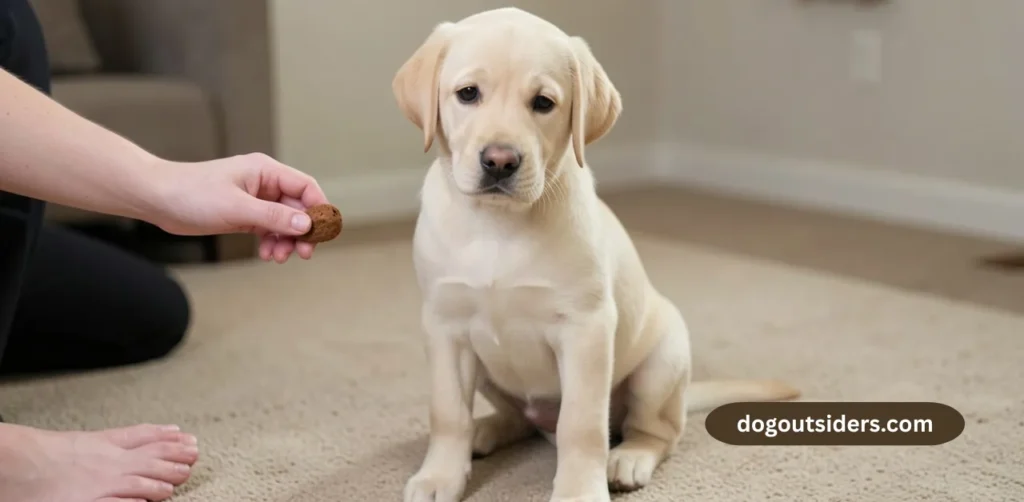
Command #1 — “Sit” (The Foundation of Everything)
Why it matters for Labs: “Sit” is the gateway command — the first moment your Labrador learns that offering a behavior on cue earns a reward. This single concept unlocks everything else. For a breed as eager-to-please as a Lab, the “sit” lightbulb moment is transformative. It’s also the natural replacement behavior for jumping — Labs jump on people because they don’t know what else to do with their excitement. “Sit” gives them an answer.
Step-by-step:
- Hold a treat close to your Lab’s nose (don’t let her grab it)
- Slowly raise your hand above and slightly behind her head
- As her nose follows the treat up, her rear will naturally lower to the ground
- The instant her butt touches the floor, say “yes!” and give the treat
- Repeat 5–8 times per session, 3 sessions per day
- Once she’s offering the sit reliably (typically within 2–3 days), add the verbal cue “sit” just before she begins the motion
- Gradually fade the treat lure — use a hand signal, then just the verbal cue
Pro tip: Never push your Lab’s rear down to force a sit. This creates resistance and teaches her nothing about choosing the behavior. Lure, mark, reward. Always.
Command #2 — “Down” (Impulse Control Starts Here)
Why it matters for Labs: “Down” requires more impulse control than “sit” because it puts your Lab in a more vulnerable, settled position. For a high-energy breed, learning to choose to lie down on cue is the beginning of self-regulation — a skill Labs desperately need.
Step-by-step:
- Start with your Lab in a “sit”
- Hold a treat at her nose, then slowly lower it straight down to the floor between her front paws
- When she follows the treat down and her elbows touch the floor, say “yes!” and reward
- If she stands up instead of lying down, don’t repeat the cue — just reset and try again
- Add the verbal cue “down” once the behavior is reliable
Pro tip: Some Labs resist “down” because the floor is cold or uncomfortable. Practice on carpet or a mat first. If she’s still resistant, try luring under your bent knee — she’ll have to lie flat to reach the treat.
Command #3 — “Stay” (The Patience Builder)
Why it matters for Labs: “Stay” teaches your Labrador that not moving is just as rewardable as doing something. This is revolutionary for a breed that wants to be in motion constantly. A solid stay prevents door-dashing, counter-surfing, and chaos when guests arrive.
Step-by-step:
- Ask your Lab to “sit” or “down”
- Hold your palm out (stop-sign gesture) and say “stay”
- Wait 1 second — then say “yes!” and reward while she’s still in position
- Gradually increase duration: 2 seconds, 5 seconds, 10 seconds, 30 seconds
- Add distance only after duration is solid: one step back, two steps, across the room
- Add distractions last: toss a treat nearby, have someone walk past, open a door
The 3 D’s Rule: Train duration, distance, and distraction — but never increase more than one at a time. This is the single most important principle of stay command training.
Pro tip: Always release your Lab with a clear release word — I use “free!” or “okay!” — so she knows when the stay ends. Without a release cue, she’ll start guessing when she can move, and “stay” falls apart.
Command #4 — “Come” (The Lifesaving Command)
Why it matters for Labs: Recall training for dogs is important for every breed, but for Labradors — a breed that will happily chase a bird into traffic or swim after a duck into a dangerous current — a bulletproof “come” can literally save your dog’s life. This is the single most important safety command your Lab will ever learn.
Step-by-step:
- Start indoors with minimal distractions
- Say your Lab’s name followed by “come!” in an excited, happy voice
- As she moves toward you, back up a few steps (motion attracts Labs)
- When she reaches you, say “yes!” and deliver a jackpot reward — 3–4 treats in a row, excited praise, a brief game of tug
- Never, ever call “come” and then do something your dog doesn’t like (nail trim, bath, crate). This poisons the cue.
- Practice 10–15 times per day in various rooms, then gradually move to the yard, then on a long line outdoors
Real example: A client of mine, Priya, had an 8-month-old yellow Lab named Mango who bolted out the front door one evening and headed straight for a busy road. Because Priya had been drilling recall training for 6 weeks using this exact progression — high-value treats, excited voice, never poisoning the cue — Mango turned on a dime at her call and sprinted back. Priya told me later: “That one command was worth every single training session.”
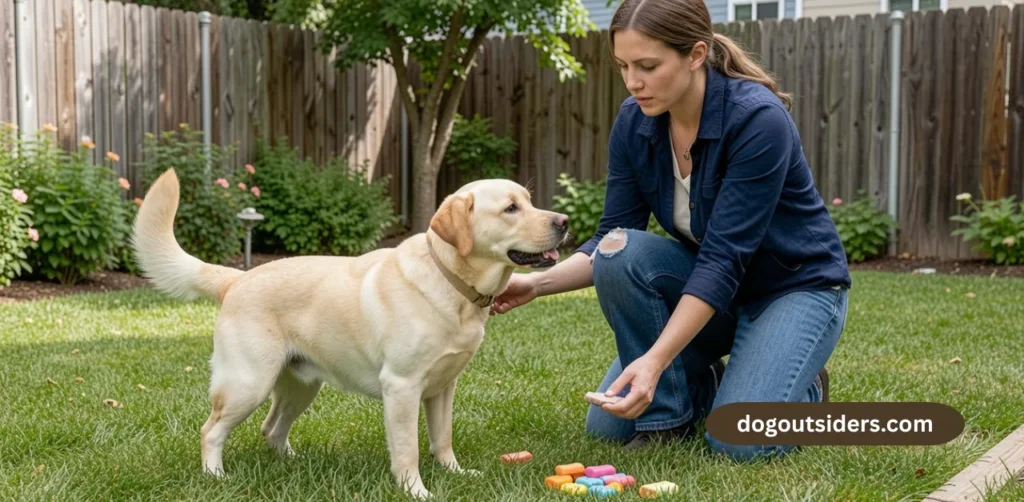
Pro tip: For the first 6 months, always reward a recall. Every single time. A recall should be the best thing that happens in your Lab’s day. The moment you start calling and not rewarding, reliability drops.
Related reading: 7 Labrador Behavior Problems and How to Fix Them
Command #5 — “Leave It” (The Mouth Manager)
Why it matters for Labs: Labrador Retrievers explore the world with their mouths. They’ll pick up — and attempt to eat — dead animals, chicken bones, chocolate, socks, medications, rocks, and literally anything else they encounter. “Leave it” tells your Lab: Don’t touch that. Walk away. I’ve got something better.
According to the ASPCA Animal Poison Control Center, dogs ingesting toxic substances is one of the most common pet emergencies, and mouthy breeds like Labs are disproportionately affected.
Step-by-step:
- Place a treat in your closed fist. Let your Lab sniff, lick, and paw at it. Wait.
- The moment she pulls her nose away (even for a second), say “yes!” and reward from your other hand
- She learns: ignoring the thing = getting something better
- Progress to an open palm (cover quickly if she dives), then treats on the floor under your foot, then on the ground at a distance
- Add the verbal cue “leave it” once she consistently turns away from the initial treat
Pro tip: “Leave it” should always mean “turn away from that thing forever — don’t go back to it.” It’s different from “drop it” (which means “release what’s already in your mouth”). Teaching these as two separate, distinct commands prevents confusion.
Command #6 — “Drop It” (The Emergency Release)
Why it matters for Labs: Your Lab will pick up something she shouldn’t — no matter how good her “leave it” is. “Drop it” is your emergency extraction tool. For a breed literally bred to hold things in their mouths, a reliable “drop it” prevents resource guarding, intestinal blockages, and panicked chase-the-dog-around-the-house scenarios.
Step-by-step:
- During play, let your Lab grab a toy
- Present a high-value treat right at her nose and say “drop it”
- When she releases the toy to take the treat, say “yes!” and reward
- Immediately give the toy back. This is critical — it teaches her that dropping something doesn’t mean losing it
- Practice with increasingly valuable items (always trading for something even better)
Pro tip: Never chase your Lab to get something from her mouth. Chasing triggers keep-away instincts and can escalate into resource guarding. Stay calm, offer the trade, reward the release. If the item is truly dangerous, walk away — most Labs will follow you, dropping the item in the process.
Command #7 — “Heel” (The Walk Transformer)
Why it matters for Labs: Let’s talk about the elephant in the room — or rather, the 70-pound Labrador at the end of the leash dragging you down the sidewalk. A full-grown Lab can pull with up to 60+ pounds of force. Without leash training basics and a solid “heel” command, walks become something you dread rather than enjoy.
“Heel” means: walk beside me, at my pace, without pulling. It doesn’t mean your Lab must heel for the entire walk — but she should be able to do it when asked.
Step-by-step:
- Start indoors or in your yard with minimal distractions
- Hold treats in your left hand (or whichever side you want your Lab to walk on)
- Take one step. If your Lab stays beside you, say “yes!” and reward at your hip level
- Gradually add steps: 2 steps, 5 steps, 10 steps — rewarding frequently
- If she pulls ahead, stop walking completely. Don’t move until the leash is loose. Then mark and reward the loose leash
- Add the verbal cue “heel” once she’s reliably walking beside you
Real example: Marcus, a first-time Lab owner in my beginner dog training group class, had a 9-month-old chocolate Lab named Bear who pulled so hard that Marcus had rope burns on his palms. We spent three weeks practicing the “be a tree” method (stop when they pull, reward when the leash is loose) combined with structured heel work. By week four, Bear was walking at Marcus’s side through the local farmer’s market — no pulling, no drama. Marcus texted me a photo with the caption: “I can finally enjoy walks with my dog.”
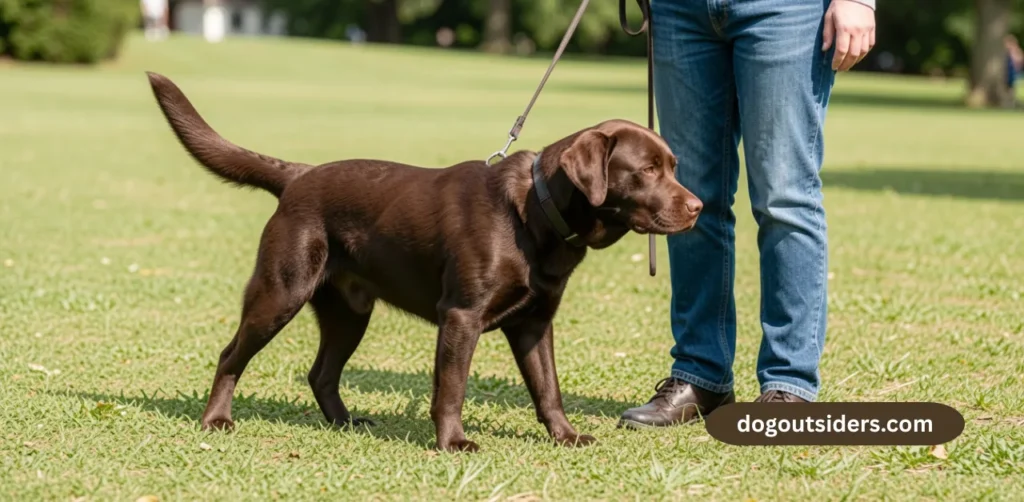
Pro tip: Use a front-clip harness (like the Freedom No-Pull Harness) while teaching heel. It redirects your Lab’s forward momentum back toward you, making training dramatically easier. Never use prong collars or choke chains — they cause pain, create negative associations with walks, and don’t teach the dog anything.
Related reading: How to Stop Your Labrador From Pulling on the Leash (5 Proven Methods)
Command #8 — “Wait” (The Doorway & Mealtime Game-Changer)
Why it matters for Labs: “Wait” is different from “stay.” “Stay” means “don’t move until I release you.” “Wait” means “pause for a moment — I’ll tell you when to proceed.” It’s shorter, more situational, and absurdly practical.
Use “wait” at doorways (prevents door-dashing), before meals (prevents food-bowl lunging), before getting out of the car (prevents launching into a parking lot), and at crosswalks.
Step-by-step:
- Stand at a doorway with your Lab on leash
- Reach for the door handle. If your Lab surges forward, remove your hand and wait
- When she settles (even slightly), say “yes!” and give a treat
- Open the door an inch. If she stays calm, “yes!” and treat. If she surges, close the door. No drama, no corrections.
- Gradually open the door wider, rewarding calm waiting
- Release with “okay!” or “free!” and walk through together
- Add the verbal cue “wait” once she’s reliably pausing
Pro tip: Practice this before every meal. Hold the food bowl, say “wait,” lower it slowly. If she lunges, raise it back up. She eats when she’s calm. Within a week, you’ll have a Lab who sits politely while you put her bowl down. It’s one of the most satisfying training wins you’ll experience.
Command #9 — “Place” (The Calm-Down Command)
Why it matters for Labs: “Place” means “go to your designated spot (bed, mat, or crate) and stay there until I release you.” This is the ultimate dog impulse control training command — and for Labs, it’s an absolute game-changer.

Why? Because Labs struggle with what I call the “FOMO problem.” They want to be in the middle of everything — dinner, guests, cooking, kids playing. “Place” gives them a job to do (go to your spot and chill) instead of ricocheting around the house like a furry pinball.
Step-by-step:
- Choose a specific bed, mat, or raised cot as the “place” station
- Toss a treat onto the mat. When your Lab steps on it, say “yes!” and reward
- Repeat until she’s eagerly going to the mat
- Add the verbal cue “place” as she moves toward it
- Once she’s going to the mat reliably, ask for a “down” on the mat, then gradually build duration (same progression as “stay”)
- Practice with distractions: doorbell, family walking around, mealtime preparation
Pro tip: Keep a “place” station in every main room of your house. One in the living room, one in the kitchen, one in the bedroom. This way, “place” works everywhere — not just in one location. It becomes your Lab’s default calm-down protocol no matter where she is.
Real example: My own Labrador, Tucker (chocolate Lab, 4 years old), uses “place” every single evening during family dinner. He goes to his mat in the kitchen, lies down, and stays there for the entire meal. He didn’t start that way — at 5 months old, he was the worst counter-surfer I’ve ever seen. Consistent “place” training, done in 3-minute sessions over about 4 weeks, transformed mealtimes from chaos to calm. I practice what I teach — and “place” is the command I recommend most often to my clients.
Labrador Training Quick-Reference Chart
| Command | Purpose | Difficulty | Average Time to Learn |
|---|---|---|---|
| 1. Sit | Foundation behavior | Easy | 1–3 days |
| 2. Down | Impulse control intro | Easy–Moderate | 3–7 days |
| 3. Stay | Patience + duration | Moderate | 1–3 weeks |
| 4. Come | Safety recall | Moderate–Hard | 4–8 weeks (ongoing) |
| 5. Leave It | Prevent ingestion | Moderate | 1–2 weeks |
| 6. Drop It | Emergency release | Moderate | 1–2 weeks |
| 7. Heel | Leash manners | Hard | 3–6 weeks |
| 8. Wait | Situational pause | Easy–Moderate | 1–2 weeks |
| 9. Place | Calm-down protocol | Moderate | 2–4 weeks |
Note: Timelines vary based on age, individual dog, consistency, and training session frequency. Puppies under 4 months will need more repetitions and shorter sessions.
5 Common Labrador Training Mistakes to Avoid
After 12 years of training Labs, these are the mistakes I see on repeat — often from the most dedicated, well-intentioned owners:
- Training sessions that are too long. Labs check out mentally after 10–15 minutes max. Three 5-minute sessions beat one 30-minute marathon. End every session on a success — even if it’s a simple “sit.”
- Repeating the cue word. “Sit. Sit. Sit. SIT!” If you say the cue more than once, you’re training your dog that the command is “sit-sit-sit-SIT.” Say it once. Wait. If she doesn’t respond, lure the behavior and try again.
- Fading treats too fast. Labs are treat motivation dogs — and that’s a feature, not a bug. Don’t rush to stop using treats. Gradually transition to intermittent reinforcement (random rewarding) over weeks and months, not days. The ASPCA’s dog training resources confirm that premature treat fading is one of the top reasons trained behaviors deteriorate.
- Training only indoors. Your Lab might nail “sit” in the kitchen but completely ignore you at the park. You must practice in progressively distracting environments. This is called “proofing” — and it’s essential for dog training consistency to transfer to real life.
- Inconsistency between family members. If you say “down” and your partner says “lie down” and your kids say “lay down,” your Lab doesn’t have one command — she has three confusing sounds. Pick one cue word per command and make sure everyone in the household uses it.
Related reading: 7 Labrador Behavior Problems and How to Fix Them
How Long Does It Take to Train a Labrador These 9 Commands?
With consistent daily training (2–3 short sessions per day), most Labrador Retrievers can learn all 9 commands at a basic proficiency level within 6–10 weeks.
However — and this is important — “learning” a command and “reliably performing” a command in real-world situations are very different things. Full reliability in distracting environments typically takes 4–6 months of ongoing practice and proofing.
According to the American Kennel Club’s training guidelines, consistent short sessions over time produce far better results than intensive boot-camp-style training. Labs are lifelong learners — and training is an ongoing conversation, not a one-time event.
The good news? Labs are among the easiest breeds to train. Their labrador retriever temperament — eager to please, food-motivated, and socially bonded to their humans — makes them ideal candidates for positive reinforcement training. You’ve picked one of the most trainable breeds on the planet. Now you just need the roadmap — and you have it.
Final Thoughts — Your Lab Is Counting on You 💛
Here’s what I want you to remember when it’s 7 PM and your Lab just stole a shoe and you’re wondering why you thought a puppy was a good idea:
You are not behind. You are not failing. You are here, reading this, learning — and that already makes you a great dog parent.
These 9 essential commands will transform your relationship with your Labrador Retriever. Not overnight. Not in a single session. But command by command, day by day, treat by treat — you’ll watch the chaos melt away and the connection deepen.
Start with “sit” today. Just “sit.” Five minutes. Five treats. That’s it.
Then come back for command #2 tomorrow.
If this guide helped you feel less overwhelmed and more confident, please save it on Pinterest so other Lab parents can find it too. And if you’re in the trenches of Labrador puppyhood right now, drop a comment on dogoutsiders.com — I’d love to hear which command you’re working on. 🐾

Jahanzaib:
Jahanzaib is a dedicated dog care researcher and content creator specializing in dog training, behavior correction, and pet wellness. As the founder of DogOutsiders.com, he focuses on creating evidence-based, experience-driven content that helps dog owners solve real problems—from training stubborn dogs to avoiding critical health and behavior mistakes. His mission is to make expert-level dog care knowledge simple and accessible for every pet owner.
Frequently Asked Questions — Labrador Retriever Training Commands
Start with basic commands in this order: sit, down, stay, and come, as they build focus, impulse control, and safety skills. Then teach leave it, drop it, heel, wait, and place to strengthen obedience step-by-step. Labrador puppies can begin training as early as 8 weeks old using short, positive, reward-based sessions. 🐶✨
Train a Labrador using positive reinforcement, consistency, and short sessions. Reward correct behavior within 1–2 seconds using treats or a marker word like “yes.” Keep sessions 5–10 minutes for puppies and 10–15 minutes for adults. Practice commands in different places (called proofing) so your Lab obeys anywhere. Make sure all family members use the same cues and rules to avoid confusion. 🐕✅
Start training your Labrador puppy as soon as you bring her home (around 8 weeks old). Begin with name recognition, sit, down, and recall using short 3–5 minute sessions. By 12–16 weeks, add stay and leave it with more structure. Early training and socialization during the 14–16 week window helps build confidence and lifelong good behavior. 🐶📚✨
For Labrador Retrievers, the hardest command is usually reliable recall (“come”), especially in distracting places like parks. It often takes 4–8 weeks of training plus several months of practice in different environments. Heel (loose-leash walking) is the second most challenging because it requires long-term impulse control. Both commands need extra patience, repetition, and high-value rewards compared to basic commands like sit or down. 🐕🎯
Yes — Labrador Retrievers are considered one of the easiest breeds to train, ranking among the top intelligent and cooperative breeds according to the American Kennel Club. Their eagerness to please and strong food motivation help them learn quickly with positive reinforcement. However, they still need consistent training, especially during adolescence (6–18 months), and typically reach full maturity around 2–3 years. 🐕📘
Teach recall by making “come” highly rewarding for your Labrador. Start indoors with no distractions, say your dog’s name + “come!” in a happy voice, and reward with multiple treats, praise, or play when she reaches you. Practice daily in different rooms, then move to a fenced yard, and later use a long training line outdoors. Never call your dog for something unpleasant, and always reward recall for the first 6 months to build reliability. 🐕🎯
Yes — food rewards are key for training Labrador Retrievers, especially early on. Use small, high-value treats like freeze-dried liver, chicken, or cheese to reinforce commands. Gradually move to intermittent rewards and real-life incentives as your Lab masters each command. In the beginning, treats are the most effective tool for building reliable obedience and strong bonds. 🐶🍖✅