You’ve taken your Dachshund outside fifteen times today. You waited patiently. You praised enthusiastically. And then — the moment you brought them inside — they walked directly to the living room rug and did exactly what you spent the last twenty minutes trying to avoid.
You’re not failing. But you might be using the wrong system.
Dachshunds are notoriously difficult to house train — not because they’re unintelligent (they’re actually quite clever), but because generic potty training advice completely ignores what makes this breed different. According to the American Kennel Club, Dachshunds are independent, stubborn, and were bred to follow their nose into burrows regardless of what their human wanted. Veterinary behaviorists consistently note that small breeds like Dachshunds also have proportionally smaller bladders that fill faster and require more frequent elimination opportunities than larger dogs.
These 6 house training steps that work for Dachshunds aren’t generic potty training advice repackaged. They’re a breed-specific system built around the unique challenges that consistently trip up even the most dedicated Dachshund owners. For owners who want to tackle broader training alongside house training, see our list of first commands to teach before house training is complete — foundation commands support the whole process.
Let’s end the accident cycle for good.
Why Generic House Training Advice Fails Dachshunds
Before the steps, you need to understand why standard potty training methods often fall apart with this breed.
Three breed-specific factors work against Dachshund house training success:
1. Small bladder, high frequency needs.
Adult Dachshunds need to eliminate more frequently than medium or large breeds. Puppies need to go every 1–2 hours when awake. Missing even one opportunity creates an accident that sets training back.
2. Cold and wet ground sensitivity.
Dachshunds are low-slung dogs. Their belly is inches from the ground. In cold, wet, or snowy conditions, going outside feels physically uncomfortable in a way it simply doesn’t for most breeds. This isn’t stubbornness — it’s genuine physical aversion. Most owners don’t account for it.
3. Strong independent streak.
Dachshunds were bred to hunt independently underground. They assess situations and decide for themselves. Standard “command and reward” systems don’t stick unless they’re made consistently and abundantly worth the dog’s time.
Understanding these three factors reveals exactly why generic advice fails. The 6 steps below address each one directly. For a look at how training tips that work for stubborn and strong-willed puppies apply across difficult breeds, those principles adapt well to the Dachshund’s independent temperament.
Step 1 — Set Up a Proper Crate Training System
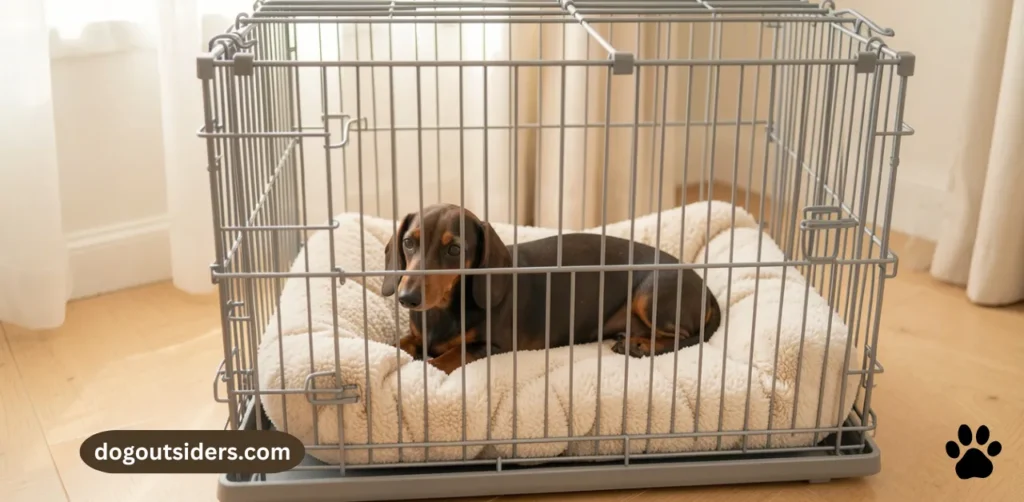
Crate training is the single most effective tool for Dachshund house training. However, most owners either skip it entirely or set it up incorrectly.
Why Crates Work for Dachshunds
Dogs have a natural instinct to avoid soiling their sleeping area. A properly sized crate uses this instinct to teach bladder control. According to VCA Animal Hospitals’ crate training guide, crates should feel like a safe, comfortable den — not a punishment space.
Getting Crate Setup Right
- Size matters critically — the crate must be large enough to stand, turn around, and lie down — but NOT large enough for the dog to use one end as a bathroom. For Dachshunds, a crate with a divider panel is ideal. Expand the space as the puppy grows.
- Make it cozy — add a soft mat or blanket and a worn t-shirt with your scent
- Place it strategically — in a quiet area but near family activity. Dachshunds hate isolation.
- Never use the crate as punishment — if the crate becomes a threat, your Dachshund will resist entering
Building a Positive Crate Association
- Feed meals inside the crate with the door open initially
- Give a high-value chew toy only when the door is closed
- Start with 5-minute durations and build gradually
- Cover the crate with a blanket — darkness mimics a burrow, which Dachshunds instinctively prefer
Real-world scenario: Many Dachshund owners report that their puppy initially whined for 20 minutes in the crate and they gave in — repeatedly. Each capitulation extended the timeline by weeks. Dachshunds learn fast that whining works. Building crate tolerance through gradual, patient introduction from day one pays off enormously.
Step 2 — Build and Follow a Strict Potty Schedule
Consistency is the most important element of Dachshund house training. Inconsistent schedules create inconsistent dogs.
How Often Dachshunds Need to Go
| Age | Frequency (Awake Hours) | Night |
|---|---|---|
| 8–10 weeks | Every 30–60 minutes | Every 2–3 hours |
| 10–14 weeks | Every 60–90 minutes | Every 3–4 hours |
| 14–20 weeks | Every 2 hours | Every 4–5 hours |
| 5–8 months | Every 3–4 hours | Usually can hold through night |
| Adult | Every 4–6 hours | Typically holds through night |
Non-Negotiable Schedule Triggers
Take your Dachshund out at these times, every single day, without exception:
- Immediately after waking (morning and naps)
- 5–10 minutes after eating or drinking
- After any active play session
- Before and after crate time
- Right before bed
Set phone alarms if needed. The schedule only works when it’s actually followed. Most Dachshund house training failures trace directly to schedule inconsistency — not breed stubbornness.
Step 3 — Establish a Reliable Outdoor Potty Routine
Consistent outdoor routine builds a habit. Habits are what finally make Dachshunds reliable.
The Designated Spot Method
Choose one specific outdoor area for elimination and use it exclusively in the early weeks. Consistent scent marking in the same location creates a powerful prompt that helps your Dachshund recognize the area as their bathroom.
- Always go to the same spot — use a short leash to guide them there directly
- Wait quietly — don’t play or engage until they’ve eliminated
- Add a verbal cue — say “go potty” (or your chosen phrase) as they squat. After enough repetitions, the cue itself begins to prompt elimination.
- Reward immediately after — treat and praise must happen the instant they finish, not when you’re back inside
The Three-Minute Rule
If your Dachshund doesn’t eliminate within 3 minutes of going outside, bring them back in, supervise closely (leash to your wrist or direct visual contact), and try again in 5–10 minutes. Don’t let them roam the house between trips if the mission wasn’t accomplished.
According to PetMD’s house training guide, most puppies can be reliably house trained by 4–6 months with consistent scheduling and immediate positive reinforcement.
Step 4 — Solve the Weather Resistance Problem
This is the step competitors don’t cover — and it’s the one that derails more Dachshund house training efforts than anything else.
Dachshunds will often refuse to go outside in rain, cold, mud, or snow. Their low-slung body means their belly contacts cold, wet ground immediately. For many Dachshunds, this physical discomfort overrides the training entirely.
Weather Resistance Solutions
For rain and wet ground:

- Dog raincoat + booties — a well-fitting waterproof jacket and rubber booties dramatically reduce physical aversion. Many Dachshund owners report this single change resolved their rain-refusal problem entirely.
- Covered potty area — if possible, create a covered corner with a canopy, umbrella, or pergola where ground stays relatively dry
- Indoor potty backup — for extreme weather only, a real-grass indoor potty box (not a pee pad) provides a weather-independent option that still teaches “grass = bathroom”
For cold and snow:
- Keep a dog sweater or coat on before the door opens
- Clear a small path in snow to their designated spot
- Use booties to prevent snow/ice between toes
- Keep outdoor trips short and focused during cold snaps — eliminate, reward, return
Real-world scenario: A Dachshund owner in the Pacific Northwest documented that their puppy had zero outdoor potty success during three weeks of October rain — until they added a small covered patio area and a dog raincoat. Indoor accidents dropped by 80% within one week of those two changes alone.
Important: Pee pads should be a weather-emergency backup only — not a permanent indoor solution. Extended pad use teaches Dachshunds that eliminating inside is acceptable, which directly undermines house training progress.
Step 5 — Clean Accidents the Right Way
This step is completely missing from most Dachshund house training guides — and it’s actively causing owners to fail without realizing it.
Why Regular Cleaners Don’t Work
Dog urine contains ammonia-based compounds that regular household cleaners don’t fully neutralize. Even if you can’t smell anything left behind, your Dachshund can — and those residual scent markers actively draw them back to the same spot to eliminate again.
The Enzymatic Cleaner Protocol
Use an enzymatic cleaner (such as Nature’s Miracle, Rocco & Roxie, or similar products) every time an accident occurs:
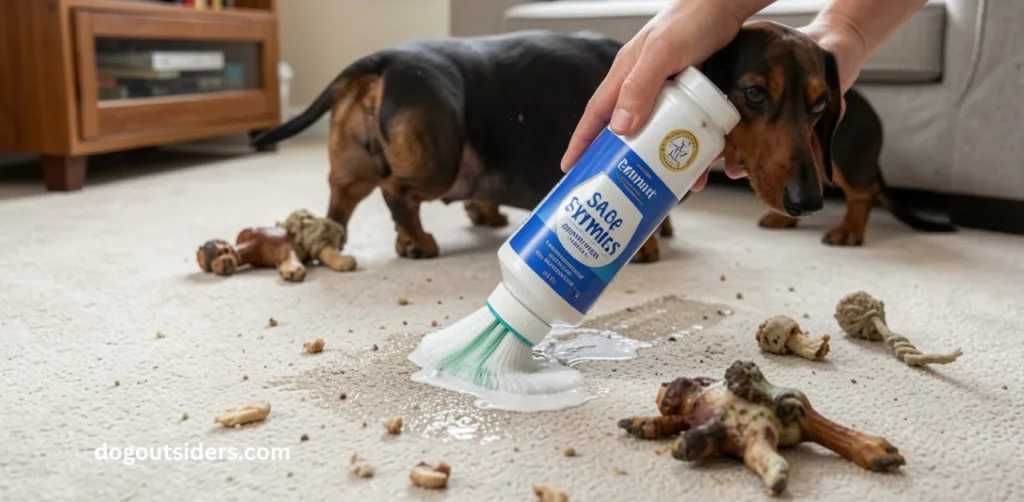
- Blot — don’t rub — absorb as much liquid as possible before applying cleaner
- Saturate the area — apply enzymatic cleaner generously. It must reach the same depth as the original accident.
- Let it sit — enzymatic cleaners need 5–10 minutes of contact time to break down odor compounds. Don’t rush this step.
- Blot dry — absorb the cleaner and residue with clean cloths or paper towels
- Air dry — allow the area to fully air dry. Confine your Dachshund away from the area until completely dry.
Never use ammonia-based cleaners on dog urine spots — ammonia smells similar to urine and can actually attract dogs to the area.
For more on what NOT to do with a small dog’s training and care, our guide on things you should never do with a small-breed dog covers critical mistakes across small-breed care.
Step 6 — Handle Regression Without Punishment
Regression — when a previously reliable Dachshund starts having indoor accidents again — is incredibly common. And it’s completely absent from most house training guides.
Why Regression Happens
- Stress or change — new family member, moved furniture, schedule change, new pet
- Medical issue — urinary tract infections cause sudden loss of bladder control. If regression is sudden and severe, rule out UTI first with a vet visit.
- Adolescence — Dachshunds hit a testing phase around 5–8 months where previously learned behaviors temporarily decline
- Insufficient reinforcement — owners stop rewarding outdoor elimination once it seems “established.” Dachshunds need longer reinforcement periods than other breeds.
How to Handle Regression
- Rule out medical causes first — sudden regression in a reliable dog always warrants a vet check
- Return to basics immediately — treat regression like a new puppy. Restart the schedule, return to crate supervision, and resume treating outdoor elimination every single time.
- Increase supervision — tether your Dachshund to your wrist with a leash indoors until reliability returns
- Don’t punish indoor accidents — punishing after-the-fact teaches your Dachshund to hide accidents, not to stop having them. It creates fear, not understanding.
- Remain consistent for 2–3 weeks — regression typically resolves within two to three weeks of returning to structured basics
According to the AVMA’s behavioral resources, punishment-based training methods increase stress and can worsen elimination problems rather than resolving them.
For a broader look at training mistakes across breeds, the guide on common training mistakes that slow progress for any breed applies many of the same principles to Dachshund house training.
House Training Expectations: Timeline by Age
One of the biggest reasons Dachshund house training fails is unrealistic expectations. Here’s what’s actually achievable at each stage:
| Age | Realistic Expectation | Common Setback |
|---|---|---|
| 8–12 weeks | Learning the concept — accidents daily | First fear period — be extra patient |
| 12–20 weeks | Improving but still 2–4 accidents/week | Weather changes or schedule shifts |
| 5–8 months | Near-reliable with close supervision | Adolescent testing phase |
| 8–12 months | Mostly reliable indoors | Stress events, new environments |
| 12+ months | Fully reliable with consistent routine | Medical issues are the main risk |
Most Dachshunds reach true reliability between 6–12 months of consistent, breed-specific training. If anyone tells you it should happen in two weeks, they don’t own a Dachshund.
5 Mistakes That Sabotage Dachshund House Training
These are the most common ways well-meaning owners accidentally extend their house training timeline by months.
1. Giving the whole house too early.
Giving a Dachshund puppy free roam of the house before they’re reliable is like removing guardrails. Confine to one room with easy supervision until reliability is established in that space, then gradually expand access.
2. Using pee pads as a permanent solution.
Pee pads teach indoor elimination is acceptable. Use them as weather emergencies only and remove them as soon as training progresses. Long-term pad use creates the very habit you’re trying to break.
3. Rubbing their nose in accidents.
This is a decades-old method that behaviorists unanimously recommend against. Dogs cannot connect a past accident with current punishment. The result is a dog that learns to hide accidents — not to stop having them.
4. Inconsistent scheduling.
The schedule must happen on weekdays AND weekends. It must happen when you’re tired AND when you’re not. Dachshunds learn patterns — and they also learn when the pattern breaks.
5. Stopping rewards too early.
Many owners stop treating outdoor elimination once the dog “gets it.” For Dachshunds, reinforcement should continue for a minimum of 3–4 months and ideally be faded gradually, not stopped suddenly. Their independent nature means the behavior stops paying off if rewards disappear too quickly.
Your Consistent Dachshund Is Closer Than You Think
You’ve already done the hardest part: you haven’t given up.
Every Dachshund owner who succeeds at house training goes through exactly what you’re experiencing — the frustration, the self-doubt, the moments of wondering if it’s ever going to click. What separates the ones who succeed is not a more trainable dog. It’s a breed-specific system applied consistently.
These 6 steps give you that system. Start with Step 1 today. Give it two honest weeks before evaluating progress. And remember: Dachshunds take longer than most breeds to reach reliability — that’s not failure, it’s just facts.
If this guide helped, save it to your Pinterest board so it’s there when you need it most — especially during the frustrating days. And for broader puppy care basics that support everything you’re working on, see our complete guide on puppy care basics every new owner should establish early — the fundamentals apply across breeds.
Your reliable Dachshund is already in there. You just need the right steps to bring them out.

Jahanzaib
Written by Jahanzaib, a Certified Professional Dog Trainer (CPDT-KA) and Karen Pryor Academy Certified Training Partner (KPA-CTP) with 14 years of experience specializing in German Shepherd and working breed training. Jahanzaib has trained GSDs for obedience, protection sport foundations, and behavior modification, and is a professional member of the Association of Professional Dog Trainers (APDT). They write regularly for dogoutsiders.com on breed-specific training, canine behavior, and working dog management.
This article was reviewed for accuracy by Dr. Pillip John, DVM, a licensed veterinarian with experience in companion animal behavioral health and small breed care.
Frequently Asked Questions About Dachshund House Training
Use a six-step system: set up a properly sized crate, follow a strict potty schedule based on your dog’s age, establish a designated outdoor spot with a verbal cue, solve weather resistance with a dog raincoat, clean accidents with enzymatic cleaners, and handle regression by returning to basics without punishment. Consistency across all six steps is essential for dachshund house training success.
Yes — dachshunds are consistently ranked among the most challenging breeds to house train. Their small bladder requires frequent trips, their low-slung anatomy makes cold and wet ground uncomfortable, and their stubborn independence means they need stronger motivation than most breeds. However, with a breed-specific system and consistent routine, most dachshunds reach reliability between 6 and 12 months.
Most dachshunds reach reliable house training between 6 and 12 months with consistent breed-specific training. Expect daily accidents for the first 8–12 weeks, gradual improvement through 5 months, and near-reliability by 8 months. Timelines vary based on age when training begins, schedule consistency, and whether breed-specific challenges like weather resistance are addressed directly.
Common causes include schedule inconsistency, incomplete accident cleanup leaving scent markers, weather resistance causing outdoor refusal, crate that’s too large allowing indoor soiling, or regression from stress or adolescence. Rule out medical causes like UTI first if accidents are sudden. Return to a strict dachshund house training schedule and restart enzymatic cleaning of all previous accident areas.
Use a waterproof dog raincoat and rubber booties to eliminate physical discomfort from cold, wet ground. Create a covered outdoor potty area if possible. Keep outdoor trips focused — go directly to the designated spot without distraction. Use extra-high-value treats for outdoor success during bad weather. Avoid allowing indoor pads as a permanent alternative, as this undermines outdoor training progress.
Regression in dachshunds typically stems from stress (new pet, family change, schedule disruption), adolescent testing around 5–8 months, stopped reinforcement of outdoor success, or medical causes like UTI. Visit your vet first if regression is sudden. Then return immediately to the full house training protocol — crate supervision, strict scheduling, outdoor rewards — for a minimum of two to three weeks.
Most dachshunds should be reliably house trained by 12 months of age with consistent training from puppyhood. However, 6 months is achievable for dogs who start training early with a breed-specific system. Adult rescue dachshunds can absolutely be house trained — the process takes 4–8 weeks of structured basics but is completely achievable at any age.