One moment you’re out for a walk or visiting a friend’s home. The next, you’re in an emergency room with a dog bite wound, a growing sense of shock, and a nurse asking about your insurance.
It’s terrifying. And confusing. And completely unfair — because you didn’t do anything wrong.
If a dog bite sends you to the ER, Missouri’s liability laws are firmly on your side. But knowing your rights and actually using them are two very different things. Most victims leave the hospital without the evidence they need to recover a single dollar.
This guide changes that. You’ll learn exactly what Missouri law says, who pays your bills, what your claim is worth, and the steps to take starting right now — before the evidence disappears.
According to the American Veterinary Medical Association, approximately 4.5 million Americans suffer dog bites each year, with around 800,000 requiring medical attention (Source: AVMA). Many of those victims never collect the compensation they’re legally entitled to.
You deserve better than that. So let’s walk through this together.
What If a Dog Bite Sends You to the ER — Understanding Missouri’s Liability Laws
Missouri is not a state that gives dog owners the benefit of the doubt. The law is clear, and it sides with victims.
Missouri Is a Strict Liability State — What That Actually Means
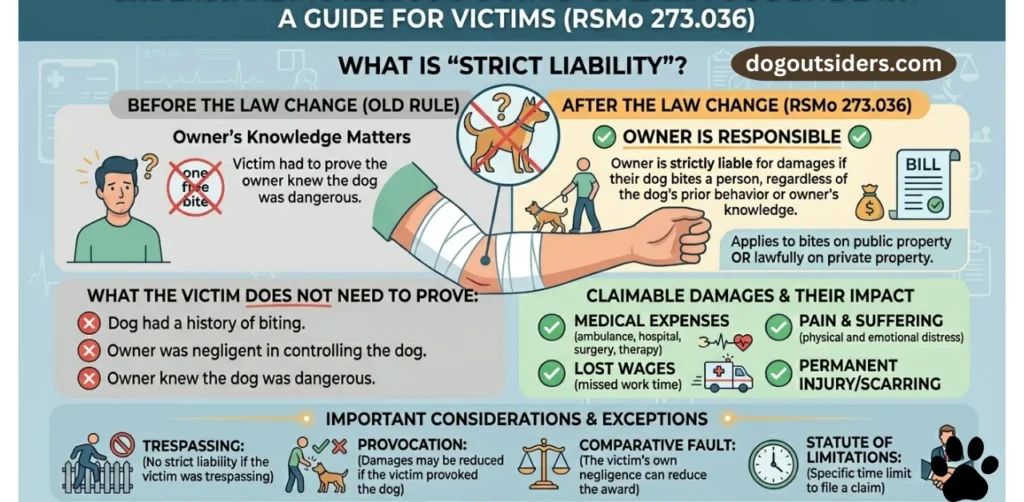
In many states, a dog owner only faces liability if their dog had previously shown aggression — this is called the “one bite rule.” Missouri is different.
Under strict liability, the dog owner is responsible for your injuries even if:
- The dog had never bitten anyone before
- The owner had no idea the dog was capable of attacking
- The bite happened on public OR private property
This is a powerful legal protection. You don’t have to prove the owner was careless. You simply have to prove the bite happened and that you were injured.
What Missouri RSMo 273.036 Says in Plain English
Missouri’s dog bite statute — RSMo 273.036 — states that a dog’s owner is liable for damages whenever their dog bites a person who:
- Was in a public place, OR
- Was lawfully on private property (including the owner’s property)
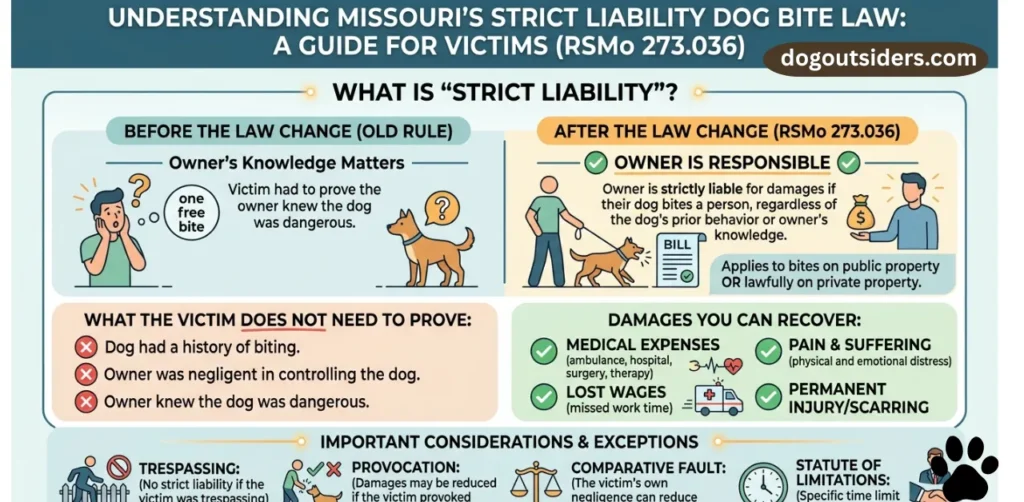
The only defenses the dog owner has are:
- You were trespassing at the time of the bite
- You provoked the dog intentionally
If neither of those applies to you — and in most cases, they don’t — the owner owes you compensation for every injury, every medical bill, and every consequence that follows.
Many victims who read this experience genuine relief. The law was designed specifically to protect people in your situation.
What to Do Immediately After a Dog Bite — Before You Leave the ER
The ER handles your physical injuries. But no one at the hospital tells you what to do to protect your legal claim. That information gap costs victims thousands of dollars every single year.
Here’s what to do — ideally while you’re still at the hospital or immediately after.
7 Steps to Take at the Hospital That Protect Your Legal Claim
- Take photographs of every injury. Before they clean or bandage the wound, photograph it clearly with your phone. Multiple angles. Good lighting. These images are irreplaceable evidence of severity.
- Get a full written record of your treatment. Ask the hospital for itemized records of every procedure, medication, and test. This becomes the foundation of your compensation claim.
- Report the bite to animal control. Ask a family member to call Missouri’s local animal control while you’re being treated. An official report creates a legal paper trail immediately.
- Identify the dog and its owner. Get the owner’s full name, address, and phone number. Confirm whether the dog’s rabies vaccinations are current — the ER will need this.
- Collect witness information. Anyone who saw the bite happen is a valuable witness. Get their name and contact details before you leave the scene.
- Document the location. Photograph where the bite happened. If the dog was in a yard or on a leash, document that too — it speaks to the owner’s control (or lack of it).
- Write a detailed account as soon as possible. Memory fades fast after trauma. Write down everything you remember about how the bite happened while it’s still fresh.
What to Document Before the Evidence Disappears
Evidence degrades quickly. Wounds heal. Witnesses forget details. Knowing what behavioral signs dogs can display before an attack may also help you reconstruct the incident accurately — understanding warning signs that a dog may attack can provide important context for your account of events.
The single most important thing you can do in the first 48 hours is create a documented record of everything.
Who Pays Your ER Bills After a Dog Bite in Missouri?
This is the question every dog bite victim asks — and the answer is more favorable than most people expect.
How Homeowner’s Insurance Covers Dog Bite Claims
In most cases, the dog owner’s homeowner’s insurance policy or renter’s insurance policy covers dog bite liability. According to the Insurance Information Institute, dog bites account for over one-third of all homeowner’s liability claims paid in the United States (Source: Insurance Information Institute).
A standard homeowner’s policy typically covers:
| Type of Damage | Covered by Homeowner’s Insurance? |
|---|---|
| Emergency room bills | ✅ Yes |
| Follow-up medical treatment | ✅ Yes |
| Surgery and rehabilitation | ✅ Yes |
| Lost wages during recovery | ⚠️ Sometimes |
| Pain and suffering | ❌ No — requires a lawsuit |
| Permanent scarring/disfigurement | ❌ No — requires a lawsuit |
This is important to understand. Insurance covers your economic damages. A lawsuit — or a strong negotiated settlement — is how you recover for everything else.
What If the Dog Owner Has No Insurance?
This is a real concern, and no competitor article addresses it honestly. Here’s the truth:
- You can still sue the dog owner personally. A court judgment against them is enforceable even without insurance.
- You may be able to use your own health insurance to cover immediate ER costs, then pursue reimbursement from the owner.
- An attorney can help identify other liable parties — such as a landlord who knew about a dangerous dog on their property and did nothing about it.
The lack of insurance makes the process harder. But it does not end your legal right to compensation.
It’s also worth understanding that when dog owners allow their animals to behave recklessly — whether that’s leaving a dog outside unsupervised in ways that endanger others or failing to control a known aggressive animal — they may be demonstrating negligence that strengthens your claim beyond strict liability alone.
Can You Sue for a Dog Bite in Missouri — And What Is Your Claim Worth?
The short answer is yes. And in Missouri, you have a strong legal foundation to do so.
What Damages You Can Recover After a Dog Bite
Missouri law allows dog bite victims to claim compensation for:
- Medical bills — ER visit, surgery, physical therapy, follow-up care
- Lost wages — income lost while you were recovering
- Future medical costs — if ongoing treatment is needed
- Pain and suffering — physical pain and emotional trauma
- Permanent scarring or disfigurement — especially important for visible injuries
- Emotional distress — anxiety, PTSD, and fear of dogs following the attack
Realistic Settlement Ranges — What Missouri Victims Actually Receive
Settlement amounts vary significantly based on injury severity. However, based on national insurance industry data, here are realistic ranges:
| Injury Severity | Typical Settlement Range |
|---|---|
| Minor bite, no stitches | $5,000 – $15,000 |
| Moderate bite requiring stitches/ER | $15,000 – $50,000 |
| Severe bite with surgery or scarring | $50,000 – $150,000+ |
| Permanent disfigurement or nerve damage | $100,000 – $500,000+ |
According to the Insurance Information Institute, the average dog bite liability claim in the U.S. was approximately $64,555 in 2023 (Source: Insurance Information Institute, 2024 data).
These numbers reflect settled claims. Taking a case to trial can result in higher awards — but also involves more time and uncertainty.
How Comparative Fault Can Reduce Your Payout
Missouri follows a pure comparative fault rule. This means that if a court finds you were partly responsible for the bite — for example, if you ignored warning signs or reached toward the dog suddenly — your compensation is reduced by your percentage of fault.
Example: If your damages total $50,000 but you’re found 20% at fault, you receive $40,000.
This is why documenting the circumstances of the bite carefully matters so much. A clear account of events protects you from having your payout unfairly reduced.
The Statute of Limitations — How Long You Have to File in Missouri
Missouri gives dog bite victims five years from the date of the injury to file a personal injury lawsuit. This comes under Missouri’s general personal injury statute of limitations (RSMo 516.120).
Why Waiting Too Long Can Cost You Everything
Five years sounds like a long time. But waiting has real consequences:
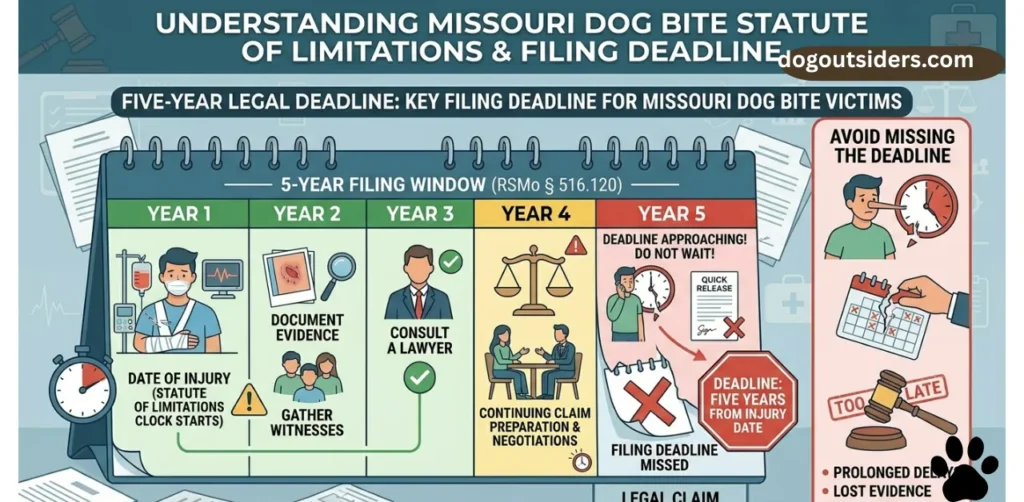
- Evidence disappears — witnesses move, photos get lost, medical records become harder to retrieve
- Insurance companies use delays against you — a long gap between the injury and a claim raises questions about severity
- Your memory fades — and so do the memories of everyone who witnessed the bite
The practical reality: consult an attorney within the first 30–60 days of the injury. Most personal injury attorneys offer free consultations and work on contingency — meaning they only get paid if you win.
Understanding how neglectful dog ownership contributes to attacks — including situations where an owner’s behavior rises to the level of animal cruelty through negligence — can also be relevant context for establishing the owner’s duty of care in your claim.
Signs of Infection After a Dog Bite — When to Return to the ER
A dog bite is a puncture wound — and puncture wounds are prone to serious infection. This medical reality intersects directly with your legal case: infection that develops because of the bite is an additional recoverable injury.
Medical Warning Signs Dog Bite Victims Must Not Ignore
Return to the ER or your doctor immediately if you notice:
- Increasing redness spreading outward from the wound
- Swelling that worsens after the first 24–48 hours
- Warmth or pulsing pain at or around the wound site
- Pus or discharge of any color
- Fever above 100.4°F (38°C)
- Red streaks spreading away from the wound — this signals a potentially life-threatening infection called cellulitis or sepsis
- Numbness or difficulty moving fingers or limbs near the bite — this may indicate nerve damage
According to PetMD, dog bites carry significant infection risk from bacteria including Pasteurella, Staphylococcus, and Capnocytophaga — species that can cause serious illness if untreated (Source: PetMD).
Every medical visit resulting from the bite is additional evidence of harm — and additional compensation you can claim.
Common Mistakes That Destroy Dog Bite Claims in Missouri
Even victims with strong cases lose compensation because of avoidable errors made in the days after the bite. Here’s what NOT to do:
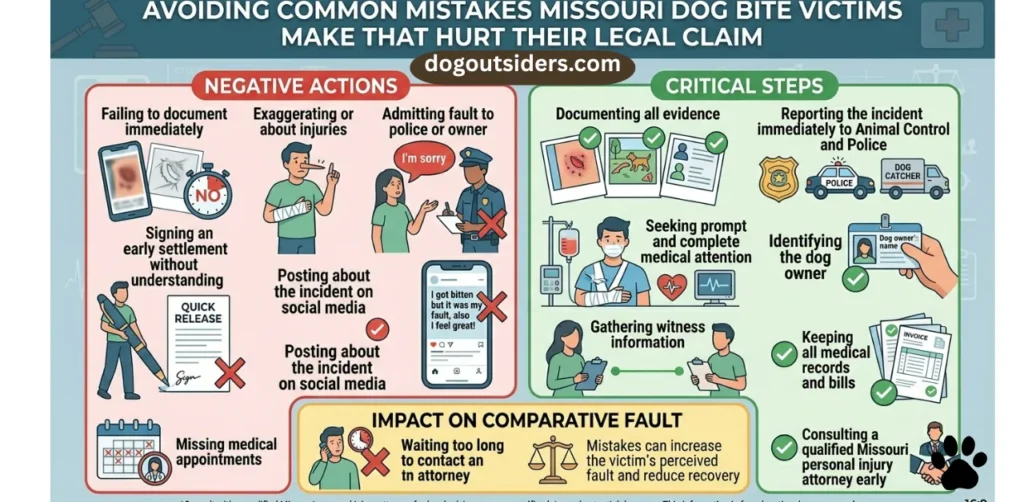
- ❌ Accepting a quick settlement from the insurance company. Insurance adjusters move fast for a reason — they want to close your claim before you know what it’s truly worth. Never accept the first offer without legal advice.
- ❌ Posting about the incident on social media. Anything you post can be used against you. A photo of you smiling at an event two weeks after the bite can be used to minimize your pain and suffering claim.
- ❌ Giving a recorded statement to the dog owner’s insurance company. You are not legally required to do this. Anything you say can be twisted to reduce your payout.
- ❌ Waiting months before seeking legal advice. Evidence degrades. Witnesses disappear. File reports and consult an attorney within the first 30 days.
- ❌ Failing to follow all medical advice. If a doctor recommends follow-up care and you skip it, the insurance company will argue your injuries weren’t that serious.
- ❌ Assuming the dog owner will “do the right thing.” Even well-meaning dog owners defer to their insurance companies — and insurance companies are not on your side.
For broader context on how owner behavior and negligence patterns contribute to dangerous dog situations, our article on behavioral warning signs in dogs that can predict aggression is worth reading alongside this guide.
You Have Rights — And the Law Is On Your Side
Being bitten by a dog is traumatic, painful, and deeply unfair. But in Missouri, the law was written specifically to protect people in your situation.
You don’t have to prove the dog had a history of aggression. You don’t have to fight alone. And you absolutely don’t have to pay medical bills that result from someone else’s failure to control their animal.
The steps in this guide — documenting at the ER, reporting the bite, understanding what your claim covers, and consulting an attorney before the evidence fades — give you the strongest possible foundation to recover what you’re owed.
Save this article to Pinterest so you always have it when you need it. And if you’re also dealing with ongoing concerns about dangerous dog behavior in your neighborhood, explore the resources available at dogoutsiders.com for practical guidance on dog safety and owner responsibility.
You didn’t deserve this. Now you know exactly what to do about it.
Legal Disclaimer: This article is for informational purposes only and does not constitute legal advice. For guidance specific to your situation, consult a licensed personal injury attorney in Missouri.

Jahanzaib
Jahanzaib J.D. candidate and certified paralegal specializing in personal injury and animal liability law, with 6+ years of experience assisting dog bite victims navigate insurance claims and legal proceedings across Missouri and surrounding states. All legal content on dogoutsiders.com is reviewed for factual accuracy and state-law compliance before publication. This article was reviewed by a licensed Missouri personal injury attorney
Frequently Asked Questions
Missouri follows strict liability under RSMo 273.036. This means a dog owner is responsible for bite injuries even if the dog never showed aggression before. The victim only needs to prove the bite occurred and that they were lawfully in the location at the time. Missouri does not use the “one bite rule” that protects owners in other states.
Yes. Missouri is a strict liability state, meaning the dog owner is automatically liable for bite injuries regardless of the dog’s prior behavior. You do not need to prove the owner knew the dog was dangerous. The only defenses are trespassing or provocation by the victim. This law strongly favors bite victims in Missouri.
The dog’s owner is primarily liable under Missouri law. However, additional parties may share liability — including landlords who knew about a dangerous dog on their property and failed to act, or property owners who allowed a dangerous animal on their premises. Consult a personal injury attorney to identify all potentially liable parties in your specific situation.
Missouri gives dog bite victims five years to file a personal injury lawsuit under RSMo 516.120. However, acting within the first 30–60 days is strongly advised. Evidence disappears quickly, witnesses forget details, and insurance companies use delays to minimize claims. Consulting an attorney early protects both your evidence and your legal options.
Yes, in most cases. Standard homeowner’s and renter’s insurance policies include liability coverage for dog bites, typically covering medical bills, ER costs, and some lost wages. However, insurance does not cover pain and suffering or permanent scarring — those require a negotiated settlement or lawsuit. Always consult an attorney before accepting any insurance offer.
Settlement amounts depend on injury severity. Minor bites often settle between $5,000 and $15,000. Severe bites requiring surgery or causing permanent scarring frequently settle between $50,000 and $150,000 or more. The national average dog bite claim was approximately $64,555 in 2023. Pain and suffering, lost wages, and long-term care all increase the total significantly.
Seek emergency medical care first. Then photograph your injuries before they are bandaged, report the bite to local animal control, collect the dog owner’s contact information, and identify any witnesses. Write a detailed account of exactly how the bite happened as soon as possible. These steps protect both your health and your legal claim simultaneously.