Your dog seemed a little off yesterday. Less enthusiastic at dinner. Slower to get up from their bed. They didn’t whimper. They didn’t cry. They wagged their tail when you looked at them.
And now you’re sitting here, hours later, wondering: are they fine — or are they hurting?
This quiet uncertainty is one of the most emotionally difficult experiences dog owners face. Because the truth is: dogs are extraordinarily good at hiding pain. Not because they’re stoic by choice, but because their biology makes it automatic. And learning how to tell if your dog is in pain even if they don’t show it might be one of the most important things you ever do for them.
This guide covers exactly that — the evolutionary reason your dog masks suffering, the specific behavioral and physical signs that reveal hidden pain, the Dog Grimace Scale that veterinary research has validated, a home assessment method you can use today, and a clear framework for deciding when to call the vet.
According to the American Veterinary Medical Association, pain recognition in companion animals is a critical component of responsible pet ownership — and early detection of unmanaged pain significantly improves treatment outcomes and quality of life (Source: AVMA).
You haven’t failed your dog by not knowing. But now you will know — and that changes everything.
Why Dogs Hide Pain — The Instinct That Makes Detection So Hard

The Evolutionary Reason Your Dog Masks Suffering
Dogs descend from wild ancestors where showing weakness was a survival risk. In the wild, an injured animal that shows obvious pain signals vulnerability — to predators, to rival pack members, and to threats of every kind.
Over thousands of years, dogs evolved to suppress visible signs of pain as a survival mechanism. That instinct didn’t disappear with domestication. Even your well-loved, safe, house dog carries this wiring — which is why they may curl up quietly in the corner and give you a tail wag while experiencing significant discomfort.
This is not your dog being deceptive. It’s your dog being exactly what evolution made them.
According to PetMD, this instinct to mask illness and injury is one of the primary reasons dogs are frequently brought to veterinary care at an advanced stage of pain or disease — because their owners genuinely couldn’t tell something was wrong (Source: PetMD).
Which Breeds Hide Pain Most Effectively
Some breeds are significantly more stoic than others. Owners of these breeds need to be especially vigilant:
- Northern and working breeds (Siberian Huskies, Alaskan Malamutes, German Shepherds) — bred for endurance, these dogs have particularly high pain thresholds and are expert pain maskers
- Herding breeds (Border Collies, Australian Shepherds) — high drive and task-focus can override pain signals entirely
- Sporting breeds (Labrador Retrievers, Golden Retrievers) — enthusiasm masks pain so effectively that injuries are often missed until they become serious
- Terriers — high-intensity dogs that keep going regardless of physical state
It’s worth noting that what sometimes appears as a “behavior problem” in working breeds is actually a pain signal in disguise. Our guide on common behavior problems in Siberian Huskies that owners commonly miss covers overlapping behavioral signs that can be misread in high-energy breeds.
How to Tell If Your Dog Is in Pain Even If They Don’t Show It — Behavioral Signs
Behavioral changes are often the first — and only — sign that a dog is in pain. The problem is that these changes are subtle enough to be explained away as “just being tired” or “having an off day.”
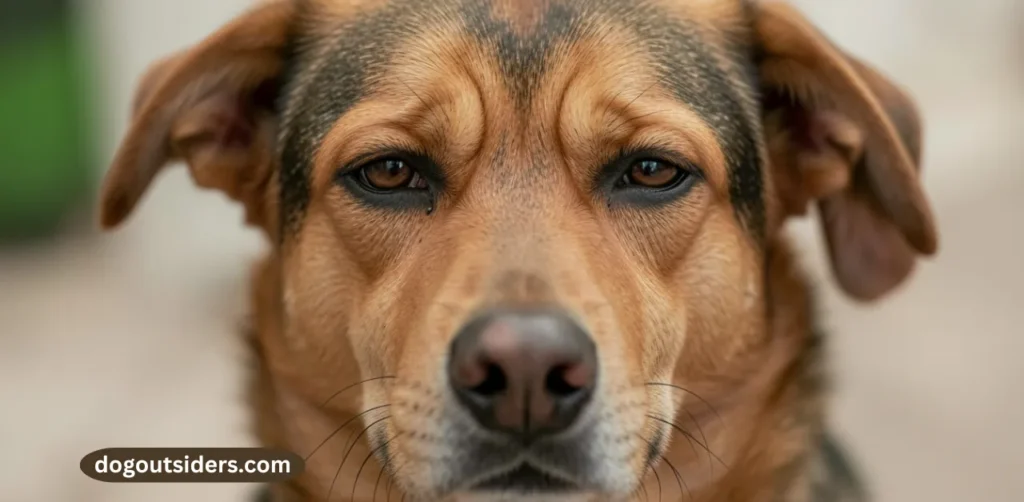
The 6 Behavioral Changes That Signal Hidden Pain
Watch for these specific changes, especially if more than one appears at the same time:
- Reduced activity or reluctance to move — a dog who used to greet you at the door now stays on their bed, or hesitates before standing up
- Withdrawal and seeking solitude — moving away from family interactions, hiding in quiet corners, or avoiding the main living areas
- Irritability or uncharacteristic aggression — snapping, growling, or showing intolerance to touch from a dog who is normally gentle
- Reluctance to jump, climb stairs, or get in the car — hesitation around movements that require joint engagement
- Decreased interest in play — a dog who normally brings you a toy but has stopped initiating play entirely
- Changes in posture during rest — lying in unusual positions, shifting frequently, or having trouble settling
What “Acting Different” Actually Looks Like in Practice
Consider this realistic scenario: a 6-year-old Labrador who normally runs to his food bowl at the sound of the cabinet opening starts walking slowly to his bowl and eating less enthusiastically. His owner assumes he’s bored with the food. Three weeks later, X-rays reveal early-stage hip dysplasia.
The signs were there — the reduced enthusiasm, the slower movement, the slight changes in how he positioned himself to eat. They were just easy to explain away.
Many Border Collie owners report a similar pattern — a dog who slows down on walks or shows less enthusiasm for fetch is often first assumed to be “tired,” when activity reduction is actually one of the clearest behavioral pain signals for high-energy breeds who are typically driven regardless of physical discomfort.
Physical Signs and the “Pain Face” — What to Look at Right Now
Beyond behavior, your dog’s body tells its own story. Knowing specifically what to look at — including facial expressions, posture, and localized responses — gives you a detailed picture that general behavior observation can miss.
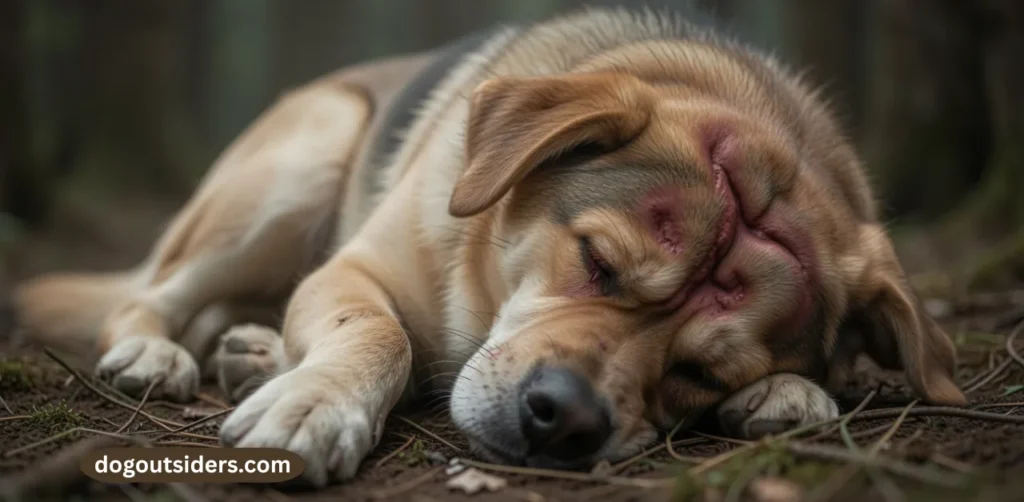
The Dog Grimace Scale — What Veterinary Research Found
In 2016, veterinary researchers developed the Dog Grimace Scale (DGS) — a validated tool that identifies pain in dogs through specific facial expression changes. This is one of the most important advances in canine pain assessment in recent years, and no competitor article covers it for general dog owners.
The DGS identifies five key facial action units that change when a dog is in pain:
| Facial Feature | Pain Sign |
|---|---|
| Orbital tightening | Eyes squinting or partially closed, not due to sleep |
| Brow lowering | The area above the eyes appears tense or furrowed |
| Cheek tightening | Muscles around the cheeks and jaw appear tense |
| Ear position | Ears pulled back and rotated outward more than usual |
| Nose/lip changes | Corners of mouth pulled back, lip tension visible |
You don’t need veterinary training to notice these changes. You need to know your dog’s normal, relaxed face — and look for any departure from it. A dog in pain looks subtly different in the face, even when their tail is wagging.
Body Language and Posture Changes That Reveal Pain
Beyond the face, watch for:
- Hunched or tucked posture — a dog who carries their back arched or holds their abdomen up and away from the ground
- Head hanging lower than usual — a sign of neck, shoulder, or general malaise
- Weight shifting — repeatedly shifting weight off one limb, even when standing still
- Panting without heat or exercise — one of the most reliable signs of pain that owners frequently miss
Localized Signs — Licking, Guarding, and Touch Sensitivity
Dogs in pain with a specific injury site often show these localized signs:
- Excessive licking of one area — the dog is trying to self-soothe a painful spot
- Flinching or pulling away when you touch a specific area
- Growling or vocalizing when an area that doesn’t normally bother them is touched
- Limping with no obvious injury — pain can be internal or joint-based without any visible wound
Some behavioral signals in stoic working breeds — including German Shepherds — can be subtle enough to appear as training resistance rather than pain. Understanding the behavioral patterns that are unique to German Shepherds helps owners distinguish between the two.
Appetite, Sleep, and Grooming Changes That Signal Hidden Pain
Eating Changes That Are More Than Just Pickiness
- Eating more slowly or dropping food frequently — may indicate mouth, throat, or dental pain
- Eating less overall — pain suppresses appetite, especially chronic pain
- Difficulty bending to the bowl — a dog with neck or back pain may resist bending down to eat
- Drinking less water — can signal nausea from pain or underlying illness
A dog who is still eating but noticeably more slowly or carefully is not necessarily fine — the change itself is the signal.
Sleep and Restlessness Patterns That Indicate Discomfort
- Panting at night without being hot — one of the clearest signs of pain-related restlessness
- Difficulty settling — standing up and lying back down repeatedly
- Whimpering during sleep — may indicate pain breaking through even during rest
- Sleeping significantly more than usual — the body conserving energy when dealing with pain or illness
Grooming Changes — Too Much or Too Little Both Matter
This is the most overlooked category in every competitor article — and one of the clearest pain indicators available.
Too much grooming: Excessive licking of a joint, limb, or abdominal area is the dog’s attempt to relieve pain through self-soothing. It’s often the first sign of arthritis, injury, or internal discomfort.
Too little grooming: A dog who stops maintaining their coat — appearing unkempt when they normally keep themselves clean — may lack the mobility or comfort to reach and groom affected areas.
Both extremes matter. For breeds with complex grooming needs, changes in self-grooming behavior are often the earliest visible health signal. Our guide on grooming routines that also reveal hidden health issues explores this connection in greater depth.
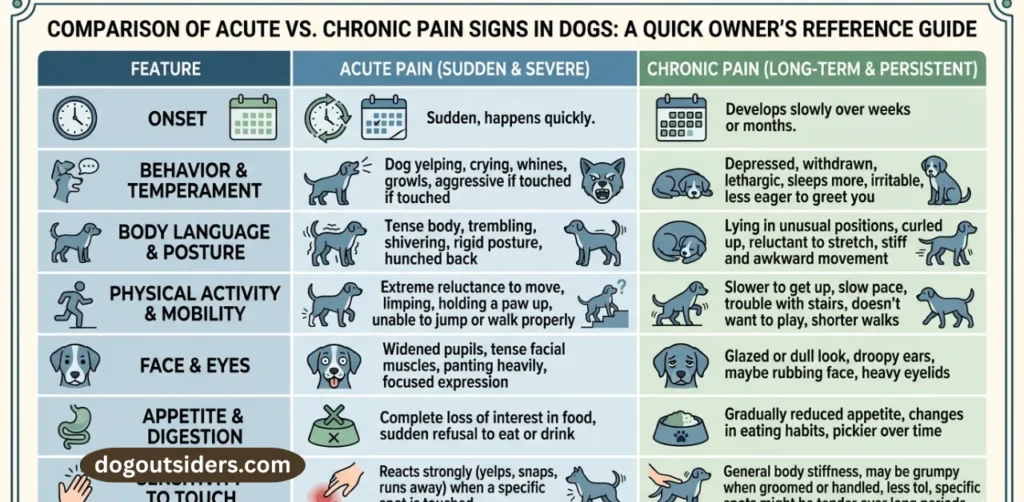
Acute vs. Chronic Pain — Why the Signs Are Different
Signs of Acute (Sudden) Pain
Acute pain appears suddenly — from an injury, illness, or acute event. The signs tend to be more obvious:
- Sudden vocalization (yelping, crying)
- Refusing to bear weight on a limb
- Guarding a specific area protectively
- Sudden behavioral change (normally calm dog becomes agitated or aggressive)
- Visible wound, swelling, or deformity
Urgency level: HIGH. Acute pain that appears suddenly requires prompt veterinary attention.
Signs of Chronic (Long-Term) Pain — Especially in Senior Dogs
Chronic pain develops slowly and hides behind gradual changes that owners adapt to without noticing:
- Stiffness that’s “always been there”
- Gradual slowing down attributed to age
- Reduced play interest that’s accepted as “calming down”
- Progressive reluctance around stairs, jumping, or certain movements
- Subtle mood changes — less interactive, more withdrawn over months
The senior dog blind spot: According to VCA Animal Hospitals, osteoarthritis affects an estimated 20% of dogs over the age of one year — and the majority of senior dogs over 8 years old — yet it is frequently underdiagnosed because owners attribute the signs to normal aging rather than treatable pain (Source: VCA Animal Hospitals).
The important distinction: slowing down is not inevitable. It may be pain — and pain can often be managed effectively when identified.
| Acute Pain | Chronic Pain | |
|---|---|---|
| Onset | Sudden | Gradual |
| Vocalization | Common | Rare |
| Visibility | More obvious | Very subtle |
| Owner recognition | Usually faster | Often missed for months |
| Urgency | Immediate vet | Schedule soon |
How to Do a Home Pain Check — A Step-by-Step Assessment
This is the section no competitor article provides — and the one most dog owners desperately want.
The 5-Point Home Pain Assessment
Run through this check if you suspect your dog is in pain but aren’t sure:
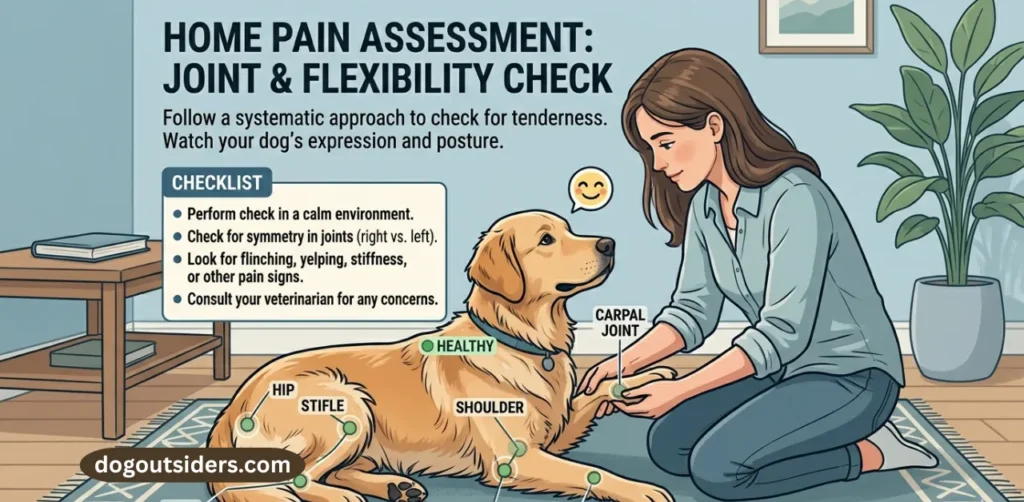
1. Observe the face first. Look at your dog’s relaxed expression and compare it to their normal. Check for orbital tightening, brow tension, and ear position changes from the Dog Grimace Scale.
2. Watch them move. Ask your dog to walk from one room to another. Watch for: any limping, reluctance to start moving, stiffness in the first few steps, unusual posture while walking.
3. Check the body systematically. Starting at the neck and working toward the tail, apply gentle, even pressure to both sides of the spine, shoulders, hips, and limbs. Watch for: flinching, vocalizing, muscle twitching, turning to look at your hand.
4. Observe the abdomen. Gently press on both sides of the belly. A dog in abdominal pain may tense, pull away, or vocalize. A distended or hard abdomen is a red flag requiring immediate vet attention.
5. Note the baseline. Write down what you observed — posture, gait, reactions to touch, appetite, sleep the previous night. This documentation helps your vet significantly, especially if you need to track changes over time.
The “See the Vet Now vs. Monitor at Home” Decision Guide
Go to the vet immediately if you observe:
- Crying, yelping, or vocalization from pain
- Inability to bear weight on any limb
- Visible swelling, deformity, or wound
- Distended, hard, or painful abdomen
- Panting, trembling, and restlessness simultaneously
- Collapse or inability to stand
- Rapid breathing with no exertion
Schedule a vet visit within 24–48 hours if you observe:
- Limping that doesn’t resolve in a few hours
- Appetite reduction for more than 24 hours
- Significant behavior change without an obvious cause
- Night restlessness for more than 2–3 nights
- Reluctance to engage in normal activities lasting more than 48 hours
Monitor at home with close observation if:
- You notice one mild sign with no other indicators
- Your dog ate normally and is moving without obvious difficulty
- The “off” behavior appeared once and hasn’t repeated
Socialization-related withdrawal — where a dog becomes less interactive with family members — can overlap with pain-related withdrawal signs. Understanding the difference between social hesitance and pain-based withdrawal helps owners distinguish between the two in multi-dog or social home environments.
Common Mistakes Owners Make When Their Dog Is in Pain
Even the most attentive dog owners make these errors — not from lack of care, but from lack of information.
- ❌ Assuming silence means no pain. The absence of whimpering or crying does not mean the absence of pain. Most dogs in significant pain never vocalize at all.
- ❌ Attributing all changes to aging. “She’s just getting older” is the most common way chronic pain goes unmanaged in senior dogs. Slowing down, stiffness, and reduced enthusiasm are signs worth investigating — not accepting.
- ❌ Waiting for limping before acting. Many sources of significant pain — dental, internal, spinal — never produce visible limping. Behavioral and appetite changes are often the only indicators.
- ❌ Over-handling a dog that’s in pain. When owners suspect pain, their instinct is often to hug, pet, and physically comfort the dog. This can actually increase pain or trigger defensive reactions. Instead, observe calmly and reduce physical demands.
- ❌ Giving human pain medication. Never give ibuprofen, acetaminophen, aspirin, or other human pain medications to a dog. Many are toxic to dogs, sometimes fatally so. Always consult your vet before administering any pain management.
You’re Your Dog’s Best Advocate — Final Thoughts
Your dog cannot tell you they’re hurting. But now, you know what their body is trying to say.
The signs of hidden pain — from subtle facial changes and behavior shifts to grooming patterns and sleep disruption — are there if you know what to look for. And you do now.
You’re not a bad dog owner because you didn’t know these signs before today. You’re a better one for learning them now. Your dog is counting on you to be their voice — and this guide gives you the language to do exactly that.
Save this article to Pinterest so you always have the home pain check, the Dog Grimace Scale, and the vet decision framework on hand when you need them. And for more practical dog health and care guidance, explore the full resource library at dogoutsiders.com.
If something feels off with your dog — trust that feeling. Then use this guide to find out why.
Medical Disclaimer: This article is for informational purposes only and does not replace professional veterinary advice. If you believe your dog is in pain, consult a licensed veterinarian as soon as possible.

Jahanzaib
Jahanzaib, Certified Veterinary Technician (CVT) and canine health educator with 9+ years of clinical experience in small animal medicine, pain management assessment, and owner education. [Name] specializes in translating complex veterinary health concepts into practical, actionable guidance for dog owners — with a particular focus on early detection of hidden illness and pain in companion dogs. All medical content on dogoutsiders.com is reviewed against current AVMA, AKC, and WSAVA clinical guidelines before publication.
Frequently Asked Questions
Watch for subtle behavioral changes — reluctance to move, withdrawal from family, changes in appetite, and uncharacteristic irritability. Physical signs include panting without heat, excessive licking of one area, and flinching when touched. The Dog Grimace Scale identifies facial signs including orbital tightening and ear position changes. Any significant behavioral shift lasting more than 48 hours warrants a vet visit.
Dogs instinctively hide pain due to an evolutionary survival mechanism. Their wild ancestors masked weakness to avoid appearing vulnerable to predators and rivals. Domestication did not eliminate this instinct. Even a safe, loved house dog will suppress visible pain signals automatically — which is why behavioral and facial changes are often the only indicators owners can observe at home.
Yes. Many dogs in significant pain continue eating, especially in the early stages of chronic conditions like arthritis. Eating normally does not mean a dog is pain-free. Watch instead for changes in eating speed, reluctance to bend to the bowl, or gradual appetite reduction over weeks. These subtle shifts are more reliable pain indicators than the presence or absence of eating alone.
A dog in pain may have a subtly tense face — squinting eyes, a furrowed brow, tight jaw muscles, and ears pulled back. Their body may appear hunched or guarded. They may move more slowly, shift weight off one limb, or lie in unusual positions. Importantly, most dogs in pain do not cry or whimper — behavioral and postural changes are the primary visible signals.
Run a systematic check: observe the face for tension, watch your dog walk for stiffness or limping, apply gentle even pressure along the spine and limbs watching for flinching, and check the abdomen for hardness or sensitivity. Note appetite, sleep quality, and grooming changes. Document everything and contact your vet if you identify multiple indicators or any single severe sign.
Most dogs do not cry when in pain. Vocalization — yelping, whimpering, or groaning — occurs in acute or severe pain but is absent in most cases of chronic or moderate pain. The evolutionary instinct to mask weakness suppresses vocalization. Silence should never be interpreted as comfort. Behavioral, postural, and facial changes are far more reliable pain indicators than sound.
Chronic pain develops gradually and hides behind subtle changes: slow stiffness that owners adapt to, reduced enthusiasm for activity, progressive reluctance around stairs or jumping, grooming changes, and withdrawal from social interaction. Owners often mistake these for normal aging, especially in senior dogs. Any gradual behavioral shift over weeks or months deserves veterinary investigation — it is not always “just getting older.”