The doorbell rings. Your dog explodes.
Within three seconds, they’re at the door — barking, spinning, jumping, completely unreachable. Your guest steps inside and gets launched at before they can even say hello. You’re apologizing before your coat is off. And your dog? Still going.
If this is your reality every time someone visits, you’re not alone — and you’re not failing as a dog owner. Learning how to get your dog to stay calm when guests arrive is one of the most common training challenges owners face, because it involves a specific trigger (the doorbell), a specific location (the door), and a specific level of excitement that overrides everything your dog normally knows.
This guide gives you a complete 4-step training system — from doorbell desensitization to the place command — plus a day-of preparation checklist and a training timeline so you know exactly what progress looks like.
According to the American Kennel Club, dogs that receive consistent, structured training for specific situations like greeting visitors show lasting improvement significantly faster than dogs trained with general obedience alone (Source: AKC).
Let’s build that structure right now.
Why Your Dog Goes Crazy When Guests Arrive (It’s Not What You Think)
Most owners assume their dog’s door behavior is about excitement — and often, it is. But before you can fix it, you need to understand what your dog is actually responding to.
The Difference Between Over-Excitement and Door Anxiety
Not all chaotic door behavior looks the same — and the distinction matters for training:
Over-excited dogs typically show:
- Tail wagging enthusiastically
- Jumping up repeatedly
- High-pitched barking or whining
- Spinning or running back and forth
- Body loose and wiggly
Anxious dogs at the door typically show:
- Barking that sounds deeper or more urgent
- Stiff body posture
- Hackles raised
- Barking that continues or escalates after the guest enters
- Moving toward then away from the guest
An over-excited dog needs impulse control training. An anxious dog may need counter-conditioning and, in some cases, guidance from a certified behaviorist. This article focuses primarily on over-excitement — the most common presentation. If your dog shows clear signs of anxiety or aggression at the door, consult a professional.
Many high-energy breeds — including Huskies, Border Collies, and working breeds — show particularly intense door excitement due to their high arousal thresholds. For more context on how this plays out across different breeds, our article on common behavior problems in high-energy breeds and how to address them explores the patterns in detail.
What Your Dog Is Actually Responding To (Hint: It Starts Before the Door Opens)
Here’s the key insight: for most dogs, the chaos doesn’t start when the door opens. It starts with the doorbell.
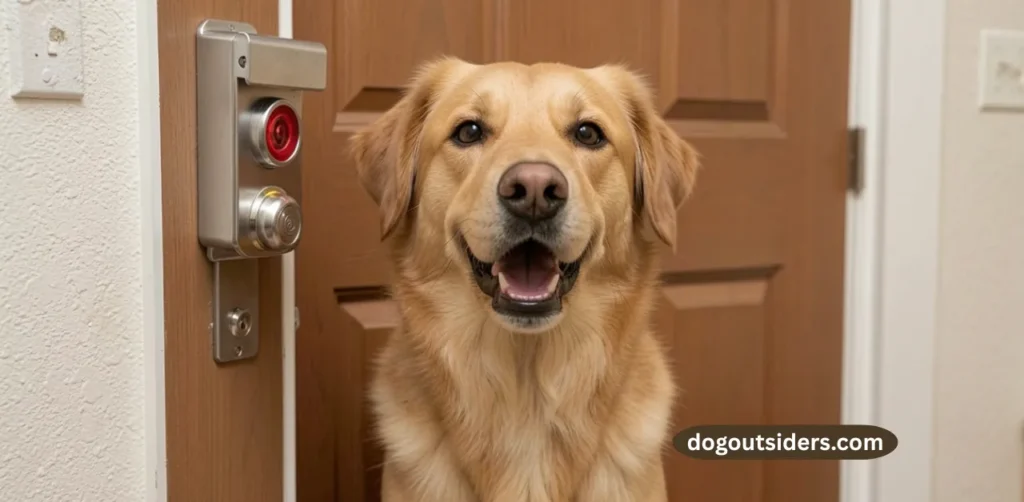
The doorbell has become a deeply conditioned trigger — every time it rings, something exciting has happened. Guests arrive. Energy spikes. People react. Over hundreds of repetitions, your dog has learned that the doorbell = massive excitement incoming.
This means if you only train at the door, you’re arriving too late. The doorbell response is where training needs to start.
How to Get Your Dog to Stay Calm When Guests Arrive — The 4-Step System
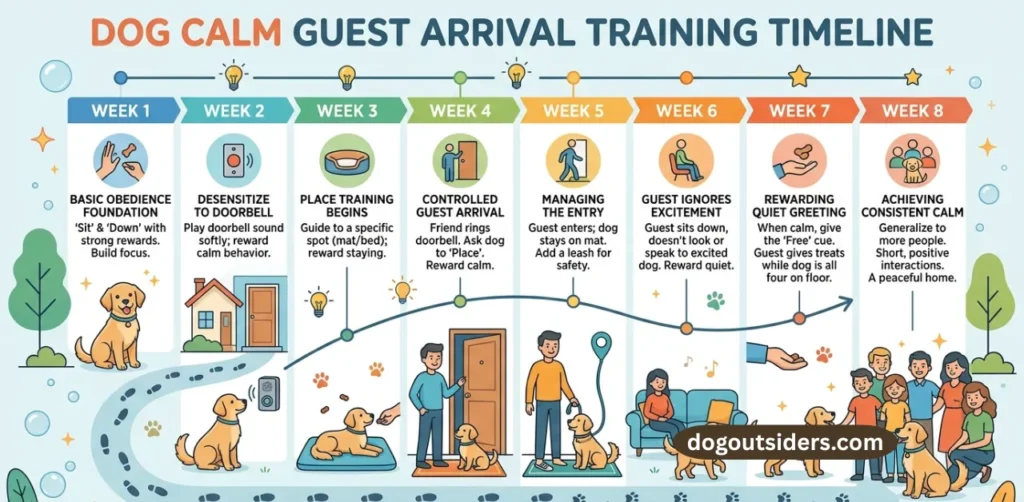
Step 1: Train the Doorbell Response First
Before you can expect calm behavior when guests walk in, you need to change what the doorbell means to your dog.
Doorbell Desensitization — How to Do It in 5 Minutes a Day
This technique is called sound desensitization and it works by repeatedly pairing the doorbell sound with a calm, reward-based response — until the sound no longer triggers arousal.
How to run a session:
- Have a partner ring the doorbell (or use a phone recording of your specific doorbell sound)
- The moment the bell rings, cue your dog to “sit”
- If they sit, immediately reward with a high-value treat
- If they rush the door, calmly redirect without raising your voice
- Repeat 5–8 times per session. One session per day.
Critical rule: Do NOT practice during real guest arrivals while desensitization is ongoing. Real arrivals create too much arousal and undo the conditioning. Use a partner or a recording exclusively for practice.
Within 1–2 weeks of consistent sessions, most dogs begin sitting automatically at the sound of the doorbell. The trigger hasn’t disappeared — but their conditioned response to it has completely changed.
According to PetMD, consistent positive reinforcement paired with a specific behavioral cue is the most effective method for replacing automatic arousal responses in dogs, regardless of breed or age (Source: PetMD).
Step 2: Teach the Sit-Stay Greeting at the Threshold
Once your dog reliably sits at the doorbell sound, you can move to the next step: teaching them to hold that sit while the door opens and a person enters.
The “Four Paws on the Floor” Rule and How to Train It
The goal is simple: your dog must have all four paws on the floor during a greeting. No jumping. No rushing. Consistent enforcement of this rule — from every family member, every time — is what makes it stick.
Training the threshold sit:
- Have your partner knock or ring the bell
- Ask your dog to sit — reward immediately
- Open the door slightly while maintaining the sit. If they hold it, treat.
- Open the door fully. If they hold it, treat.
- Allow your “guest” to enter only when the dog remains seated
- If the dog breaks the sit at any point, calmly close the door and start again
The extinction burst warning: When you first stop allowing jumping, your dog will likely try harder — jumping higher, louder, more persistently. This is called an extinction burst, and it’s completely normal. Don’t interpret it as failure. Stay consistent through it and it will pass.
Building reliable behaviors around the home requires the same consistency you’d apply to any other training goal — the same patience you’d use when training your dog to behave reliably in and around the home applies directly to greeting training too.
Step 3: Teach the Place Command — Your Most Powerful Tool
The place command tells your dog to go to a specific location — a bed, mat, or designated spot — and stay there until released. It’s the single most underused tool for managing guest arrivals, and no competitor article covers it with the depth it deserves.
How to Teach the Place Command From Scratch
What you need: A dog bed or elevated cot placed in a visible spot in the room, about 10–15 feet from the front door.
The training sequence:
- Luring phase: Lure your dog onto the mat with a treat. Say “place” as they step onto it. Reward immediately.
- Duration phase: Once they go to the mat on cue, add a “stay.” Reward for staying 5 seconds, then 10, then 30.
- Distance phase: Start sending your dog to place from increasing distances. Reward each successful go.
- Distraction phase: Practice with knocking sounds, door opening, and eventually real people entering while your dog holds the place command.
Practice this command outside of guest arrival scenarios first — at random times throughout the day. It needs to be fluent before you rely on it during a real visit.
Using the Place Command When Guests Arrive
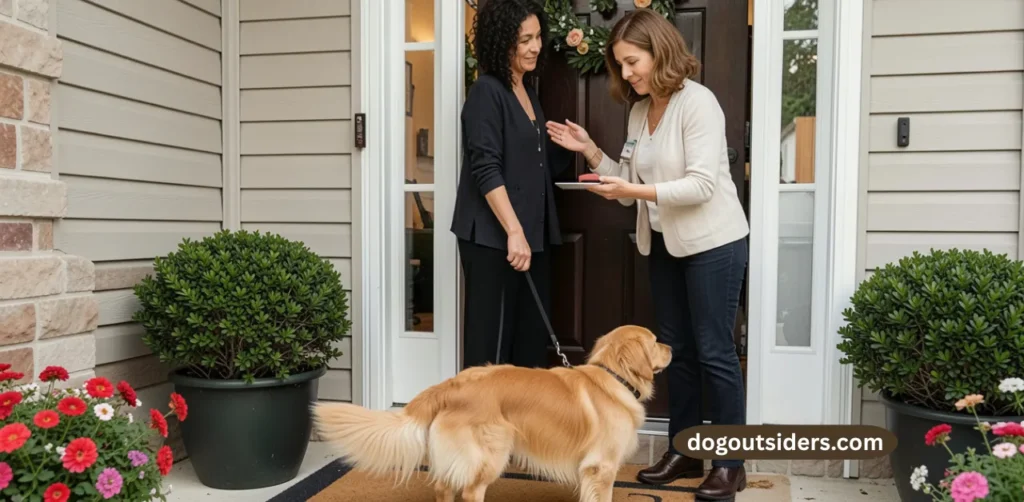
Here’s what a trained guest arrival looks like with the place command:
- Doorbell rings → dog goes to place (cued)
- Guest enters, removes shoes, greets you calmly
- Dog holds place and is rewarded multiple times
- After 3–5 minutes of calm, you release the dog from place with a calm “okay”
- Dog greets guest with four paws on the floor — sitting or standing, not jumping
This sequence removes the hyper-arousal at the door entirely. Your dog has a job to do, a location to be, and a clear sequence of reinforcement. That structure is exactly what over-excited dogs need.
During the early training stages, it’s also smart to protect your home from the physical consequences of an overexcited dog — from furniture scratches to muddy paw prints. Our guide on protecting your furniture from dogs who get overexcited indoors covers practical solutions for keeping your home intact while training is ongoing.
Step 4: Practice With Simulated Guest Arrivals
Real training requires repetition — and you can’t wait for real guests to show up to practice. Simulated arrivals are the professional trainer’s method for building fluent greeting behavior fast.
How to Set Up a Simulated Arrival Practice Session
- Ask a partner, neighbor, or family member to act as a “guest” multiple times per day during the training period
- They ring the bell, wait 60 seconds, and you run through the full training sequence
- Vary the scenario: sometimes they knock, sometimes they ring; sometimes they enter immediately, sometimes they wait
- Practice at different times of day — morning, afternoon, evening — so the behavior becomes generalized
Aim for 3–5 simulated arrivals per day during the first two weeks. This density of repetition accelerates learning dramatically compared to waiting for real visits.
What to Tell Your Guests — The Script That Protects Your Training
This is the piece most owners miss completely. Guests who immediately rush to greet your dog — bending down, making eye contact, speaking in an excited voice — undo your training in seconds. Dogs learn that their jumping and barking works because it gets the guest’s attention.
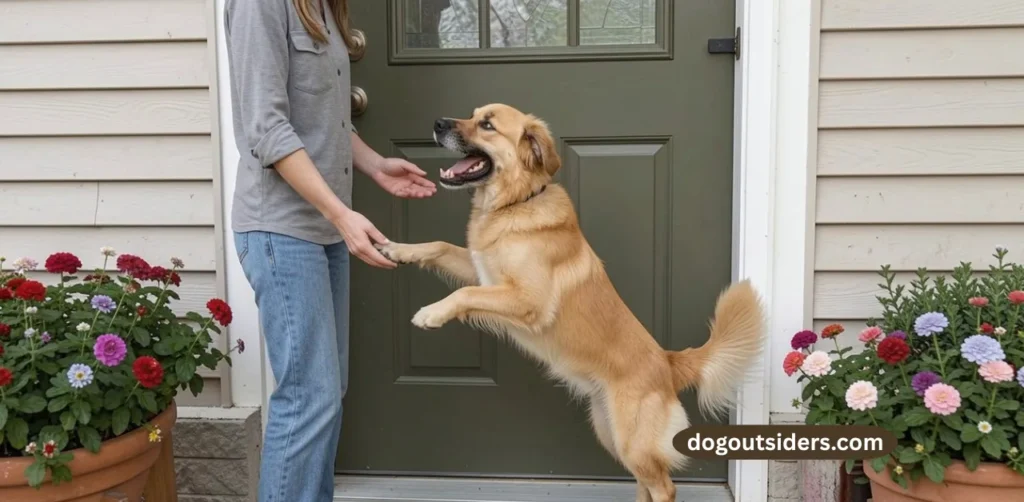
Here’s the exact script to share with guests before they arrive:
“We’re training [dog’s name] to greet visitors calmly. When you come in, please completely ignore him until he has all four paws on the floor — no eye contact, no speaking, no touching. Once he’s calm for at least 10 seconds, you can greet him gently. We know it’s hard to ignore him, but it really helps! Thank you.”
Most guests are genuinely happy to help once they understand the purpose. This one change accelerates the training timeline significantly.
The Day-of-Visit Preparation Checklist
Use this before every guest visit during the training period:
60 Minutes Before Guests Arrive:
- ✅ Exercise your dog — a 20–30 minute walk or high-energy play session significantly reduces arousal level at the door
- ✅ Complete a 5-minute training session (doorbell + sit) to prime the right behavioral state
- ✅ Set up the place mat in position near the door
15 Minutes Before Guests Arrive:
- ✅ Prepare high-value treats in a pouch or pocket — accessible throughout the visit
- ✅ Cue your dog to settle or go to place briefly to establish the calm state
- ✅ Send the guest instructions if you haven’t already
When the Doorbell Rings:
- ✅ Cue “place” or “sit” before opening the door
- ✅ Reward your dog for holding position while the door opens
- ✅ Ask the guest to wait 5–10 seconds before entering if needed
- ✅ Reward your dog multiple times during the first few minutes of the visit
During the Visit:
- ✅ Reinforce calm behavior frequently — don’t only reward at the door
- ✅ If your dog breaks the calm, calmly redirect back to place without drama
- ✅ Release from “place” only when your dog is genuinely settled
This checklist transforms guest visits from stressful events into training opportunities. Protecting your furniture and home during this phase is also worth addressing — our guide on keeping your sofa protected when training is still in progress has practical solutions for the transition period.
Training Timeline — What Progress Actually Looks Like
Owners quit when they don’t see results — and that happens because no article tells them what a realistic timeline looks like. Here’s what to expect:
| Timeline | Milestone |
|---|---|
| Days 1–3 | Dog starts associating doorbell sound with “sit” cue — still requires prompt |
| Week 1 | Dog begins sitting automatically at doorbell — some breaking still occurs |
| Week 2 | Threshold sit holds more consistently — still needs reward reinforcement |
| Weeks 3–4 | Place command is fluent in low-distraction practice |
| Month 2 | Dog holds place during real guest arrivals with reinforcement |
| Month 3 | Calm greeting behavior is largely reliable — occasional management still helpful |
Important: Every dog progresses at a different pace. Puppies and young dogs typically see faster results. Adult dogs with years of practiced jumping behavior may take 3–4 months to show fully reliable change. Consistency matters more than speed.
According to the AVMA, behavior modification using positive reinforcement is most effective when applied consistently across all household members and all similar trigger situations — inconsistency is the leading cause of training regression (Source: AVMA).
Common Mistakes That Keep Dogs Chaotic When Guests Arrive
Even owners who are trying hard make these mistakes — and they’re why the chaos keeps returning.
- ❌ Only training during real guest arrivals. Real arrivals create too much arousal for learning. Most training must happen in low-stakes simulated sessions.
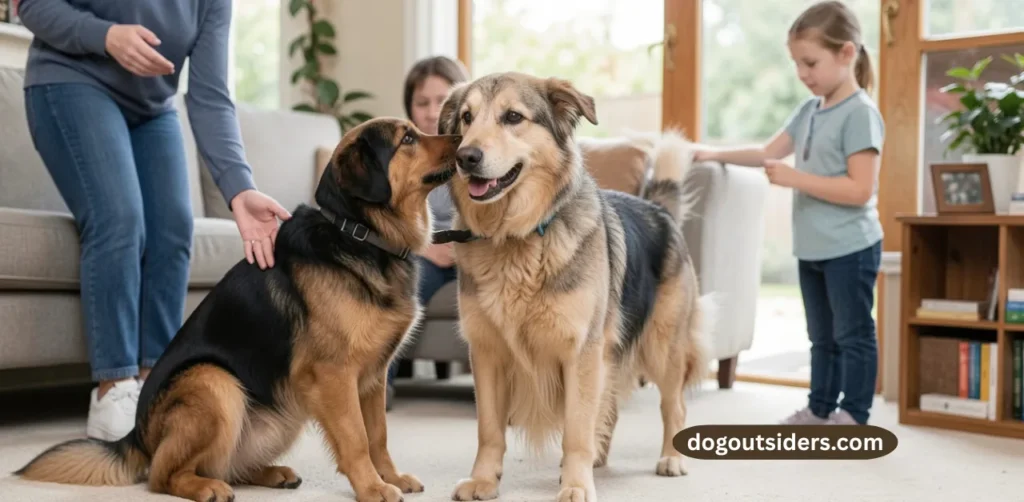
- ❌ Allowing guests to greet the dog before the dog is calm. This is the single most common sabotage. Guests who say “oh, it’s fine!” and immediately pet your jumping dog undo weeks of training in seconds.
- ❌ Punishing the jumping without rewarding the calm. Telling your dog “no” or pushing them off teaches them what not to do, but not what to do instead. The calm sit must be actively reinforced.
- ❌ Inconsistency between family members. If one person enforces the sit rule and another lets the jumping slide, your dog will learn that jumping works with the right person — and keep trying.
- ❌ Skipping the doorbell step. If you train the door behavior but not the doorbell response, you’re addressing the symptom, not the trigger. The doorbell is where the arousal cycle starts.
- ❌ Giving up during the extinction burst. When you first remove the reward (attention) for jumping, behavior gets worse before it gets better. This is normal. Pushing through this phase is where most owners quit — and where the real breakthrough is waiting.
Calm Guest Arrivals Are Closer Than You Think
The chaos at your front door is not a permanent feature of life with your dog. It’s a learned behavior — which means it can be unlearned and replaced with something much better.
The 4-step system in this guide — doorbell training, the threshold sit, the place command, and simulated practice sessions — gives your dog a complete framework for what to do when guests arrive. And the day-of checklist and training timeline give you a framework for making it happen consistently.
Start with just the doorbell desensitization this week. Add the sit at the threshold in week two. Build the place command in week three. By the end of the month, you’ll have a dog who is genuinely on their way to calm, four-paws-on-the-floor greetings — and you’ll stop dreading that doorbell.
Save this article to Pinterest so you always have the training steps, the day-of checklist, and the timeline on hand. And for more practical dog behavior guidance that actually works in real life, explore the full resource library at dogoutsiders.com.
Your guests are going to notice the difference. So will you.

Jahanzaib
Jahanzaib, Certified Professional Dog Trainer (CPDT-KA) and canine behavior consultant specializing in home manners training, impulse control, and behavioral modification for companion dogs. With over 8 years of experience working with dog owners on real-world behavior challenges — including guest arrival behavior, leash reactivity, and resource guarding — Jahanzaib focuses on positive reinforcement methods that produce lasting, reliable results. All content is reviewed against current AKC, AVMA, and CPDT training standards before publication.
“This article was reviewed for training accuracy by a Certified Professional Dog Trainer (CPDT-KA) specializing in home manners and impulse control training. All methods align with current positive reinforcement standards recommended by the AVMA and AKC. Last Updated: June 2026.”
Frequently Asked Questions
Train a specific sequence before guests ever walk in. Start with doorbell desensitization — reward your dog for sitting when the bell rings. Then teach a sit at the threshold, followed by the place command. Practice all three steps in simulated arrivals daily. Consistency across all family members is the factor that determines how quickly the calm greeting becomes reliable.
Your dog is responding to a deeply conditioned trigger — usually the doorbell — that has predicted exciting arrivals hundreds of times. Over-excitement is the most common cause, though door anxiety also exists in some dogs. The key is identifying whether your dog’s behavior is loose and wiggly (excitement) or stiff and intense (anxiety), since each requires a different training approach.
Temporarily, yes — especially early in training. Crating or gating your dog during the initial high-arousal moment allows the guest to settle before the greeting happens. Over time, however, management should give way to trained behavior. A dog who is simply removed from guests never learns the calm greeting skills they need for long-term success.
Reward the behavior you want — four paws on the floor — rather than just punishing the jumping. When your dog jumps, remove all attention immediately (turn away, cross arms, no eye contact). The moment all four paws are on the floor, reward with a treat and calm praise. Ensure every family member and every guest applies this rule consistently.
The place command tells your dog to go to a specific mat or bed and stay there until released. It’s one of the most practical tools for managing guest arrivals. Train it in stages: lure the dog onto the mat, reward for staying, gradually add duration and distance. Once fluent, use it as soon as the doorbell rings to give your dog a structured alternative to chaos.
Yes. Older dogs with established jumping habits simply take longer than puppies — typically 2–4 months of consistent training rather than weeks. The same methods apply: doorbell desensitization, sit-stay at the threshold, and the place command. The key for older dogs is patience through the extinction burst phase, when behavior temporarily gets worse before improving.
Most dogs show noticeable improvement within 2–4 weeks of daily practice. Full reliability — where the dog holds a calm greeting without constant reward — typically takes 2–3 months of consistent training. Dogs with years of practiced jumping behavior or higher arousal thresholds may need closer to 4 months. Consistent daily repetition matters more than the intensity of any single session.