Your puppy looked at the water. Then at you. Then scrambled backward so fast they nearly fell out of the tub.
Sound familiar? Bath time panic is one of the most common challenges new puppy owners face — and it almost always happens because of how the first few baths go. If those early experiences are stressful, confusing, or physically uncomfortable for your puppy, bath time becomes something they dread. And then you dread it too.
The good news: these 5 dog bath tips for puppy owners are specifically designed to prevent that cycle before it starts. They cover everything from the right supplies and safe water temperature to ear protection, anxiety reduction, and the drying technique most owners get completely wrong.
Get these five things right, and bath time becomes something your puppy can actually tolerate — and eventually, look forward to.
According to the American Kennel Club, early positive grooming experiences are one of the most important factors in raising a well-adjusted adult dog — and bath time is one of the first grooming experiences most puppies encounter (Source: AKC).
Let’s make it a good one.
Why Your Puppy’s First Bath Sets the Tone for Every Bath After
Most new owners think of the first bath as just a hygiene task. But for your puppy, it’s something much bigger.
What Puppies Are Learning During Bath Time (Even When You Can’t Tell)
During their first bath, your puppy isn’t just getting clean. They’re asking a set of very important questions:
- Is water safe?
- Does my owner keep me calm when things are unfamiliar?
- Is this something I can handle?
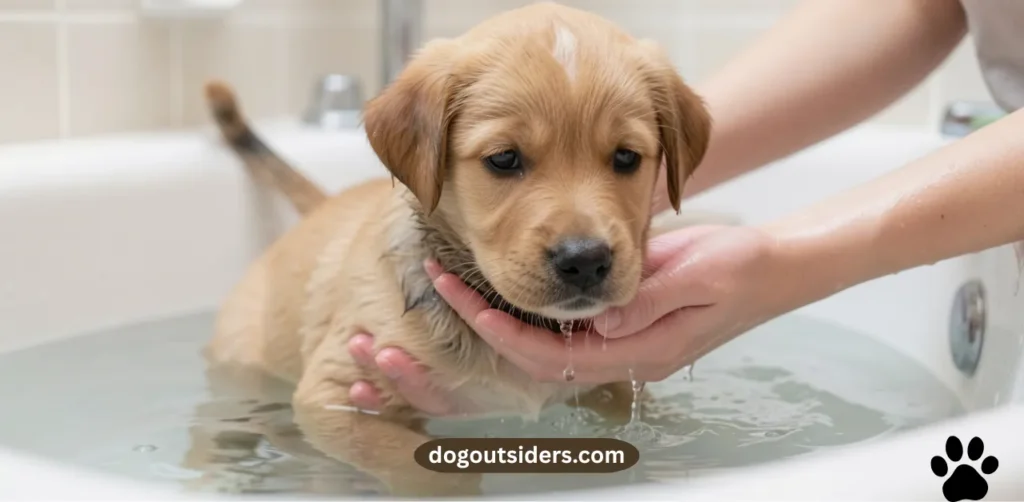
The answers your puppy forms during those early experiences shape their bath-time behavior for years. A tense, rushed first bath can create water anxiety that takes months of patient work to undo. A calm, controlled, rewarding first bath builds trust and makes every future bath easier.
The Bonding Opportunity Most New Owners Miss
Bath time, done well, is one of the most powerful bonding routines you can build with your puppy. The physical closeness, the gentle handling, and the consistent positive reinforcement all communicate safety and trust.
Many Golden Retriever owners, for example, report that puppies who had calm, treat-rewarded baths from week one became adults who walked into the bathroom voluntarily on bath day. The habit forms early — and it works in your favor if you set it up correctly from the start.
5 Dog Bath Tips for Puppy Owners — The Complete System
Tip 1: Gather Your Supplies Before the Puppy Ever Touches Water
The number one mistake new owners make? Starting the bath before they’re ready. You reach for the shampoo, your puppy escapes, water goes everywhere, and the chaos sets a terrible precedent.
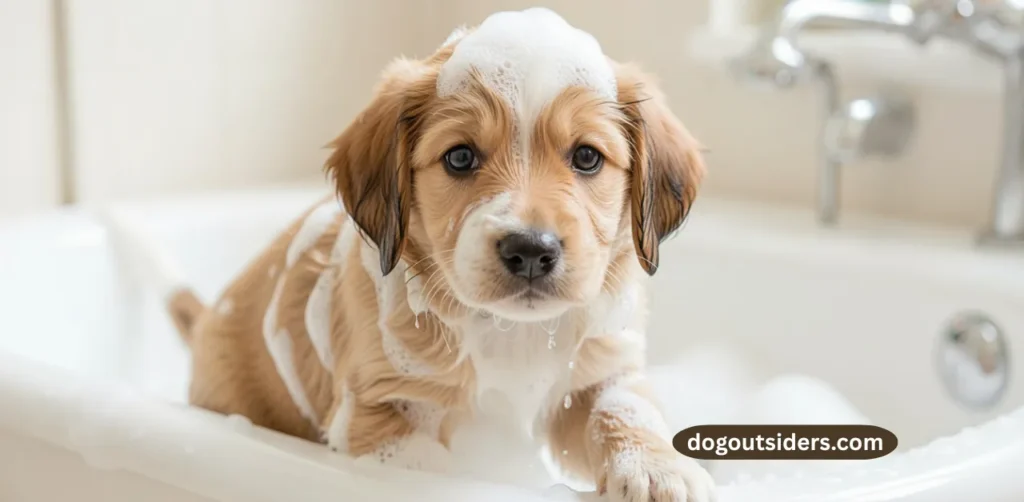
Prepare everything in advance. Get it all within arm’s reach before your puppy enters the bath space.
The Essential Puppy Bath Supplies Checklist
Here’s what you actually need:
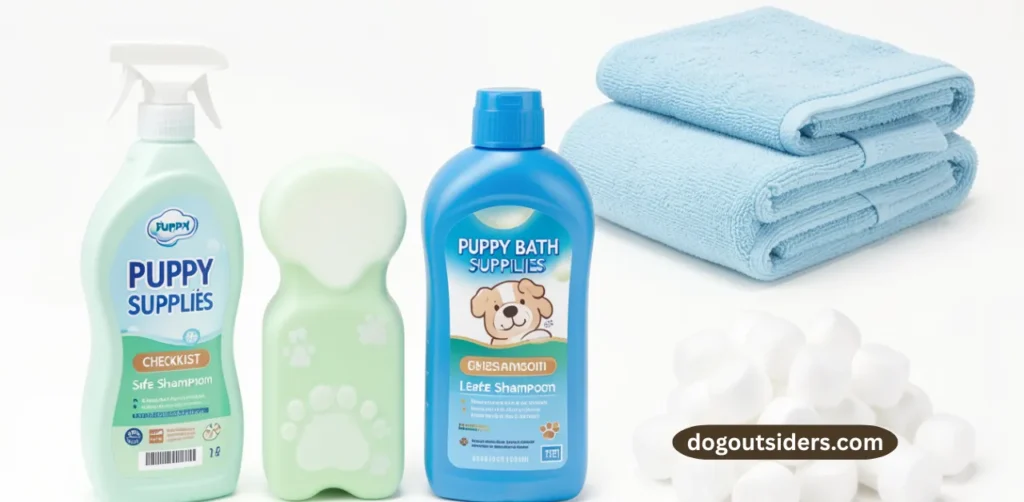
Essential:
- ✅ Puppy-specific shampoo (more on this below)
- ✅ Two clean, dry towels (one for the body, one for the face/head)
- ✅ A non-slip mat for the tub or sink bottom
- ✅ A handheld sprayer or a plastic cup for rinsing
- ✅ Cotton balls (for ear protection — more on this in Tip 4)
- ✅ High-value treats for reward throughout the bath
- ✅ A soft-bristle brush or rubber grooming mitt
Skip:
- ❌ Human shampoo or baby shampoo
- ❌ Harsh disinfectant soaps
- ❌ A high-heat blow dryer without a cool setting
For small breeds, the sink often works better than a full bathtub in early puppyhood — it’s a smaller, more contained space that feels less overwhelming. For more specific care guidance tailored to petite breeds, our guide on small dog grooming and care essentials has additional helpful context.
What Shampoo Is Actually Safe for Puppies?
This is the most important supply decision you’ll make — and it’s where many new owners unknowingly cause skin problems.
Why human shampoo harms puppies: Human skin has a pH of roughly 5.5 (acidic). Dog skin has a pH of 6.5–7.5 (closer to neutral). Human shampoos — including baby shampoo — are formulated for human skin pH. When you use them on a puppy, they strip the natural oils from the skin, disrupt the protective acid mantle, and often cause dryness, flaking, and irritation.
According to PetMD, using shampoos not formulated for dogs can damage the skin barrier and make puppies more vulnerable to bacterial and fungal infections (Source: PetMD).
What to look for in a puppy shampoo:
- pH balanced for dogs (6.5–7.5)
- Free from sulfates, parabens, and artificial fragrances
- Labeled specifically for puppies or “gentle/sensitive formula”
- Tearless formula for the face
Tip 2: Get the Water Temperature and Bathing Setup Right Every Time
Water that’s too cold stresses and chills your puppy — especially small breeds who lose body heat quickly. Water that’s too hot damages sensitive puppy skin and causes panic.
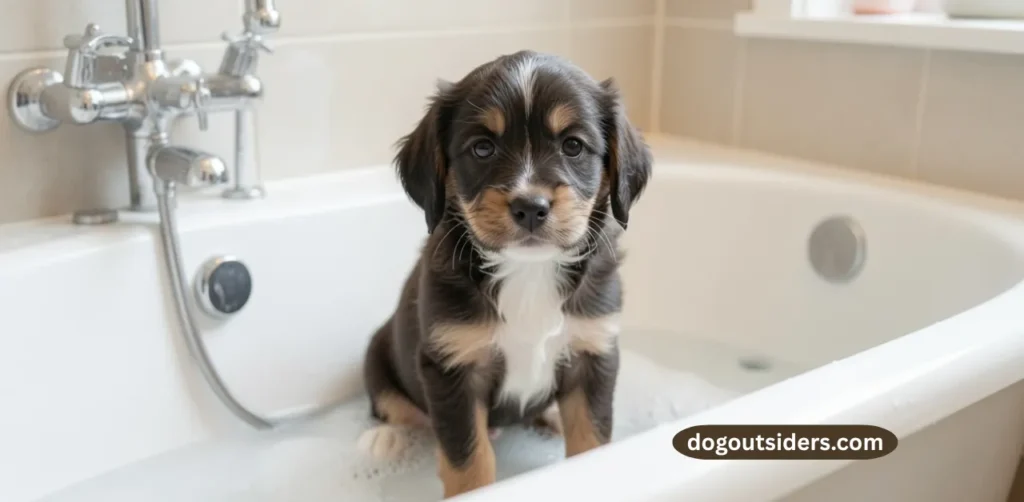
What Is the Safe Water Temperature for a Puppy Bath?
The safe water temperature range for puppies is 37–39°C (98–102°F) — approximately the same as comfortably warm human bath water. Test it on the inside of your wrist before placing your puppy in the water. It should feel pleasantly warm, not hot.
A useful rule: if it feels even slightly uncomfortable on your skin, it’s too warm for your puppy.
Before you bathe your puppy outdoors, it’s worth checking whether hose water is safe and warm enough for a puppy bath — garden hose water is often significantly colder than it feels, especially in early spring and autumn.
Indoor vs. Outdoor Bathing — Which Works Better for Puppies?
| Factor | Indoor (Sink/Tub) | Outdoor (Hose/Tub) |
|---|---|---|
| Temperature control | ✅ Excellent | ⚠️ Variable |
| Stress level for puppy | ✅ Usually lower | ⚠️ Higher (new environment) |
| Ease of rinsing | ✅ Good with sprayer | ✅ Good with hose |
| Appropriate age | ✅ From 8 weeks | ⚠️ Best after 3–4 months |
| Weather dependency | ✅ None | ❌ Weather-dependent |
For most new puppy owners, indoor bathing in a sink or tub gives you the most control. However, as your puppy grows and gains confidence, outdoor bathing becomes a practical option — our full guide on how to bathe your dog outdoors safely covers the setup in detail. If you’re considering a hose setup, we also cover using a garden hose to bathe your dog at home with everything you need to know.
Tip 3: Desensitize Before You Bathe — The Pre-Bath Method That Changes Everything
For anxious puppies, the bath itself isn’t the real problem. The transition from “normal life” to “suddenly wet and confined” is where the panic starts. A short pre-bath desensitization routine bridges that gap — and it’s something no competitor article covers.
A 3-Step Pre-Bath Routine for Anxious Puppies
Do this for 3–5 days before the first real bath:
Step 1 — Introduce the bath space without water.
Place your puppy in the dry tub or sink. Give them a treat. Let them sniff around. Take them out before they show any stress. Repeat once or twice per day. The goal: the tub becomes a neutral, safe space before water ever enters the picture.
Step 2 — Add a small amount of lukewarm water.
Place just an inch of water in the bottom of the tub. Let your puppy stand in it. Treat generously. Keep it short. The sensation of wet paws is new — give them time to process it without being overwhelmed.
Step 3 — Introduce the sprayer sound.
Many puppies are startled by the sound of running water more than the water itself. Turn the sprayer or tap on at low pressure while your puppy is nearby and relaxed. Pair the sound with treats. Do this before using it directly on the puppy.
By the time the actual bath happens, none of the individual elements — the space, the water, the sound — are new or scary. This dramatically reduces bath-time panic in even the most anxious puppies.
Tip 4: Protect the Ears and Eyes During Every Bath
Water in a puppy’s ears is one of the leading causes of ear infections in young dogs — and it’s almost entirely preventable with one simple step that almost no bathing guide mentions.
How to Keep Water Out of Your Puppy’s Ears (Step-by-Step)
Before the bath begins:
- Place a small cotton ball gently into each ear canal opening. Don’t push it in deeply — just enough to block water from running in during rinsing. Remove them immediately after the bath is complete.
- During washing, tilt your puppy’s head slightly upward when rinsing the neck and top of the head, so water runs backward away from the ears.
- Never aim the sprayer directly into the ear area. Use a cupped hand to wet and rinse the sides of the head.
- For the face: use a damp cloth rather than the sprayer. Wipe gently from the inner corner of the eye outward.
According to VCA Animal Hospitals, moisture trapped in the ear canal creates the warm, humid environment that bacteria and yeast thrive in — making water prevention during baths a critical step in ear health maintenance (Source: VCA Animal Hospitals).
After the bath, gently lift each ear flap and dry the outer ear canal area with a dry cotton ball or soft cloth. Never insert anything into the ear canal itself.
Tip 5: Dry Your Puppy Correctly — This Step Matters More Than You Think
The bath is done. Your puppy shook water onto everything in a five-foot radius. Now what?
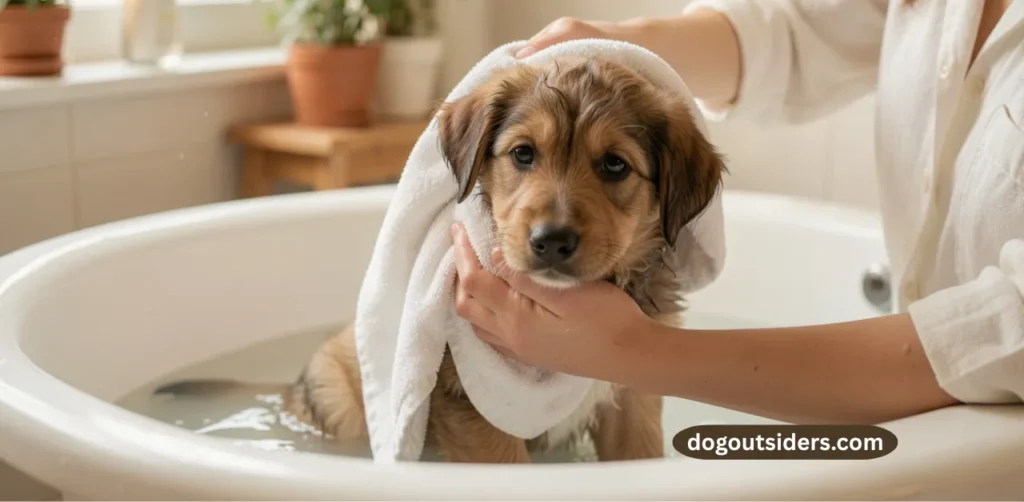
How you dry your puppy affects both their comfort and their skin health — and getting it wrong can undo everything you did right during the bath itself.
Towel vs. Blow Dryer: What’s Safer for Puppies?
| Method | Safety | Effectiveness | Best For |
|---|---|---|---|
| Warm towel wrap | ✅ Safest | Good for first drying pass | All puppies, especially small breeds |
| Microfiber towel | ✅ Safe | Excellent — absorbs 3x more water | All coat types |
| Blow dryer (cool/low setting) | ⚠️ Use carefully | Excellent for thick coats | Medium/large breeds, thick coats |
| High-heat blow dryer | ❌ Not safe for puppies | — | Avoid entirely for puppies |
The correct towel technique: Wrap your puppy loosely in a warm towel immediately after the bath. Gently press — don’t rub — to absorb water without tangling the coat. Change to a second dry towel once the first is saturated.
If using a blow dryer: Use the lowest heat setting only. Keep the dryer at least 6 inches from the coat. Move it constantly — never hold it stationary. Always test the air temperature on your own wrist first. Many puppies are frightened by the noise initially — if so, introduce it the same way you would a new sound: from a distance, with treats, before using it directly.
Never let your puppy air-dry in a cold environment. Small breeds especially can lose body heat rapidly when wet, leading to chilling and potential hypothermia in cold rooms.
How Often Should You Bathe Your Puppy?
This is one of the most common questions new owners search for — and almost no competitor article answers it with the specificity owners need.
| Coat Type | Bath Frequency |
|---|---|
| Short coat (Beagle, Boxer) | Every 4–6 weeks |
| Medium coat (Labrador, Border Collie) | Every 3–4 weeks |
| Long coat (Golden Retriever, Shih Tzu) | Every 2–3 weeks |
| Double coat (Husky, German Shepherd) | Every 4–6 weeks (more during shedding season) |
| Hairless/Very short (Chihuahua, Dachshund) | Every 2–3 weeks |
Over-bathing strips the natural oils from your puppy’s skin and coat. Under-bathing allows bacteria, dander, and odor to build up. The frequency ranges above are general guidelines — always adjust based on your puppy’s activity level and how dirty they get.
For breed-specific grooming needs beyond bathing, our article on puppy care tips every Golden Retriever owner should know includes additional coat-specific guidance for one of the most popular family breeds.
Common Puppy Bath Mistakes to Avoid
Even well-meaning new owners make these mistakes regularly. Here’s what to watch out for:
- ❌ Using human shampoo or baby shampoo. As covered above, the pH mismatch damages your puppy’s skin barrier. Always use a puppy-specific formula.
- ❌ Starting the bath before you’re fully prepared. Scrambling for supplies mid-bath creates chaos, disrupts your puppy’s trust, and makes bath time harder every time it happens.
- ❌ Using water that’s too cold or too hot. Always test temperature on your wrist. Aim for 37–39°C (98–102°F). Cold water stresses small breeds severely — and hose water outdoors is often much colder than it feels.
- ❌ Skipping the ear protection step. Cotton balls take 10 seconds to place and prevent weeks of ear infection treatment. This is one of the most skipped steps — and one of the most consequential.
- ❌ Rubbing the coat vigorously with a towel. Vigorous rubbing causes tangling, matting, and breakage — especially in long-coated breeds. Always press and pat, not rub.
- ❌ Ending the bath on a stressful note. Always finish with a treat, calm praise, and a few minutes of gentle play. The last thing your puppy experiences after a bath shapes how they feel about the next bath. End it positively, every time.
Bath Time Can Be One of Your Favorite Routines Together
The difference between a puppy that panics at bath time and one that trots into the bathroom calmly comes down almost entirely to those first few baths — and the habits you build around them.
These 5 dog bath tips for puppy owners give you everything you need to make bath time calm, safe, and even enjoyable. The right supplies, the right temperature, a gentle desensitization routine, proper ear protection, and the correct drying technique all add up to something that goes far beyond hygiene.
Done well, bath time becomes one of the most trust-building routines in your relationship with your puppy.
Save this article to Pinterest so you always have the checklist, temperature guide, and frequency table on hand when you need them. And for more practical puppy care guidance you can use from day one, explore the resources available at dogoutsiders.com — there’s a lot more waiting for you there.
Your puppy is counting on you to make this feel safe. Now you know exactly how.

Jahanzaib
Jahanzaib, Certified Professional Dog Trainer (CPDT-KA) and canine grooming consultant with 6+ years of experience working with new puppy owners on early grooming habituation, coat care, and positive handling techniques. Jahanzaibspecializes in creating fear-free grooming routines for puppies and has worked with owners of every breed size and coat type. All content is reviewed for accuracy against current AKC, AVMA, and veterinary grooming guidelines before publication.
Frequently Asked Questions
Prepare all supplies before the puppy enters the bath. Use lukewarm water at 37–39°C, a puppy-specific shampoo, and cotton balls in the ears to prevent water entry. Introduce the bath space gradually using treats before the first real wash. Keep the session short, stay calm, and always end with a reward to build a positive association with bath time.
Bath frequency depends on coat type. Short-coated puppies need a bath every 4–6 weeks. Medium-coated breeds do well every 3–4 weeks. Long-coated puppies may need bathing every 2–3 weeks. Over-bathing strips natural oils and causes dry, flaky skin. Always use these ranges as guides and adjust based on how dirty your puppy gets between baths.
Use a shampoo specifically formulated for puppies — never human shampoo or baby shampoo. Human skin pH is around 5.5, while dog skin sits at 6.5–7.5. Human shampoos disrupt the puppy’s skin barrier and can cause dryness, irritation, and infection risk. Look for a tearless, sulfate-free, fragrance-free formula labeled “puppy-safe” or “gentle/sensitive.”
Yes, you can bathe an 8-week-old puppy safely with the right precautions. Use only lukewarm water, a gentle puppy shampoo, and a warm drying towel immediately after. Avoid cold environments and cold water — young puppies lose body heat rapidly when wet. Keep the first bath very short, reward generously, and focus on making the experience calm rather than thorough.
Wrap your puppy loosely in a warm towel immediately after the bath and gently press — don’t rub — to absorb water. Switch to a second dry towel once the first is saturated. If using a blow dryer, use the lowest heat setting only, keep it 6 inches from the coat, and move it continuously. Never let a wet puppy sit in a cold room — small breeds chill rapidly.
Use a pre-bath desensitization routine before the first real wash. Place your puppy in a dry tub with treats, then add a small amount of water on separate days, then introduce the sprayer sound from a distance with treats. By the time the actual bath begins, none of the individual elements are new or frightening. Patience and consistent positive reinforcement are the only tools that truly work.
Place a small cotton ball gently at the opening of each ear canal before the bath begins. During rinsing, tilt your puppy’s head slightly upward so water runs away from the ear area. Never aim the sprayer directly at the ears — use a cupped hand instead. Remove the cotton balls immediately after the bath and gently dry the outer ear area with a soft cloth.