Your German Shepherd locks eyes with every passing dog. They pull so hard on the leash your shoulder aches. They seem to listen perfectly at home — and completely ignore you the moment you step outside.
Sound familiar? You’re not alone, and you’re not doing anything catastrophically wrong.
Here’s what most training guides won’t tell you: the 7 German Shepherd training secrets you need to know aren’t the same tips that work for golden retrievers, Labradors, or any other breed. German Shepherds are wired differently — and they need a training approach that respects that wiring.
According to the American Kennel Club, German Shepherds rank among the top three most intelligent dog breeds. They were bred for complex decision-making, environmental awareness, and independent problem-solving in high-pressure working conditions. That extraordinary brain is your greatest training asset — but only if you know how to engage it.
Canine behavioral research consistently shows that high-drive, working breeds like German Shepherds respond best to structured, engagement-based training that channels their natural intensity rather than suppressing it (Source: Journal of Veterinary Behavior). The problem isn’t your dog’s energy. It’s that generic training methods don’t match the German Shepherd operating system.
This article gives you 7 breed-specific training secrets — each one designed to work WITH your German Shepherd’s intelligence, drive, and protective instincts. Whether your GSD is 8 weeks old or 3 years old, these secrets build the partnership that transforms chaos into confidence.
While the approach differs significantly from training tips that work for golden retriever puppies, the foundation is the same: understanding your breed’s brain.
Secret 1 — Earn Your German Shepherd’s Focus Before Demanding Obedience
Most owners jump straight to commands. Sit. Down. Stay. Come. But here’s the secret that professional German Shepherd trainers know: obedience without engagement is just compliance — and compliance breaks down the moment something more interesting appears.
Before teaching a single command, you need to become the most interesting thing in your dog’s environment. This means building voluntary focus — your German Shepherd choosing to pay attention to you because they’ve learned that you are the source of everything good.
How to build engagement:
- Reward every voluntary check-in. Any time your GSD looks at you without being asked, mark it with “yes!” and reward. Do this 20–30 times daily during the first two weeks.
- Control the resources. Meals, toys, access to doors, walks — all come through you. Not as punishment, but as a communication system that says “good things flow from engagement with me.”
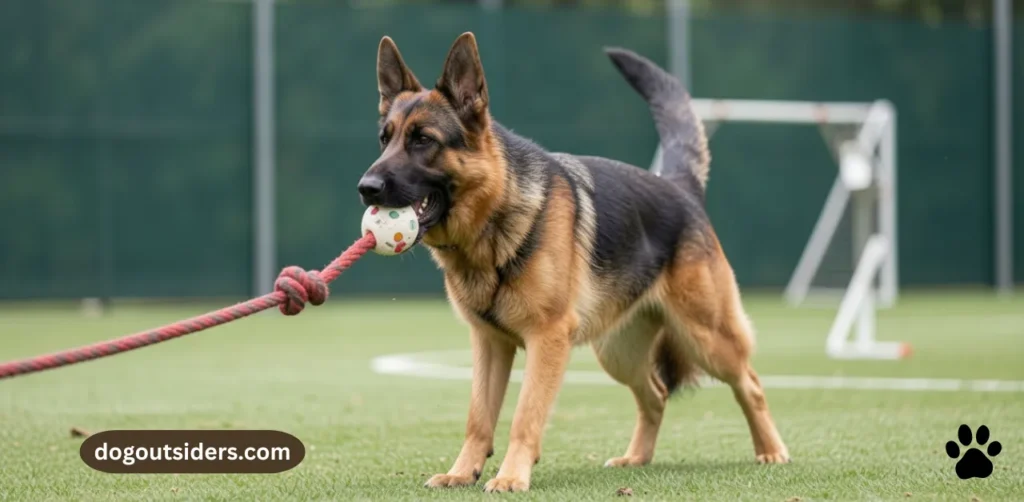
- Play with purpose. Structured tug, chase games, and hide-and-seek with you as the prize build engagement faster than treats alone.
The “Check In” Game That Builds Voluntary Focus
Stand in a low-distraction environment. Drop treats on the ground. Say nothing. Wait. The moment your German Shepherd finishes the treat and looks up at your face — mark “yes!” and reward again. Repeat for 3 minutes.
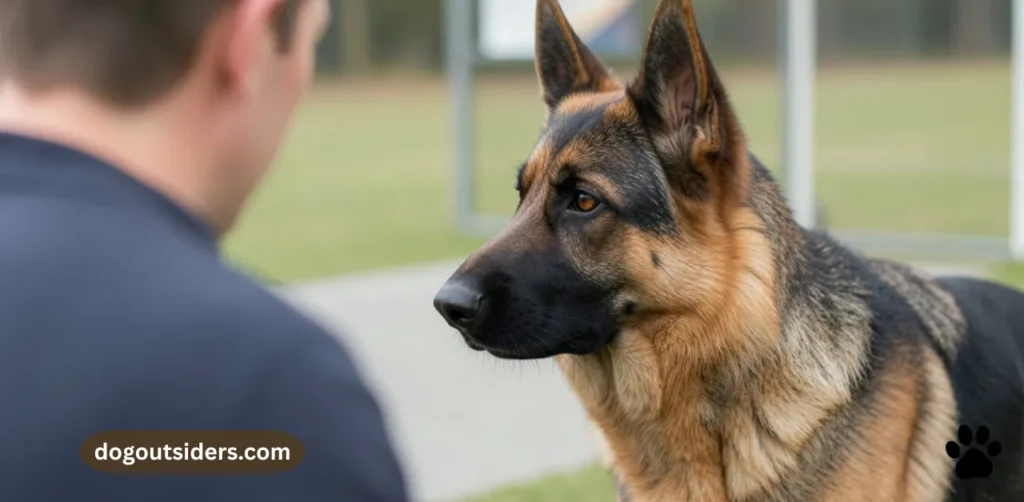
Within a week of consistent practice, most German Shepherd owners notice their dog offering unprompted eye contact throughout the day. That’s engagement — and it’s the foundation every other secret builds on.
Secret 2 — Use Marker Training for German Shepherd Precision
German Shepherds are precision learners. They notice details that other breeds miss, and they crave clarity. Consequently, vague praise (“good boy!”) delivered two seconds too late leaves them guessing about what they actually did right.
Marker training solves this problem completely.
A marker is a specific sound — a clicker or a sharp “yes!” — that tells your dog the EXACT moment they performed the correct behavior. It bridges the time gap between the behavior and the reward.
How to implement marker training with your GSD:
- Charge the marker first. Click (or say “yes”), then give a treat. Repeat 30 times over 2–3 sessions. Your dog now understands that the marker sound means “reward incoming.”
- Mark the instant of correct behavior. When your GSD’s rear touches the ground during a sit, mark immediately — not a second later.
- Vary your rewards. After the marker, sometimes deliver a treat. Sometimes deliver a toy. Sometimes deliver real-life rewards (opening the door, starting a walk). This creates a dog who stays engaged because the reward is always exciting.
German Shepherds trained with marker precision develop noticeably faster and more reliable responses than those trained with vague verbal praise alone. Their intelligence thrives on exact feedback.
Secret 3 — Channel Your German Shepherd’s Drive (Don’t Suppress It)
This is the secret that changes the entire training experience for frustrated GSD owners.
When a German Shepherd pulls on the leash, chases squirrels, or barks at the window, the instinct is to say “no,” correct the behavior, and try to “calm them down.” That approach backfires spectacularly with this breed.
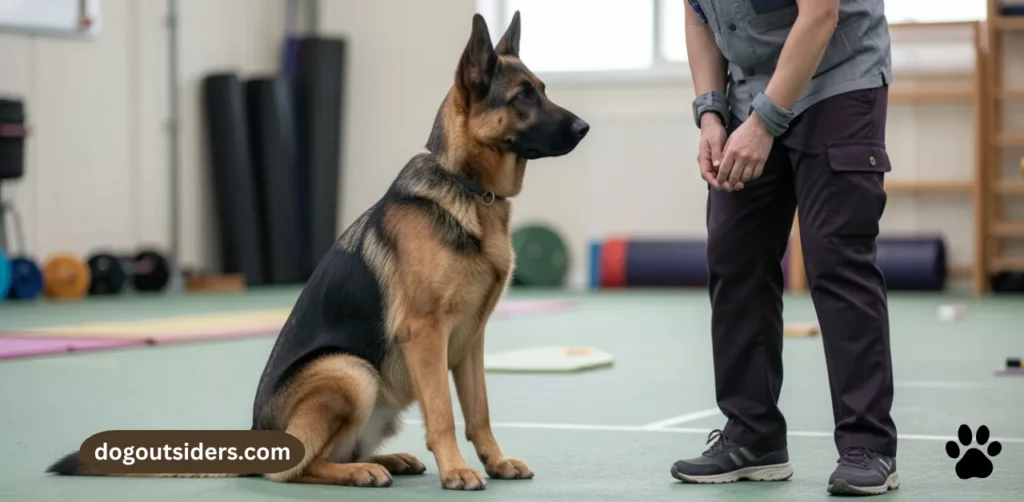
German Shepherds have high prey drive, high defense drive, and intense environmental awareness. These traits are genetically hardwired — they’re not behavior problems. Suppressing drive creates frustration. Frustration creates reactivity, destructive behavior, and the obsessive repetitive patterns GSD owners dread.
The secret: give the drive a legitimate outlet.
5 Drive-Channeling Activities for German Shepherds
- Structured tug games — builds impulse control while satisfying prey drive. Use rules: tug starts on your cue, stops on your cue.
- Scent detection work — satisfies the GSD’s nose drive and provides intense mental stimulation
- Flirt pole sessions — mimics prey chase in controlled bursts; incredibly tiring in 5–10 minutes
- Agility or obstacle courses — channels physical drive through cognitive problem-solving
- Retrieve-and-deliver exercises — satisfies carry/hold instincts while teaching impulse control
A German Shepherd whose drive has a daily outlet is noticeably calmer, more focused, and dramatically easier to train in obedience sessions afterward.
For more on structuring physical outlets for working breeds, our guide to exercise routines for high-energy working breeds provides additional strategies.
Secret 4 — Make Mental Exercise Non-Negotiable for Your German Shepherd
Physical exercise alone will never be enough for a German Shepherd. You can run them for two hours and they’ll still pace the house looking for something to do.
Why? Because their brain is still hungry.
According to VCA Animal Hospitals, cognitive enrichment is as effective as physical exercise at reducing behavioral problems in dogs — and for high-intelligence working breeds like German Shepherds, it’s arguably more important.
The principle is simple: a mentally tired German Shepherd is a calm German Shepherd.
6 Brain Games for German Shepherds
- Puzzle feeders — replace the bowl entirely; make every meal a cognitive task
- Snuffle mats — scatter food in a textured mat for foraging enrichment
- Hide and seek — hide yourself or objects; use “find it” cue
- Scent discrimination — teach your GSD to identify and find specific scented items
- Object naming — German Shepherds can learn dozens of object names; teach “get your ball,” “find your rope”
- Frozen Kongs — stuff, freeze, and deliver; provides 20–30 minutes of focused engagement
Daily mental exercise recommendation: 15–20 minutes of dedicated brain work, split into 2 sessions. This can be worked into mealtimes (puzzle feeders) or immediately before obedience training (to take the edge off excess arousal).
Secret 5 — Socialize Your German Shepherd Strategically
German Shepherds are naturally alert, protective, and environmentally aware. This makes socialization critically important — but it also makes the METHOD of socialization critically important.
The most common mistake: taking a GSD puppy to a crowded dog park and expecting them to “figure it out.” For a breed with strong protective instincts, overwhelming social exposure creates fear — and fear creates aggression.
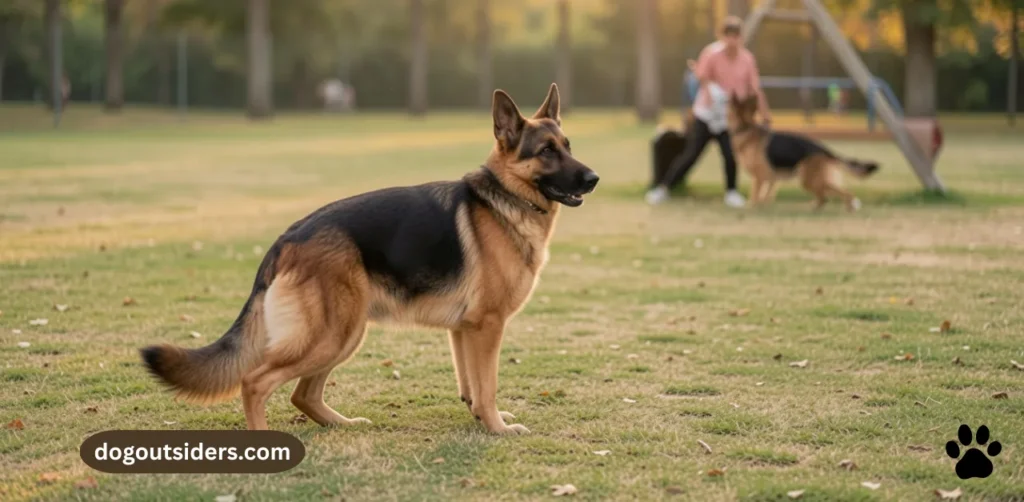
Strategic socialization for German Shepherds means controlled, positive exposure at the dog’s pace.
According to the American Veterinary Society of Animal Behavior (AVSAB), the critical socialization window is 3–16 weeks. After this window closes, forming new positive associations becomes significantly more difficult.
The German Shepherd Socialization Checklist
People (expose before 16 weeks):
- Men, women, and children of varying appearances
- People wearing hats, sunglasses, uniforms, and high-visibility clothing
- People with wheelchairs, walkers, and crutches
- Delivery workers and strangers approaching the home
Environments:
- Various floor surfaces — tile, grass, gravel, wood, metal grates
- Traffic sounds and urban environments
- Pet-friendly stores and veterinary waiting rooms
- Car rides of varying lengths
Animals:
- Calm, vaccinated adult dogs (NOT dog parks)
- Puppy socialization classes with a qualified trainer
- Cats, if part of your household
Critical GSD-specific rule: Every socialization experience should be positive. If your puppy shows stress signals — ears back, tucked tail, whale eye, cowering — immediately increase distance from the stimulus and pair with treats. Never force a German Shepherd puppy into an interaction they’re retreating from.
For more on building positive associations in reactive contexts, our guide on using positive reinforcement to address aggression covers complementary principles.
Secret 6 — Always Train Below Your German Shepherd’s Threshold
This is the training secret most owners have never heard of — and it’s the one that prevents the most serious behavioral problems.
Threshold is the distance or intensity at which your dog transitions from “aware but able to think” to “overwhelmed and reactive.” Below threshold, your German Shepherd can learn, respond to commands, and make good choices. Above threshold, they’re operating on pure emotion — barking, lunging, or shutting down.
The secret: never train at or above threshold. Always work at a distance where your dog notices the trigger but can still respond to you.
How to Identify Your German Shepherd’s Threshold Distance
Use this progression with any trigger (other dogs, strangers, bicycles, etc.):
- Start far away — 50+ feet from the trigger
- Watch for body language — can your dog still take a treat? Still respond to their name? Ears relaxed? That’s below threshold.
- Move 5 feet closer. Reassess. Still responsive? Continue.
- Stop moving closer the instant your dog stiffens, fixates, or stops responding. That’s your threshold boundary.
- Train at the distance just BEFORE that boundary. Mark and reward attention on you. Build positive associations at that distance over multiple sessions.
- Gradually decrease distance over days and weeks — not minutes.
Many German Shepherd owners describe threshold training as the turning point that resolved months of leash reactivity. The key is patience: rushing the distance reduction undoes all progress.
Secret 7 — Structure Training Sessions for the German Shepherd Brain
German Shepherds learn fastest in short, intense bursts — not long, drawn-out sessions. Their intelligence means they process information quickly, but their drive means they also lose patience quickly when sessions drag on.
Training Session Length by Age
| GSD Age | Session Length | Sessions Per Day | Focus Areas |
|---|---|---|---|
| 8–12 weeks | 3–5 minutes | 4–5 sessions | Engagement, name, sit, marker conditioning |
| 3–4 months | 5–8 minutes | 3–4 sessions | Down, stay, come, leash introduction, socialization |
| 4–6 months | 8–12 minutes | 3 sessions | Recall proofing, impulse control, heel foundations |
| 6–12 months | 10–15 minutes | 2–3 sessions | Distraction proofing, threshold work, adolescent refreshers |
| 12+ months | 15–20 minutes | 2 sessions | Advanced obedience, sport foundations, environmental reliability |
The golden session structure for German Shepherds:
- Brief physical outlet (2–3 minutes of tug or fetch) to take the edge off
- Focus/engagement exercise (1–2 minutes of check-in game)
- Core training content (5–12 minutes of new or practiced commands)
- End with an easy win — ask for a command they already know, reward generously
- Finish with play — the session ending should always be fun
The German Shepherd Adolescent Phase (What to Expect)
Around 8–14 months, nearly every German Shepherd owner experiences what feels like total training collapse. Your previously obedient puppy suddenly ignores commands, tests boundaries, becomes pushy, and acts like they’ve forgotten everything.
This is the adolescent regression phase. It’s completely normal — and it’s temporary.
How to train through it:
- Shorten sessions back to puppy-length durations
- Increase reward value — bring out the high-value treats again
- Reduce distraction level — go back to training in low-stimulation environments
- Stay consistent — this is the phase where many owners give up, creating long-term behavioral fallout
- Add more mental stimulation — the adolescent GSD brain needs extra cognitive challenge
This phase typically resolves between 14–20 months as the dog matures neurologically. Owners who maintain consistent training through this period emerge with an exceptionally reliable adult dog.
For tips on structuring a detailed puppy training schedule, our week-by-week retriever guide provides a complementary scheduling framework adaptable to German Shepherds.
5 Training Mistakes German Shepherd Owners Make
Even well-intentioned GSD owners fall into these breed-specific traps:
❌ Mistake 1: Using dominance-based or punishment-heavy methods
German Shepherds are sensitive dogs with strong fight-or-flight responses. Harsh corrections don’t create respect — they create a conflicted dog who becomes either fearfully aggressive or avoidant. Modern behavioral science confirms that positive, engagement-based methods produce more reliable and resilient results with this breed.
❌ Mistake 2: Skipping mental stimulation
Physical exercise alone creates an athlete who’s still mentally starved. German Shepherds need daily brain work — puzzle toys, scent games, training sessions — to be truly calm and fulfilled.
❌ Mistake 3: Socializing too aggressively
Forcing a GSD into overwhelming social situations (dog parks, crowded events) during the socialization window creates the exact fearfulness and reactivity you’re trying to prevent. Strategic, controlled exposure at the dog’s pace is the only approach that works.
❌ Mistake 4: Training sessions that are too long
Ten-minute sessions are more effective than 30-minute sessions for this breed. GSDs lose focus when drills drag on, leading to frustration for both handler and dog. Keep it short. Keep it fun.
❌ Mistake 5: Giving up during the adolescent phase
The 8–14 month regression phase is where the majority of GSD training failures occur — not because the dog can’t learn, but because the owner gives up when progress seems to reverse. Consistency through this phase is the single biggest predictor of adult GSD behavior.
For a deeper dive into this topic, our complete guide on common mistakes that slow down German Shepherd progress explores each pitfall in detail.
Your German Shepherd Is Waiting for the Right Partner
Your German Shepherd isn’t difficult. They aren’t stubborn. And they definitely aren’t broken.
They’re one of the most capable, intelligent, loyal animals on earth. And they’re waiting for a handler who understands how to partner with their intensity instead of fighting it.
Start with the secret that addresses your biggest current frustration. For most GSD owners, that’s Secret 1 (building engagement) or Secret 3 (channeling drive). Pick one, commit to it for two weeks, and watch the shift happen.
If this guide changed how you think about your German Shepherd, save it to your Pinterest board. Pull it up before every training session. Share it with another GSD owner who’s struggling — because they need to hear this too.
And when you’re ready to go deeper, dogoutsiders.com has detailed guides on German Shepherd training mistakes, puppy training schedules, and exercise routines for high-drive breeds.
Your German Shepherd’s potential is extraordinary. Now you have the secrets to unlock it.

Jahanzaib
Written by Jahanzaib, a Certified Professional Dog Trainer (CPDT-KA) and Karen Pryor Academy Certified Training Partner (KPA-CTP) with 14 years of experience specializing in German Shepherd and working breed training. Jahanzaib has trained GSDs for obedience, protection sport foundations, and behavior modification, and is a professional member of the Association of Professional Dog Trainers (APDT). They write regularly for dogoutsiders.com on breed-specific training, canine behavior, and working dog management.
Frequently Asked Questions About German Shepherd Training Secrets
Use engagement-based positive reinforcement combined with marker training. Earn your German Shepherd’s voluntary focus before demanding obedience commands. Structure sessions in short, intense bursts (5–15 minutes) and include daily mental stimulation alongside physical exercise. Consistency and drive channeling matter more than any single technique.
Replace punishment with redirection and structure. German Shepherds respond poorly to physical corrections — which create fear or conflict aggression. Instead, remove the reward for unwanted behavior (withdraw attention), redirect to a desired behavior, and reward the correct choice immediately. Management (preventing mistakes) is more effective than correction.
German Shepherds are among the most trainable breeds — but they require breed-specific methods. Their intelligence means they learn quickly, but their high drive and environmental sensitivity mean generic training advice often fails. With the right approach (engagement-first, marker precision, drive channeling), GSDs excel beyond nearly every other breed.
Start at 8 weeks old. Begin with engagement exercises, name recognition, and marker conditioning. Formal command training (sit, down, stay) starts immediately using short, positive sessions. Socialization should begin simultaneously and intensify between 8–16 weeks during the critical developmental window.
Your German Shepherd likely isn’t hard to train — they’re under-stimulated or overwhelmed. Common causes include insufficient mental exercise, training sessions that are too long, lack of engagement foundation, or training above the dog’s threshold. Adjusting session structure and adding brain games typically produces rapid improvement.
Total daily training should be 20–40 minutes, split across 2–4 short sessions. Individual sessions should last 5–15 minutes depending on the dog’s age. Add 15–20 minutes of separate mental stimulation (puzzle toys, scent work) daily. Quality and consistency matter infinitely more than total training hours.
Avoid physical punishment, alpha rolls, and leash corrections — these create fear and conflict in an already intense breed. Don’t skip mental stimulation. Don’t socialize aggressively by forcing interactions. Don’t repeat commands multiple times — say it once, help them succeed, then reward. And never give up during the adolescent regression phase.