Your golden retriever puppy is adorable. Undeniably, irresistibly cute. But right now, that adorable puppy is also chewing your furniture, biting your hands, peeing on the carpet, and ignoring every single word you say.
Sound about right? Take a breath. You’re not failing.
The truth is, golden retriever puppies are one of the most trainable breeds on the planet — but only when you use the right approach at the right time. According to the American Kennel Club, golden retrievers consistently rank among the top five most intelligent dog breeds, combining natural eagerness to please with exceptional food motivation. Veterinary behaviorists emphasize that this breed responds best to structured, positive training that begins during the earliest weeks of development.
These 7 golden retriever puppy training tips every new owner should know give you a clear, breed-specific system — not generic advice with a golden retriever photo slapped on top. For foundational puppy care beyond training, our guide to essential puppy care tips for golden retriever owners covers the basics you’ll also want in place.
Let’s build the dog your golden retriever was born to become.
Why Golden Retriever Puppies Need a Breed-Specific Training Approach
Not all puppies train the same way. Golden retrievers have specific temperament traits that directly impact how you should approach training:
- Extreme food motivation — goldens are driven by treats more than almost any other breed. This makes positive reinforcement incredibly effective.
- People-pleasing nature — they genuinely want to make you happy, which means harsh corrections create confusion and anxiety rather than obedience.
- Sensitivity to tone — raised voices and physical correction can shut a golden retriever puppy down emotionally. They respond to calm, consistent guidance.
- Slow physical and mental maturity — goldens don’t fully mature until age 2–3. Expecting adult behavior from a 6-month-old puppy sets everyone up for frustration.
- Mouthy breed — bred to retrieve game birds with a soft mouth, golden puppies explore the world through their mouths. This isn’t aggression — it’s genetics.
Understanding these traits changes everything about your training approach. The 7 tips below are built specifically around them.
Tip 1 — Start Socialization During the Critical Window
Socialization is the single most time-sensitive training element. Miss it, and you can’t get it back.
The Critical Period
Puppies have a socialization window that begins around 3 weeks and starts closing by 14–16 weeks of age. During this period, your golden retriever puppy’s brain is wired to accept new experiences as normal. After the window closes, new experiences increasingly trigger fear responses instead. According to VCA Animal Hospitals, puppies that miss adequate socialization during this window are significantly more likely to develop fear-based behavioral problems as adults.
What to Expose Your Puppy To
Aim for safe, positive exposure to as many novel experiences as possible:
- People — men, women, children, people wearing hats, sunglasses, uniforms
- Surfaces — grass, tile, concrete, metal grates, wet ground
- Sounds — vacuum cleaners, doorbells, thunder recordings, traffic noise
- Other dogs — vaccinated, friendly dogs in controlled settings (puppy classes are ideal)
- Environments — pet-friendly stores, cars, parks, different rooms in your home
- Handling — paws touched, ears examined, mouth opened, belly rubbed by strangers
Every experience should be paired with treats and calm praise. If your puppy shows fear, don’t force the interaction — create distance and try again more gradually.
If you’re wondering about handling cold weather outings with your golden retriever, socialization walks in cooler weather are perfectly safe with appropriate precautions.
Real-world scenario: Many golden retriever owners who adopted puppies during the pandemic report that inadequate socialization during the critical window led to lasting fear of strangers and unfamiliar environments. Early socialization is prevention, not a bonus.
Tip 2 — Teach the Five Foundation Commands First
Your golden retriever puppy doesn’t need to learn twenty tricks this week. Start with five foundational commands that create safety, communication, and structure.

The Five Commands, In Order of Priority
- Sit — the gateway command. Teaches impulse control and creates a default behavior.
- Come (recall) — the safety command. Could literally save your dog’s life.
- Stay — builds duration and patience. Start with 3 seconds, build to minutes.
- Down — a calm-down command. Helps transition from activity to rest.
- Leave it — prevents ingestion of dangerous items and teaches self-control.
Session Length Matters
This is where most new owners go wrong. Puppy attention spans are extremely short:
- 8–10 weeks: 3–5 minutes per session, 3–4 sessions per day
- 10–14 weeks: 5–7 minutes per session, 3 sessions per day
- 14–20 weeks: 7–10 minutes per session, 2–3 sessions per day
End every session on a success. If your puppy gets something right, stop there and celebrate. Short, positive sessions build enthusiasm for the next one.
For a broader list of commands that work beautifully with retrievers, check out our guide to foundational commands every retriever needs.
Tip 3 — Use Positive Reinforcement Exclusively
This isn’t optional for golden retrievers. It’s the only approach that works correctly with this breed’s temperament.
Why Positive Reinforcement Is Non-Negotiable for Goldens
Golden retrievers are emotionally sensitive dogs. Harsh corrections — yelling, leash jerks, physical punishment, or dominance-based methods — don’t create obedience. Instead, they create anxiety, confusion, and a puppy who becomes afraid to try new behaviors.
The American Veterinary Society of Animal Behavior (AVSAB) has stated that reward-based training is the most effective and humane approach for all dogs. For goldens specifically, it leverages their two strongest traits: food motivation and desire to please.
How to Apply It
- Mark the desired behavior the instant it happens (use “yes!” or a clicker)
- Deliver the reward immediately — within 1–2 seconds of the behavior
- Use high-value treats for new behaviors, lower-value treats for practiced ones
- Fade treats gradually — replace with verbal praise and life rewards (play, walks) over time
- Ignore unwanted behavior when possible — attention (even negative) reinforces behavior in goldens
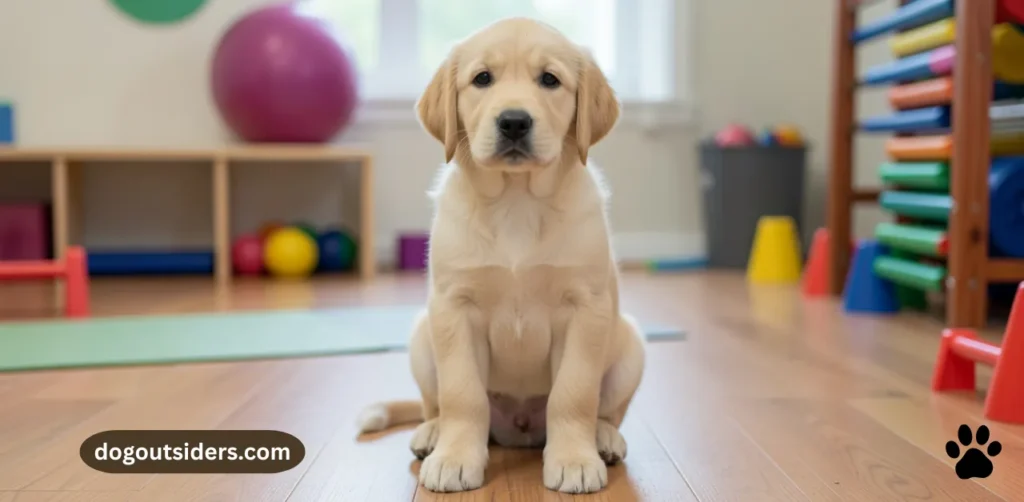
Real-world example: A common thread among golden retriever trainers is that puppies trained with positive-only methods learn commands 40–60% faster than those trained with mixed methods. The golden’s eagerness to earn rewards creates a feedback loop that accelerates learning dramatically.
Tip 4 — Make Crate Training a Positive Experience
Crate training isn’t punishment. Done correctly, it becomes your golden retriever puppy’s safe haven — and your most powerful house training tool.
Why Crate Training Works So Well for Goldens
Golden retrievers are den-oriented dogs. A properly sized crate provides a sense of security and satisfies their natural instinct to rest in an enclosed space. Additionally, puppies instinctively avoid soiling their sleeping area, which makes the crate a cornerstone of house training.

How to Introduce the Crate
- Choose the right size — large enough to stand, turn around, and lie down, but not so large the puppy can use one end as a bathroom. Use a divider panel and expand as the puppy grows.
- Make it inviting — add a soft bed, a safe chew toy, and a worn t-shirt that smells like you
- Feed meals inside the crate — this builds a positive association fast
- Start with the door open — let the puppy explore voluntarily
- Close the door briefly — 1 minute at first, then 5, then 15, building up gradually
- Never use the crate as punishment — if the crate becomes a timeout zone, your puppy will resist entering it
Age-Based Crate Duration Guide
| Puppy Age | Max Time in Crate (Daytime) |
|---|---|
| 8–10 weeks | 30–60 minutes |
| 10–14 weeks | 1–2 hours |
| 14–20 weeks | 2–3 hours |
| 20–30 weeks | 3–4 hours |
| 6+ months | 4–5 hours (maximum) |
If you’re considering whether your golden should live primarily indoors or outdoors, crate training is especially important for indoor living. For tips on setting up the ideal kennel space, that guide covers physical setup in detail.
Tip 5 — Follow a Consistent House Training Schedule
House training is a patience game. However, golden retriever puppies are surprisingly fast learners when you provide consistent structure.
The House Training Formula
The key principle is simple: take your puppy outside before they have a chance to have an accident inside.
Take your puppy out:
- Immediately after waking (morning and naps)
- Within 5–10 minutes of eating or drinking
- After play sessions
- Every 1–2 hours during awake periods (for young puppies)
- Right before bedtime
When Accidents Happen
They will happen. How you respond matters enormously:
- If you catch them mid-accident: Calmly interrupt (“oops!”), scoop them up, and take them outside. Praise heavily when they finish outdoors.
- If you find an accident after the fact: Clean it up silently with an enzymatic cleaner. Do NOT punish. Your puppy cannot connect a past accident with current punishment — they’ll only learn to fear you, not to hold their bladder.
According to PetMD’s house training guide, most golden retriever puppies can be reliably house trained by 4–6 months with consistent scheduling, though occasional accidents may continue until 12 months.
Tip 6 — Teach Bite Inhibition and Leash Manners Early
Golden retriever puppies bite. A lot. Those needle-sharp puppy teeth make contact with your hands, ankles, clothing, and furniture dozens of times per day.
This is normal. In fact, it’s essential — because the puppy stage is when you teach them how to control that mouth.
Bite Inhibition: The Step-by-Step Approach
Bite inhibition doesn’t mean teaching your puppy to never use their mouth. It means teaching them how hard is too hard.
- When the puppy bites too hard, say “ouch!” in a normal voice — not a yell, just a clear verbal marker
- Immediately withdraw your hand and turn away for 3–5 seconds
- Resume play — repeat the process every time pressure is too hard
- If the puppy escalates, stand up and leave the room for 15–30 seconds — this is the strongest message
- Always redirect to an appropriate chew toy — keep one within arm’s reach at all times
The message becomes clear over time: gentle mouth = play continues; hard mouth = play stops.
Leash Training Basics for Golden Puppies
Golden retriever puppies grow fast — from 10 pounds to 65+ pounds in under a year. Teaching loose-leash walking NOW prevents a future of being dragged down the street by a powerful adult.
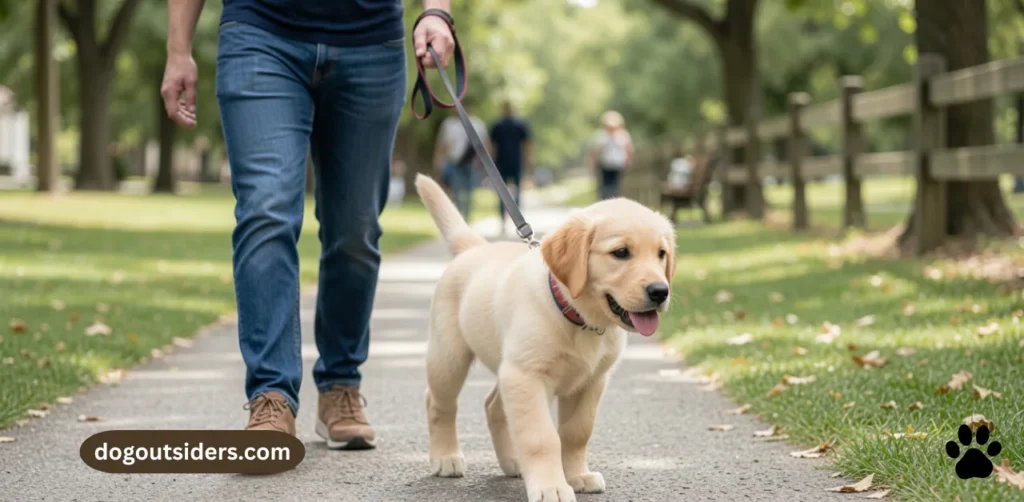
- Start indoors — clip the leash on and let the puppy drag it around (supervised) to get used to the sensation
- Reward walking beside you — every few steps, treat your puppy for staying at your side
- Stop when they pull — the instant the leash goes taut, become a tree. Don’t move until slack returns.
- Change direction — if pulling persists, turn and walk the other way. The puppy learns that pulling doesn’t get them where they want to go.
Tip 7 — Practice Patience and Celebrate Small Wins
This tip isn’t about a technique. It’s about your mindset — and it matters more than you think.
The “Puppy Blues” Are Real
Many new golden retriever owners experience a period of genuine regret, exhaustion, and frustration during the first few weeks. The constant supervision, the accidents, the biting, the sleep disruption — it’s a lot. And the gap between the “perfect golden retriever” you imagined and the chaotic puppy in front of you can feel enormous.
This feeling is normal. It’s so common that the dog training community has a name for it: puppy blues.
Here’s what you need to hear: it gets better. Golden retrievers mature slowly — most don’t reach full behavioral maturity until age 2 to 3 (Source: AKC). The puppy phase feels eternal when you’re in it, but it’s actually a tiny fraction of the 10–12 year journey ahead.
What “Celebrating Small Wins” Looks Like
- Your puppy sat for 2 seconds? That’s a win.
- Your puppy walked three steps without pulling? That’s a win.
- Your puppy slept through the night once? That’s a massive win.
- Your puppy looked at you when you said their name? Celebrate it.
Training a golden retriever puppy is not about perfection. It’s about progress. Every small step forward compounds into the well-trained, joyful companion you imagined when you first decided to bring this dog home.
Golden Retriever Puppy Training Tips: Milestones by Age
| Age | Training Focus | Daily Session Length | Key Milestones |
|---|---|---|---|
| 8–10 weeks | Name recognition, sit, socialization, crate introduction | 3–5 min × 3–4 sessions | Responds to name; sits on cue |
| 10–14 weeks | Come, stay, house training consistency, bite inhibition | 5–7 min × 3 sessions | Recalls across room; reduced biting pressure |
| 14–20 weeks | Down, leave it, leash walking intro, impulse control | 7–10 min × 2–3 sessions | Walks on leash without constant pulling; waits for food bowl |
| 20–30 weeks | Heel, extended stay, recall outdoors, public socialization | 10–15 min × 2 sessions | Reliable indoor commands; improving outdoor focus |
| 6–12 months | Distraction proofing, advanced recall, greeting manners | 15–20 min × 2 sessions | Commands reliable in new environments; reduced jumping |
Screenshot this table and keep it on your phone. Many golden retriever puppy owners reference it weekly as their puppy grows.
5 Training Mistakes New Golden Retriever Owners Make
Even dedicated owners fall into these traps. Catching them early saves months of frustration.
1. Training sessions that are too long.
A 20-minute training session with a 10-week-old puppy doesn’t build skills — it builds frustration. Keep sessions under 5 minutes for young puppies. Short and positive always wins.
2. Accidentally rewarding bad behavior.
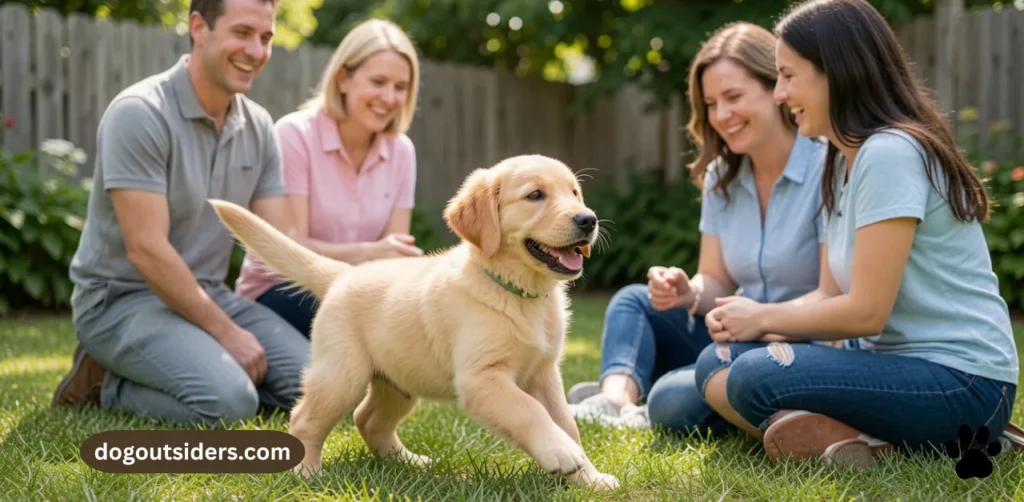
When your puppy jumps on you and you push them down while saying “no!” — you’ve just given them attention, touch, and eye contact. That’s three rewards. Instead, turn your back completely and only give attention when all four paws are on the floor.
3. Inconsistent rules across family members.
If one person lets the puppy on the couch and another doesn’t, the puppy doesn’t learn “sometimes” — they learn “try harder.” Every family member must follow the same rules, use the same commands, and apply the same boundaries.
4. Punishing accidents after the fact.
Rubbing a puppy’s nose in a urine spot teaches them absolutely nothing except to fear you. Puppies cannot connect past events with current punishment. Clean it up silently and supervise more closely next time.
5. Skipping socialization because of vaccination fears.
Many new owners keep their puppy isolated until fully vaccinated at 16 weeks — which means the socialization window closes before it’s used. The AVMA and most veterinary behaviorists agree that controlled socialization should begin before the vaccination series is complete, because the behavioral risks of inadequate socialization outweigh the disease risks in controlled settings.
Your Golden Retriever Puppy Is Worth Every Moment
Right now, your puppy is chaos wrapped in golden fur. Right now, you might be questioning everything.
But here’s what’s actually happening: you’re building a bond that will last a decade or more. Every frustrating repetition of “sit,” every redirected bite, every middle-of-the-night potty trip — it’s all building the foundation for the loyal, gentle, joyful companion golden retrievers are famous for becoming.
These 7 tips give you the structure. Your consistency provides the follow-through. And your golden retriever’s incredible temperament handles the rest.
If this guide helped bring some calm to the puppy chaos, save it to your Pinterest board so you can reference it every week as your puppy grows. And for a broader look at raising your golden retriever well, explore our comprehensive golden retriever care guide — it covers living environment, health, and lifestyle beyond training.
You chose one of the best breeds in the world. Now you have the training blueprint to match.

Jahanzaib
This article was written by Jahanzaib, a Certified Professional Dog Trainer (CPDT-KA) with specialized experience in retriever breeds and early puppy development. Jahanzaib holds certification through the Certification Council for Professional Dog Trainers and has guided over 400 golden retriever families through the puppy training process. They contribute expert training and behavior guides to dogoutsiders.com.
This article was reviewed for accuracy by Dr. Phillip John, DVM, DACVB (Diplomate, American College of Veterinary Behaviorists), specializing in early canine development and positive reinforcement training protocols.
Frequently Asked Questions About Golden Retriever Puppy Training
Name recognition and the “sit” command are the ideal starting points. Name recognition builds attention and communication. Sit teaches impulse control and becomes the foundation for every future command. Start the day your golden retriever puppy comes home using treats and a calm, happy voice during 3-minute training sessions.
Yes — golden retrievers are among the easiest breeds to train because of their exceptional food motivation and eagerness to please. However, “easy to train” doesn’t mean “trains itself.” They still require consistent positive reinforcement, short structured sessions, and patient repetition. Start golden retriever puppy training early and stay consistent for the best results.
Never use physical punishment or harsh verbal correction. Golden retrievers are sensitive dogs that shut down under intimidation. Instead, redirect unwanted behavior to appropriate alternatives, withdraw attention when mouthing or jumping, and reward the behavior you want to see. Positive reinforcement is the only discipline method that builds lasting obedience with this breed.
Begin training immediately — as early as 8 weeks old. Golden retriever puppies can learn name recognition, sit, and basic socialization from the moment they arrive home. The critical socialization window begins closing around 14–16 weeks, making early training essential. Keep initial sessions to 3–5 minutes and focus on building positive associations with learning.
Use the bite inhibition method: when your puppy bites too hard, say “ouch” calmly, withdraw your hand, and pause play for 5 seconds. If biting continues, leave the room briefly. Always redirect to an appropriate chew toy. This teaches that gentle mouth keeps play going, while hard biting ends it. Most golden retriever puppies show improvement within 2–4 weeks.
Basic obedience takes approximately 4–6 months of consistent daily training. However, golden retrievers don’t reach full behavioral maturity until age 2–3, meaning ongoing reinforcement continues throughout the first two years. With daily positive training sessions, most golden retriever puppies have reliable indoor commands by 6 months and solid outdoor obedience by 12 months.
Total daily training time should be 15–30 minutes, split across multiple short sessions. For puppies 8–12 weeks old, keep each session to 3–5 minutes. Gradually increase to 10–15 minute sessions by 6 months. Golden retriever puppies learn best through brief, focused, reward-heavy repetitions rather than long marathon sessions that exhaust their attention span.