Let’s just say it.
Your Chihuahua runs your house.
She barks at the mailman like she’s a Rottweiler. She growls when anyone gets too close to her spot on your couch. She has personally vetoed at least two of your friendships. And somewhere between the snapping at strangers and the death-stare she gives your partner every night at bedtime, you’ve started wondering:
Is this just… how Chihuahuas are? Or am I doing something wrong?
Take a breath. I’ve got answers — and they’re probably not what you’ve heard before.
As a small-breed behavior specialist with over 11 years of experience working specifically with toy breeds — Chihuahuas being the breed I see more than any other — I can tell you two things with absolute certainty:
First: Your Chihuahua’s “big attitude” isn’t a character flaw. It’s a predictable behavioral pattern with identifiable causes and very real solutions.
Second: Most of the advice you’ve gotten about Chihuahuas — from well-meaning friends, internet forums, and even some trainers — is not just unhelpful. It’s making the attitude worse.
This guide delivers the chihuahua care tips that actually work for small dogs with big attitudes. Not generic small dog advice. Not “just love them more” platitudes. Real, breed-specific, evidence-based strategies covering behavior, training, health, grooming, nutrition, and daily care — all designed for the unique reality of living with a 5-pound dog who genuinely believes she’s a wolf.
You love this tiny, sassy, fiercely loyal little dog. Let’s make sure you’re caring for her in a way that brings out the best in both of you.
Why Chihuahuas Have Such Big Attitudes (It’s Not What You Think)
Before we dive into care tips, let’s address the elephant — or rather, the 4-pound Chihuahua — in the room.
Why do Chihuahuas have such outsized attitudes compared to their body size?
The answer isn’t “they’re just mean dogs.” And it’s not genetics alone.
The Real Reason Behind Chihuahua “Aggression”
Most chihuahua aggression isn’t actually aggression at all. It’s fear.
According to a landmark 2008 study published in Applied Animal Behaviour Science, Chihuahuas ranked among the breeds with the highest rates of owner-directed aggression and stranger-directed aggression. But the researchers noted a critical distinction: this wasn’t predatory or dominance-based aggression. It was fear-based reactivity — a defensive response from a very small animal in a very large world.
Think about it from your Chi’s perspective. She weighs 4–6 pounds. Every human, every dog, every piece of furniture towers over her. A toddler running toward her is a charging giant. A stranger reaching down to pet her is a massive hand descending from the sky.
Her barking, lunging, and snapping? That’s not attitude. That’s a survival strategy.
Understanding this reframes everything about how we care for and train Chihuahuas.
Small Dog Syndrome — Myth vs. Reality
You’ve probably heard the term “small dog syndrome” — the idea that small dogs develop behavioral problems because owners spoil them, carry them, and fail to set boundaries.
Here’s what the science actually says: small dog syndrome, as a clinical diagnosis, doesn’t exist. It’s not a term used by veterinary behaviorists. The American College of Veterinary Behaviorists (DACVB) does not recognize it as a behavioral condition.
What does exist is a pattern of under-socialization, permissive management, and inadvertent reinforcement of fearful behaviors — patterns that are more common in small-breed ownership because owners are less likely to enroll small dogs in training classes, less likely to enforce boundaries, and more likely to carry or shelter the dog from normal experiences.
The chihuahua temperament is naturally alert, loyal, and confident within their bonded circle. The “big attitude” emerges when that confidence hasn’t been developed through proper socialization, training, and care.
Good news? It’s entirely fixable. Let’s get into the care tips that make the difference.
Behavior & Training Tips — Managing the Big Attitude
These first five care tips address the behavioral side of Chihuahua ownership — the part most care guides skip entirely.
Tip #1 — Stop Carrying Your Chihuahua Everywhere
I know. This one stings.
Your Chi is tiny and adorable and fits perfectly in the crook of your arm. But here’s what happens when you carry your Chihuahua through every new situation: you remove her ability to learn that the world is safe.
A Chihuahua who is always carried never learns to walk confidently on her own four feet. She never practices navigating new environments. She never builds the behavioral resilience that comes from encountering something unfamiliar and discovering it didn’t hurt her.
The result? A dog who screams, barks, and lunges when she is placed on the ground — because the ground has become unfamiliar and terrifying.
What to do instead:
- Walk your Chihuahua on a harness (never a collar — their tracheas are fragile) in calm, controlled environments
- Carry her only when there’s a genuine safety concern (crowds, large unfamiliar dogs, extreme temperatures)
- When she encounters something new, let her observe from a comfortable distance — don’t pick her up at the first sign of hesitation
- Reward brave behavior with treats and calm praise
Real example: A client of mine, Monica, had a 3-year-old long-coat Chihuahua named Pepita who had never walked on a sidewalk. Monica carried her everywhere — into stores, through the park, at the vet. When Pepita was placed on the ground outdoors, she’d freeze, tremble, and then erupt into frantic barking. We started with indoor walking on different surfaces (tile, carpet, wood), then moved to her own driveway, then the sidewalk in front of her house, then around the block. Within 6 weeks, Pepita was walking confidently to the end of the street — still nervous, but walking. Monica cried the first time Pepita sniffed a fire hydrant on her own. “I didn’t realize I was the one holding her back,” she told me.
Tip #2 — Use Positive Reinforcement (Yes, It Works for Stubborn Chis)
“But my Chihuahua is too stubborn for training.”
I hear this from Chihuahua owners constantly — and it’s simply not true. Chihuahuas aren’t stubborn. They’re discriminating. They need a reason to comply, and fear-based methods (yelling, spraying, physical corrections) don’t give them a reason. They give them trauma.
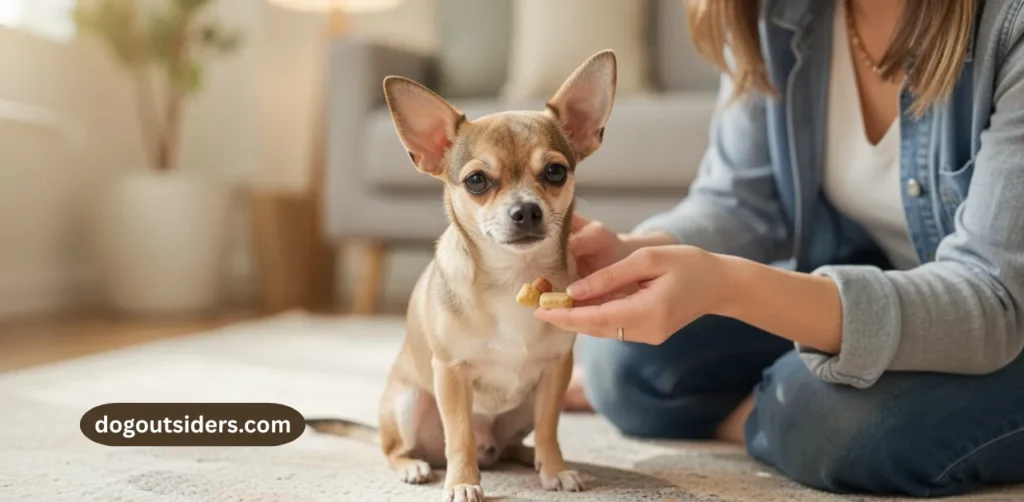
Positive reinforcement small dogs training works the same way it works for large dogs — you reward the behavior you want, and you ignore or redirect the behavior you don’t. The only difference is your tools need to be size-appropriate:
- Treats: Tiny, soft, high-value. Break standard training treats into pea-sized pieces. Chihuahuas have fast metabolisms — even small treats are impactful.
- Sessions: 2–3 minutes maximum. Chihuahuas have shorter attention spans than large breeds, but they learn quickly in focused micro-sessions.
- Timing: Mark correct behavior instantly with “yes!” or a clicker. Chihuahuas are emotionally sensitive — the precision of your reward timing matters even more than with larger breeds.
Start with “sit,” “look at me” (eye contact on cue), and “touch” (nose to your palm). These three foundation behaviors build focus, confidence, and a reward history that makes all future training easier.
Related reading: How to Stop Small Dog Aggression: A Positive Reinforcement Guide
Tip #3 — Socialize Early, Socialize Often
Chihuahua socialization training is the single most important investment you’ll make in your dog’s behavioral future — and it’s the one most Chihuahua owners skip.
According to the American Veterinary Society of Animal Behavior (AVSAB), the critical socialization window for puppies closes between 12–16 weeks of age. After this window, new experiences become progressively harder for dogs to process without fear.
But here’s the problem specific to Chihuahuas: because they’re small, owners tend to shelter them from exactly the experiences they need. No puppy kindergarten (“she’s too small, the big dogs will hurt her”). No walks in public (“she gets too stressed”). No exposure to new people (“she barks too much, it’s embarrassing”).
Every avoided experience is a missed opportunity. And every missed opportunity makes the next new experience scarier.
Socialization goals for Chihuahuas:
- Different people: men, women, children, people in hats/sunglasses/uniforms
- Different environments: pet stores (in a carrier initially), outdoor cafés, friends’ homes
- Different sounds: traffic, music, household appliances, dogs barking at a distance
- Different surfaces: grass, gravel, wood decks, tile, metal grates
- Different dogs: controlled introductions with calm, small-to-medium dogs only. No dog parks for Chihuahuas — the injury risk is too high.
For adult Chihuahuas who missed early socialization: It’s harder but not impossible. Counter-conditioning (pairing the scary thing with high-value treats at a comfortable distance) works at any age. It just takes longer — weeks to months instead of days.
Related reading: How to Socialize a Chihuahua That Barks at Everything (Step-by-Step)
Tip #4 — Address Barking with Redirection, Not Yelling
Chihuahuas bark. A lot. It’s one of the top reasons people search for small dog barking solutions — and one of the most mishandled behaviors in the breed.
Here’s what most owners do: the Chihuahua barks, the owner yells “STOP!” or “QUIET!” — and to the Chihuahua, the owner is now barking along with her. The behavior intensifies.
What actually works:
- Identify the trigger. Is she barking at strangers? Other dogs? Sounds? Boredom? Each trigger requires a different response.
- Interrupt, don’t punish. Use a calm, upbeat interruptor (“oops!” or a kissy noise) to break the barking cycle, then redirect to an alternative behavior (sit, touch, go to bed).
- Reward silence. The moment she stops barking — even for 1 second — say “yes!” and treat. You’re teaching her that quiet earns rewards.
- Manage the environment. Close blinds if she’s barking at passersby. Move her away from the door before guests arrive. Prevention is always easier than correction.
- Never yell, shake a can of pennies, or use a spray bottle. These aversive methods increase small dog anxiety and worsen reactivity in fearful breeds like Chihuahuas.
Tip #5 — Handle Resource Guarding Before It Escalates
Small dog resource guarding — growling, snapping, or stiffening over food, toys, beds, or even people — is alarmingly common in Chihuahuas and alarmingly under-addressed.
Why? Because it’s small. A growling Great Dane gets professional intervention. A growling Chihuahua gets laughed at. “Oh, she’s so feisty!”
Resource guarding is not cute. It’s a fear-based behavior that escalates when ignored.
How to address it:
- Don’t take things away to “teach her.” This confirms her fear that good things get stolen, making guarding worse.
- Trade up. Approach with something better than what she’s guarding. Drop a high-value treat nearby. She learns that humans approaching = good things added, not removed.
- Practice “drop it” with low-value items first. Build a reward history before working with high-value objects.
- If guarding is directed toward people (e.g., she guards you from your partner), this is a more complex issue. Consult a certified professional who specializes in small dog behavior management — not a general trainer.
Pro tip: Never punish resource guarding. Punishment suppresses the warning signals (growling) without addressing the underlying anxiety. A dog who guards silently is far more dangerous than a dog who growls first.
Health Care Tips Every Chihuahua Owner Needs
Your Chihuahua’s attitude is only half the picture. The other half? Breed-specific health needs that, if ignored, can cause pain — and pain makes every behavioral issue exponentially worse.
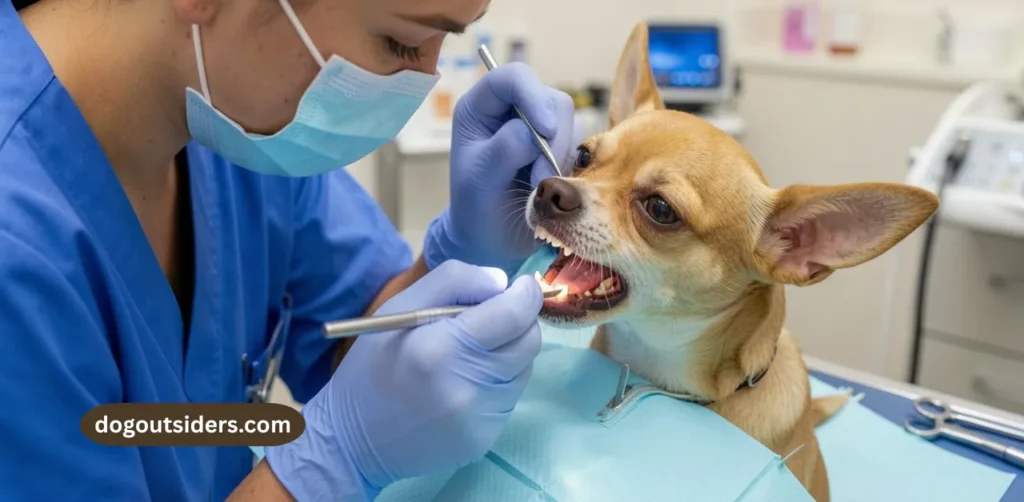
Tip #6 — Prioritize Dental Care (It’s a Breed Emergency)
This is the care tip I wish I could tattoo on every Chihuahua owner’s forehead.
Chihuahua dental care is not optional. It’s arguably the single most important health investment you’ll make.
According to the American Veterinary Dental College, toy breeds like Chihuahuas are predisposed to periodontal disease at dramatically higher rates than larger breeds. Their tiny jaws create overcrowding, which traps bacteria, which leads to tartar buildup, gum disease, tooth root abscesses, and — in severe cases — jaw fractures and organ damage from bacteria entering the bloodstream.
By age 2, the majority of Chihuahuas already show signs of dental disease.
Your at-home chihuahua dental care routine:
- Brush teeth daily (or at minimum 3x/week) using a finger brush and dog-specific enzymatic toothpaste
- Offer dental chews sized for toy breeds (CET Veggiedent XS or Whimzees XS)
- Schedule professional veterinary dental cleanings annually — ideally starting at age 1–2
- Watch for signs: bad breath, dropping food, pawing at mouth, reluctance to eat hard food, bleeding gums
Real example: My client Danielle’s Chihuahua, Churro, developed such severe dental disease by age 4 that he needed 11 teeth extracted. The vet bill was over $2,200. After surgery, Danielle noticed something remarkable: Churro’s snapping and growling, which she’d attributed to “attitude,” decreased by about 80%. He’d been in chronic dental pain for years — and his “aggression” was actually pain-based reactivity. “I thought he was just a grumpy Chihuahua,” Danielle told me. “He was in pain the entire time.”
This is why health and behavior are inseparable in Chihuahua care.
Related reading: Chihuahua Health Problems: 7 Issues Every Owner Must Watch For
Tip #7 — Know the Health Problems Chihuahuas Are Prone To
Beyond dental disease, Chihuahuas are predisposed to several breed-specific health conditions:
- Patellar luxation (kneecap dislocation) — affects up to 30% of small breeds, according to the Orthopedic Foundation for Animals. Watch for skipping gait, holding a hind leg up intermittently, or sudden lameness.
- Tracheal collapse — the cartilage rings in the windpipe weaken, causing a honking cough. This is why you should always use a harness, never a collar, on a Chihuahua.
- Hypoglycemia (low blood sugar) — especially dangerous in puppies and dogs under 3 pounds. Symptoms: lethargy, trembling, disorientation, seizures. Keep Nutri-Cal paste on hand for emergencies.
- Heart murmurs and mitral valve disease — common in aging Chihuahuas. Annual cardiac screenings with your vet are essential.
- Hydrocephalus (fluid on the brain) — more common in apple-head Chihuahuas. Signs include a domed skull, seizures, and behavioral changes.
The takeaway: Annual veterinary checkups are non-negotiable for this breed. Many of these conditions are manageable when caught early — but catastrophic when missed.
Tip #8 — Feed a Toy-Breed-Specific Diet
Chihuahuas have unique toy breed nutrition needs that differ significantly from larger breeds:
- High metabolic rate. Chihuahuas burn calories fast. They need calorie-dense, small-kibble food designed for toy breeds — not the same formula you’d feed a Lab.
- Frequent meals. Feed 3–4 small meals per day (not 1–2 large meals) to prevent hypoglycemia, especially for Chis under 5 pounds.
- AAFCO-approved toy/small breed formula. Look for brands with named animal protein as the first ingredient and a kibble size designed for tiny mouths. Royal Canin Chihuahua, Wellness Small Breed, and Hill’s Science Diet Small Paws are commonly recommended by veterinary nutritionists.
- Watch the weight. Chihuahuas gain weight quickly, and even half a pound of excess weight is significant on a 5-pound frame. Obesity in Chihuahuas worsens patellar luxation, breathing difficulties, and joint stress.
Pro tip: No table scraps. A single chicken nugget can represent 20–25% of a Chihuahua’s daily caloric needs. What seems like a “tiny bite” to you is a full meal to your Chi.
Related reading: The Best Food for Chihuahuas: Small Breed Nutrition Guide (2025)
Grooming & Daily Care Tips for Chihuahuas
Tip #9 — Establish a Simple Grooming Routine
Chihuahua grooming basics are thankfully simpler than many breeds — but they’re not zero-maintenance.
Smooth coat Chihuahuas:
- Brush weekly with a soft bristle brush or rubber grooming mitt
- Bathe every 3–4 weeks (or as needed) with a gentle, dog-specific shampoo
- Wipe facial wrinkles and eye discharge daily with a damp cloth
Long coat Chihuahuas:
- Brush 2–3 times per week with a slicker brush or pin brush to prevent matting
- Pay extra attention to behind the ears, under the legs, and the feathering on the tail
- Bathe every 2–3 weeks
All Chihuahuas:
- Trim nails every 2–3 weeks (their nails grow fast and most don’t naturally wear them down)
- Clean ears weekly — check for redness, odor, or discharge
- Brush teeth daily (see Tip #6 — this one is non-negotiable)
Key insight: Start grooming handling from puppyhood. Touch paws, ears, mouth, and tail daily, paired with treats. A Chihuahua who isn’t accustomed to handling will turn nail trims into a contact sport. Start early, go slow, reward everything.
Related reading: Chihuahua Grooming Guide: Coat Care, Dental, Nails & More
Tip #10 — Protect Your Chihuahua from Cold Weather
Chihuahuas originated in the warm climate of Mexico. They have virtually no body fat reserves and minimal insulating undercoat. They get cold — fast.
Chihuahua cold weather care is essential if you live anywhere with temperatures below 50°F:

- Sweaters and jackets aren’t fashion — they’re functional. Use a well-fitted dog coat for walks when temperatures drop below 50°F.
- Limit outdoor time in cold weather to 10–15 minutes maximum.
- Provide warm bedding — a self-heating pet pad or a covered dog bed preserves body heat.
- Watch for shivering. If your Chihuahua is shivering, she’s already too cold. Bring her inside immediately.
- Paw protection. Ice, salt, and de-icing chemicals can irritate tiny paw pads. Use paw balm or dog booties in winter.
According to the American Veterinary Medical Association, toy breeds are among the most vulnerable dogs in cold weather due to their size, low body fat, and high surface-area-to-volume ratio. Cold stress can cause hypothermia in Chihuahuas far faster than in larger breeds.
Bonding & Lifestyle Tips — Living with a Big-Attitude Chi
Tip #11 — Create a Safe Space (They Need Their Own Territory)
Chihuahuas are territorial by nature. Rather than fighting this instinct, work with it.
Give your Chihuahua a designated space that’s entirely hers — a covered dog bed in a quiet corner, a crate with the door left open, or a specific spot on the couch with a blanket.
When she retreats to her safe space, leave her alone. No petting, no picking up, no “just saying hi.” This teaches her that she has a reliable escape route from overstimulation — which dramatically reduces defensive aggression.
This is especially critical for apartment dog care. In small living spaces, Chihuahuas can feel overwhelmed by constant proximity. A defined territory gives them psychological breathing room.
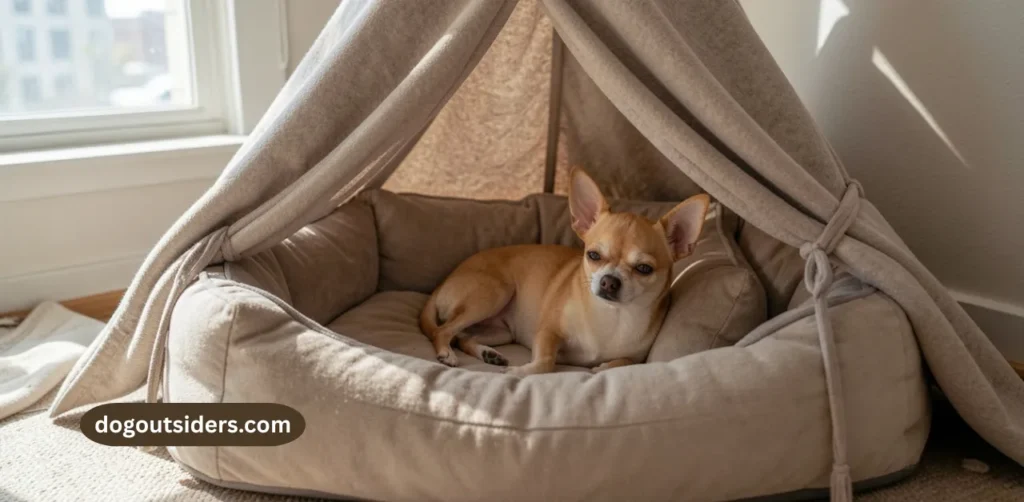
Real example: My client James lived in a studio apartment with a Chihuahua named Lola who would bark aggressively at his girlfriend every time she walked past the couch. We discovered that Lola had no defined space of her own — the couch was her only territory, and she was guarding it desperately. James set up a covered den bed in a quiet corner with a self-heating pad and a favorite toy. Within two weeks, Lola started choosing the den bed over the couch — and the defensive barking at the girlfriend dropped by about 90%. She just needed a space that was unambiguously hers.
Related reading: 8 Things You Should Never Do With a Chihuahua
Tip #12 — Exercise Their Brain, Not Just Their Body
Chihuahuas don’t need marathon walks, but they absolutely need chihuahua exercise — and the most impactful kind is mental, not physical.
Physical exercise guidelines:
- Two 15–20 minute walks per day for adult Chihuahuas
- Avoid overexertion — Chihuahuas overheat easily and tire faster than they let on
- Indoor play counts: fetch down a hallway, tug-of-war (use toy-breed-sized toys), hide and seek
Mental exercise (the attitude secret weapon):
- Puzzle feeders and snuffle mats at mealtime
- “Find it” games — hide treats around the house and let her search
- Training micro-sessions (2–3 minutes, 3–4 times per day)
- Rotating toy selection — put toys away and reintroduce them weekly to maintain novelty
Why mental exercise matters for attitude: A bored Chihuahua is a barky, destructive, demanding Chihuahua. Mental stimulation exhausts the brain, reduces anxiety, and gives your Chi a productive outlet for her natural alertness and intelligence. A tired Chihuahua is a calmer Chihuahua — and tired doesn’t just mean physically tired.
5 Chihuahua Care Mistakes That Make the Attitude WORSE
After 11 years of working with Chihuahuas, these are the mistakes I see repeatedly — often from the most loving, well-intentioned owners:
- Picking her up when she barks or lunges. You think you’re rescuing her. She learns that barking/lunging makes the scary thing go away (because you remove her from the situation). The behavior intensifies. Instead: stand still, let her observe, reward calm behavior.
- Letting her “rule the roost” because she’s small. No boundaries = more anxiety, not less. Structure, predictability, and consistent rules actually make Chihuahuas feel safer. A dog who knows the rules is a dog who can relax.
- Skipping training because “she’s too small.” Small dogs need training just as much as large dogs. The behaviors are the same — they’re just easier to ignore at 5 pounds. Until they’re not.
- Ignoring dental care. (See Tip #6. I can’t stress this enough.) Chronic dental pain causes chronic behavioral problems. A snappy Chihuahua is often a Chihuahua in pain.
- Avoiding socialization because “she doesn’t like other dogs/people.” She doesn’t like them because she hasn’t been properly socialized. Avoidance reinforces fear. Controlled, positive exposure reduces it. Start slow, stay consistent.
Complete Chihuahua Care Quick-Reference Chart
| Care Area | Key Action | Frequency |
|---|---|---|
| Behavior | Positive reinforcement training sessions | Daily (2–3 min, 3–4x) |
| Socialization | Controlled exposure to new experiences | 3–5 times per week |
| Dental | Tooth brushing | Daily (min. 3x/week) |
| Vet visits | Comprehensive wellness exam | Annually (min.) |
| Grooming | Brushing + nail trim + ear check | Weekly |
| Bathing | Gentle dog shampoo | Every 2–4 weeks |
| Feeding | Toy-breed-specific formula | 3–4 small meals/day |
| Exercise | Short walks + mental stimulation | 2 walks + brain games daily |
| Cold protection | Sweater/coat for temps below 50°F | As needed seasonally |
| Safe space | Dedicated den/bed available | Always accessible |
Final Thoughts — Small Dog, Big Heart, Bigger Love 💛
Your Chihuahua isn’t a problem to solve. She’s a tiny, complex, fiercely devoted companion who needs breed-specific care that most generic advice completely ignores.
The “big attitude” that drives you crazy? It’s actually a sign of intelligence, alertness, and bond-strength. Your Chi isn’t mean. She’s not broken. She’s navigating a very large world in a very small body — and she needs your help to do it confidently.
These 12 care tips — from behavior and training to health, grooming, and bonding — are the same strategies I use with every Chihuahua client. They work. Not overnight. But consistently, reliably, transformatively.
Start with one tip today. Just one. The one that resonates most with where you are right now.
If this guide helped you understand your Chihuahua better, please save it on Pinterest so other Chi parents can find it too. And if you’re in the middle of managing a tiny dog with a massive personality, drop a comment on dogoutsiders.com — I’d love to hear your story. 🐾

Jahanzaib:
Jahanzaib is a dedicated dog care researcher and content creator specializing in dog training, behavior correction, and pet wellness. As the founder of DogOutsiders.com, he focuses on creating evidence-based, experience-driven content that helps dog owners solve real problems—from training stubborn dogs to avoiding critical health and behavior mistakes. His mission is to make expert-level dog care knowledge simple and accessible for every pet owner.
Frequently Asked Questions
Understand that a Chihuahua’s “attitude” usually comes from fear, not dominance. Use positive reinforcement, consistent routines, and gentle socialization to build confidence. Avoid over-carrying, manage barking calmly, provide a safe space, and keep training short with rewards. Prioritize dental care and set loving, predictable boundaries.
Chihuahuas aren’t naturally aggressive—they’re more prone to fear-based reactivity. Studies show their behavior often stems from poor socialization, reinforced fear (like being picked up when barking), and hidden pain, especially dental issues. Because their size makes it seem harmless, the behavior is often ignored and worsens. With proper socialization, positive training, pain care, and consistent boundaries, most aggression improves.
“Discipline” in dog training—especially for Chihuahuas—is really about redirection and reinforcement, not punishment. Calmly interrupt unwanted behavior, redirect to a desired action, and reward it. Avoid yelling or harsh methods, as they increase fear and aggression. Experts like the American Veterinary Society of Animal Behavior recommend positive reinforcement as the most effective approach.
Socialize your Chihuahua through gradual, positive exposure to new people, places, sounds, and surfaces—starting early and continuing for life. During early weeks, introduce safe experiences and environments; for adults, use treats to build positive associations at a comfortable distance. Never force interactions, and avoid dog parks—choose calm, controlled play with gentle dogs instead.
Bathe your Chihuahua every 2–4 weeks based on coat type—smooth coats every 3–4 weeks, long coats every 2–3 weeks. Use a gentle dog shampoo to avoid dry skin. Clean face, paws, and eyes between baths, and always dry thoroughly after washing to prevent chilling.
Chihuahuas are prone to specific health issues, especially dental disease, which affects most by age 2. Other common problems include patellar luxation, tracheal collapse (use a harness, not a collar), hypoglycemia in small or young dogs, heart disease in older Chis, and hydrocephalus in some cases. Regular vet checkups, daily dental care, and early symptom awareness are key to keeping them healthy.