If you’re asking this question, you’re probably hurting right now.
Maybe your dog just passed. Maybe you watched it happen and you’re sitting in the quiet that followed, wondering where they went. Maybe you’re not there yet — but you can feel the day approaching, and the thought alone is unbearable.
The question of where dogs go when they die is one of the most deeply human questions we ask. And the honest answer is: no one knows for certain.
But across every culture, every religion, and every corner of human history, people have found ways to believe that the love between a dog and a person doesn’t simply stop. According to the American Veterinary Medical Association, pet loss grief is a legitimate and significant form of bereavement — as real and as valid as any other loss. (Source: AVMA.org)
This guide explores five ideas that have brought comfort to millions of grieving dog owners — and answers the questions you’re afraid to Google alone.
Where Do Dogs Go When They Die?
No one knows for certain where dogs go when they die. Most people find comfort in one of five ideas: the Rainbow Bridge, heaven as described in the Bible, reincarnation, a peaceful energy return to the universe, or simply the enduring love they left behind. Each belief is valid, and many owners hold more than one.

Idea #1: The Rainbow Bridge
Perhaps the most widely shared comfort in the dog-owning world is the Rainbow Bridge.
The concept comes from an anonymous prose poem — widely circulated since the 1980s and 1990s — that describes a beautiful meadow just beyond the edge of heaven, where pets who have died wait for their owners. They are healed, pain-free, and young again. When the person they loved finally crosses over, they are reunited and enter heaven together.

The Rainbow Bridge is not rooted in formal theology. It is a collective human wish — a story told not because anyone proved it, but because millions of people needed it to be true.
Why the Rainbow Bridge resonates so deeply:
- It answers the “will I see them again?” question with a clear yes
- It gives grieving owners a specific mental image to return to
- It frames the dog’s afterlife as active, happy, and full of play — not passive or unknown
- It holds the reunion as guaranteed — and that guarantee is the comfort
Many pet loss counselors and veterinary grief specialists recommend the Rainbow Bridge concept not as theology, but as emotional scaffolding — a story to lean on while the rawness of loss softens.
Idea #2: Heaven — The Christian and Catholic View
For millions of Christians and Catholics around the world, the question of where dogs go when they die is answered through faith in a loving God who created all living things.
The Bible does not explicitly state that animals go to heaven. However, several passages suggest that God’s redemption extends beyond humans. Ecclesiastes 3:19–21 acknowledges that animals and humans share the same breath of life. Romans 8:21 speaks of all creation being freed from decay. Isaiah 11:6–9 famously describes the peaceable kingdom — where animals and humans live in harmony — as part of God’s coming restoration.
Many theologians, including C.S. Lewis, argued that the love between a human and their animal companion may be sufficient for that animal’s continued existence beyond death.
The Catholic Church’s official position is nuanced. Animals do not have immortal souls in the same theological sense as humans — but Pope Paul VI is reported to have told a grieving child, “One day we will see our animals again in the eternity of Christ.” Many contemporary Catholic priests offer similar pastoral comfort.
What the Bible suggests about animals and the afterlife:
| Scripture Reference | What It Says | Implication for Dogs |
|---|---|---|
| Ecclesiastes 3:19–21 | Animals and humans share the breath of life | Their life has equal sacred origin |
| Romans 8:21 | All creation will be freed from decay | Animals included in redemption |
| Isaiah 11:6–9 | Peaceful kingdom includes animals | Animals present in God’s restored creation |
| Revelation 19:11–14 | Christ returns on a white horse | Animals appear in heaven’s imagery |
For Christian dog owners, the theological case for animals in heaven is not closed — and many find deep comfort in that openness.
Idea #3: Reincarnation — A New Life Begins
In Hindu, Buddhist, and many broader spiritual traditions, death is not an ending — it is a transition. The soul continues, taking on a new form in accordance with its spiritual journey.
For dog owners drawn to these beliefs, their dog did not disappear. They completed this chapter of their existence and moved forward — perhaps into a new puppy being born somewhere, perhaps into a different kind of life entirely.
The concept of reincarnation offers a specific kind of comfort: the idea that your dog’s love and energy is still present in the world, just wearing a different form. Some grieving owners find themselves drawn powerfully to a new dog who seems inexplicably familiar — a feeling that many who hold reincarnation beliefs find significant.
If you’re curious about whether a dog’s spirit can literally enter another dog you bring home, the exploration of whether a dog’s spirit can go into another dog is worth reading — it’s one of the most fascinating questions in this space.
Idea #4: Return to Universal Energy
Not everyone approaches this question through religion. Many dog owners hold a secular spiritual view: that when any living creature dies, the energy that animated them — the warmth, the love, the presence — doesn’t vanish. It returns to the larger fabric of the universe.
This perspective draws on physics as much as spirituality. Energy is never destroyed — it changes form. The love that existed between you and your dog is real, measurable in its effects on your brain chemistry, your daily life, your sense of self. That love doesn’t stop existing simply because the body that generated it is gone.
For owners who find religious frameworks difficult to embrace but still feel that something continues — this idea offers a scientifically compatible form of comfort that doesn’t require belief in supernatural realms.
Idea #5: They Live On in the Love They Left Behind
The fifth idea is perhaps the simplest — and for many people, the most lasting.
Your dog changed you. They changed how you walk, how you spend your mornings, how you feel when you come home. They shaped relationships, created routines, left marks on furniture and floors and your heart that will never fully disappear.
Some pet loss grief counselors describe this as the dog’s continued presence through impact — the way a beloved person lives on through everyone they touched. Your dog lives in the way you stop to pet a stranger’s dog on the sidewalk. In the way you can’t quite bring yourself to move their water bowl. In the way someone who loves you asks about them by name, weeks after they’re gone.
This isn’t consolation — it is reality. And many grieving owners find it becomes the most solid ground they have.
What Different Belief Systems Say — Comparison Table
| Belief System | Where Dogs Go | Reunion Possible? | Key Idea |
|---|---|---|---|
| Christianity (general) | Heaven / God’s presence | Debated — hopeful | C.S. Lewis: beloved animals may persist |
| Catholicism | Uncertain — pastoral hope | Pastorally affirmed | Pope Paul VI: “We will see them again” |
| Islam | Return to God / rewarded | Not emphasized | All creatures are God’s — treated with mercy |
| Hinduism/Buddhism | Reincarnation | In new form | Soul continues evolving through lives |
| Secular Spiritual | Energy returns to universe | Through love and memory | Energy is never destroyed |
| Rainbow Bridge | Meadow before heaven | Yes — guaranteed | Waits for owner; enters heaven together |
Do Dogs Say Goodbye Before They Die?
Many dogs do show behavioral changes in their final hours or days that owners interpret as saying goodbye. They may seek more physical closeness, become unusually still, or rest their head on their owner’s lap for extended periods. Veterinary hospice specialists note that dogs often appear to wait for their owner to be present before passing.
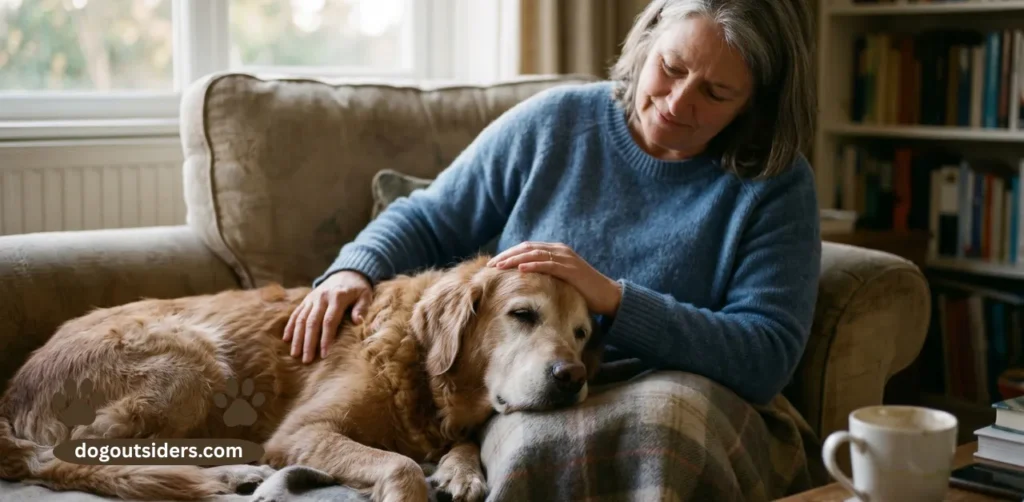
This behavioral shift is well-documented by veterinary end-of-life care specialists. Dogs in their final hours often:
- Seek more physical contact than usual — leaning in, resting closer
- Become unusually quiet and still — a marked contrast to their normal energy
- Stop eating or drinking, even for beloved treats
- Move to a familiar, comforting spot — a bed, a corner, a sunny patch of floor
- Make prolonged eye contact — something many owners describe as the most heartbreaking moment
Many owners report that their dog seemed to wait — holding on until a specific family member arrived home, or until the owner finally said the words “it’s okay to go.” Whether this is intuition, love, or something else entirely, it is experienced by enough pet owners to be recognized in veterinary hospice literature.
What Happens 2 Minutes Before a Dog Dies?
In the final two minutes before a dog dies, breathing typically slows dramatically or becomes irregular — often called Cheyne-Stokes breathing. The muscles relax completely, the eyes may remain partially open, and the heartbeat fades. Many owners who are present describe the moment as deeply peaceful. Veterinarians note that dogs rarely appear to be in pain in these final moments.
If you are with your dog in their final moments:
- Speak calmly and softly — your voice is familiar and comforting
- Keep physical contact if they seem to welcome it
- The room does not need to be silent — familiar sounds and your presence matter most
- You do not need to say anything perfect — just be there
Being present with your dog as they pass is a profound act of love. Many owners who choose to stay describe it as one of the most important moments they shared — even through the pain.
What Happens to a Dog After Death?
After a dog dies, the body undergoes the same physical processes as any living creature — muscles relax, breathing stops, and the body gradually cools. At a veterinary clinic, you will typically be offered the choice of private cremation, communal cremation, or taking the body home for burial. The dog’s spirit, according to most belief systems, transitions immediately.
At the veterinary clinic, if your dog passed during a procedure or was euthanized, the clinical staff will handle the body with care and dignity. You will typically be given private time with your dog before any arrangements are made.
Common aftercare options:
- Private cremation — your dog is cremated alone; you receive their ashes
- Communal cremation — cremated with other pets; ashes are not returned individually
- Home burial — legal in most areas; check local regulations
- Pet cemetery — professional burial with memorial options
- Aquamation (water cremation) — a gentler, increasingly available option
If you’re navigating the practical side of what comes next, understanding what dog cremation actually costs and involves can help you make a decision without financial shock during an already painful time.
Where Does a Dog’s Soul Go After Death?
Where a dog’s soul goes after death depends on your beliefs. Many spiritual traditions hold that animals have souls that return to a loving, peaceful realm. The Bible does not explicitly address animal souls, but passages like Romans 8:21 suggest all creation is redeemed. Most grieving owners find that whatever the answer, the love their dog gave does not disappear.
What all belief systems share — from Christianity to Buddhism to secular grief counseling — is this: the bond between a human and their dog is recognized as real, significant, and meaningful. Whether that bond continues in a supernatural realm or lives on through memory and impact, it is not dismissed.
The AVMA acknowledges that the human-animal bond is one of the most powerful documented in behavioral science — and the grief that follows its severance is proportionate to that power. (Source: AVMA.org)
Will I See My Dog in Heaven?
Many Christian theologians believe that if heaven exists as a place of perfect joy, animals — including dogs — may be part of it. C.S. Lewis argued that beloved animals may participate in resurrection through their bond with humans. No religion definitively answers this, but the hope of reunion brings real comfort to countless grieving owners.
The desire to see your dog again is not sentimental weakness. It is one of the most human things you can feel — and across thousands of years of human history, it has been expressed in scripture, poetry, art, and prayer by people who loved their animals as deeply as you loved yours.
Can Dogs Hear You After They Pass?
There is no scientific proof that dogs can hear you after they pass. However, many owners report a strong sense of their dog’s presence in the days and weeks following their death — hearing familiar sounds, feeling warmth, or sensing them nearby. These experiences are widely reported and may reflect the depth of the bond shared.
What we do know from neuroscience is that grief involves the brain’s deeply wired relational systems — the same circuits that registered your dog’s presence for years continue to anticipate them. Hearing their collar, seeing their bowl, smelling their bed — all of these trigger responses that can feel like presence.
Whether that is only neurology or something more is a question no scientist can fully answer. Many people find comfort in speaking to their dog after they’ve passed — telling them they were loved, that they were good, that they are missed. Whether or not the dog hears it, the person saying it often needs to.
What NOT to Do When Grieving Your Dog
Grief after losing a dog is real. But there are patterns of thinking and behavior that make it harder than it needs to be.
Avoid these grief mistakes:
- Don’t rush yourself — “You can always get another dog” is well-intentioned but harmful when said too early. Grief has no timeline.
- Don’t minimize your own loss — Saying “it was just a dog” is a betrayal of the relationship you had. It wasn’t “just” anything.
- Don’t isolate — Dog loss grief is sometimes trivialized by people who haven’t experienced it. Find communities who understand — the pet loss Reddit communities, grief hotlines, and online groups exist specifically for this.
- Don’t make major decisions immediately — Decisions about getting a new dog, moving, or changing routines are best made after the acute grief phase has softened.
- Don’t force closure — There is no correct way to grieve a dog. Some people feel better in weeks; others carry the loss for months. Both are normal.
The AVMA’s pet loss support resources confirm that grief following the death of a companion animal can be as intense as grief following human loss — and that professional bereavement support is appropriate and available. (Source: AVMA.org)
Comfort Checklist for Grieving Dog Owners
This is not a to-do list. It is a permission slip.
In the first days:
- Allow yourself to cry — as much as you need to, as often as it comes
- Tell someone who will understand — grief shared is grief lightened
- Keep the routines that feel comforting — walks at the usual time, sitting in the usual spot
- Don’t rush to move or remove their things — do this when it feels right, not when it’s “supposed” to happen
- Eat something. Drink water. Sleep when you can.
In the first weeks:
- Allow yourself to feel whatever you feel — guilt, relief, anger, numbness are all normal parts of grief
- Find the idea that brings you the most comfort — Rainbow Bridge, heaven, energy, love — and let yourself believe it
- Talk to your dog — out loud, in writing, or in your mind. Many grief counselors recommend this.
- Reach out to a pet loss support resource if you’re struggling (ASPCA Pet Loss Support Hotline: 877-474-3310)
- Give yourself permission to smile at a memory without feeling guilty for feeling okay
When you’re ready:
- Create a small memorial — a photo, a paw print, a candle
- Write about your dog — what they taught you, how they made you laugh, what you’ll never forget
- Consider whether you’re ready for a new dog — and know that getting a new dog is not a betrayal
You Loved Them Well — and That Is Enough
Wherever your dog went, they went knowing they were loved.
They spent their life fed, sheltered, played with, and chosen — every single day. And the questions you’re asking right now — wondering where they are, whether they can still sense you, whether you’ll meet again — those questions are the questions of someone who loved completely.
The five ideas in this guide don’t compete with each other. They represent thousands of years of humans trying to make sense of a love that doesn’t seem like it should just end. You’re allowed to hold all five at once if that’s what helps.
If you’re navigating the practical side alongside the grief, our guide to what dog cremation actually costs and involves walks you through every option without pressure. And if the idea of your dog’s spirit continuing in some form brings you comfort, the exploration of whether a dog’s spirit can enter another dog may be the next read you need.
Save this article. Share it with someone you know who is hurting. And if it helped — even a little — that’s exactly what it was written to do. 🐾
Frequently Asked Questions: Where Do Dogs Go When They Die
Where a dog’s soul goes after death depends entirely on your beliefs. Christianity and Catholicism suggest possible reunion in heaven; Buddhism and Hinduism describe reincarnation; secular views describe energy returning to the universe. No belief system has definitive proof, but all major traditions recognize the depth of the human-dog bond. Let the belief that brings you comfort guide you.
Many dogs show clear behavioral changes in their final hours that owners interpret as saying goodbye — seeking closer contact, becoming unusually still, making prolonged eye contact, or waiting until a loved one arrives. Veterinary hospice specialists document this pattern regularly. If your dog seemed to linger until you were present, that experience is widely reported and recognized by end-of-life care professionals.
Many theologians — including C.S. Lewis — argue that if heaven is a place of perfect joy, beloved animals may be part of it. No religion offers a definitive answer, but the hope of reunion is pastorally affirmed by many Christian and Catholic clergy. The desire to see your dog again is one of the most human feelings imaginable — and across history, it has never been dismissed as foolish.
Physically, breathing stops, muscles relax, and the body gradually cools. At a vet clinic, you’ll be offered cremation, communal cremation, or home burial options. Most belief systems hold that the dog’s spirit transitions immediately at death. You are not required to make any decisions quickly — most veterinary clinics allow time for you to be with your dog before arrangements are made.
There is no scientific proof that dogs can hear after death. However, speaking to your dog after they’ve passed is a recognized and recommended grief practice — it helps many owners process loss. Many people report sensing their dog’s presence in the weeks following death. Whether this is neurology, memory, or something more is a question science cannot fully answer. If it brings comfort, it is valid.
Breathing slows dramatically or becomes irregular. Muscles relax completely. The eyes may remain partially open. The heartbeat gradually fades. Most veterinarians describe the final moments as peaceful — dogs rarely appear to be in distress. Many owners who were present say it was quiet and gentle. Your presence, your voice, and your touch are the greatest comfort you can offer in those final minutes.
The Rainbow Bridge is a concept from an anonymous poem describing a beautiful meadow just beyond heaven where dogs wait, healed and young, for their owners. When the owner passes, they are reunited and cross into heaven together. While not rooted in formal theology, the Rainbow Bridge brings genuine comfort to millions of grieving dog owners worldwide and is widely used in pet loss grief support.