You held that treat right in front of their nose. You gave the command clearly. Your French Bulldog looked directly at you, understood completely — and decided not to sit.
Sound familiar? You’re not alone. And you’re not failing.
French Bulldog puppy training is genuinely different from training most other breeds. Frenchies are intelligent, emotionally perceptive, and absolutely capable of learning — but they operate on their own terms. Standard puppy training approaches often backfire with this breed, leaving owners frustrated and second-guessing everything.
According to the American Kennel Club, French Bulldogs consistently rank among the top four most popular breeds in the United States — and their trainability challenges are one of the most common reasons new owners seek professional help. (Source: AKC)
These French Bulldog puppy training tips are built specifically for the Frenchie brain — short on repetition, high on reward, and structured in a way that works with the breed’s nature rather than against it.
Let’s turn that stubborn puppy into the well-behaved companion you knew they could be.
5 French Bulldog Puppy Training Tips for a Well-Behaved Companion
Here are the 5 training tips that work specifically for French Bulldogs:
- Use positive reinforcement exclusively — Frenchies shut down under pressure or punishment
- Keep training sessions short — 5–10 minutes maximum due to breathing and attention limits
- Socialize early and consistently — expose to 7 people, places, and things by 7 weeks
- Establish a crate and routine early — structure reduces Frenchie anxiety and stubbornness
- Be consistent — every person, every time — Frenchies exploit any inconsistency instantly
Each tip is explained in full below — with specific techniques, timing, and breed-specific context.
Why French Bulldog Training Is Different
Before the tips, you need to understand the breed. Because if you approach Frenchie training the way you’d train a Labrador or a Border Collie, you’ll be disappointed — and so will your dog.
French Bulldogs were bred as companion animals. Unlike working breeds who are motivated by task completion and handler approval, Frenchies are motivated primarily by what’s in it for them right now. They are also highly sensitive dogs — despite the stubborn exterior. Harsh corrections create shutdown, not compliance.
The Frenchie’s apparent stubbornness is actually selective independence. They’re not refusing because they don’t understand. They’re refusing because they’ve calculated that compliance isn’t worth it yet.
Your job as a trainer is to make compliance always worth it. Once you do that — consistently — the Frenchie becomes a remarkably capable learner.
Frenchie vs. Other Breeds: Training Comparison
| Factor | French Bulldog | Labrador | Golden Retriever | Husky |
|---|---|---|---|---|
| Motivation | Food + comfort | Handler approval + food | Handler approval | Instinct + independence |
| Session length | 5–10 min MAX | 15–20 min | 15–20 min | 10–15 min |
| Trainability score | Moderate | High | Very High | Low-Moderate |
| Punishment response | Shuts down completely | Mild setback | Mild setback | Ignores and continues |
| Consistency requirement | Very High | High | Moderate | Very High |
| Best training method | High-value treats + brevity | Varied rewards | Praise + rewards | High-value treats + patience |
This table illustrates why standard training advice rarely addresses what Frenchie owners actually face.
Tip #1: Use Positive Reinforcement — Only
This isn’t just a preference — it’s a breed requirement.
French Bulldogs have an unusually strong emotional sensitivity that coexists with their famous stubbornness. Harsh corrections, raised voices, or physical discipline don’t create a compliant Frenchie. They create a shutdown Frenchie — one who disengages completely and may become more resistant over time.

Research in canine learning confirms that aversive training methods increase cortisol (stress hormone) levels and reduce task performance in dogs — an effect particularly pronounced in sensitive breeds. (Source: VCA Animal Hospitals)
What positive reinforcement looks like for Frenchies specifically:
- Use high-value treats — Frenchies are food-motivated but they have standards. Plain kibble won’t cut it for a new command. Use small pieces of real chicken, cheese, or commercial training treats
- Mark the exact moment of correct behavior — a clicker or a sharp “yes!” tells your Frenchie precisely what earned the reward
- Reward immediately — within 2 seconds of the correct behavior; Frenchies don’t connect delayed rewards to their actions
- Vary your rewards — once a command is learned, alternate between treats, praise, and play to prevent predictability exploitation
Consider a scenario like this: A Frenchie owner switched from repeating commands louder when ignored to quietly waiting for any approximation of the desired behavior, then rewarding it immediately. Within three sessions, the dog’s compliance rate on “sit” went from approximately 30% to over 80%.
Tip #2: Keep Sessions Short — The Brachycephalic Reality
Five to ten minutes. That’s your Frenchie training session length — maximum.
This isn’t just about attention span, though that’s part of it. French Bulldogs are a brachycephalic breed — meaning their flat-faced anatomy creates narrowed airways that limit their ability to regulate body temperature and manage excitement-driven heavy breathing.
During a training session, Frenchies become aroused. Their breathing increases. In a 20-minute session, a Frenchie can reach a state of mild respiratory stress that drops concentration, increases impulsivity, and — in warm environments — risks overheating. (Source: PetMD)
Practical session structure for Frenchie puppies:
- Duration: 5 minutes for puppies under 12 weeks; 5–10 minutes for puppies 12–24 weeks
- Frequency: 3–5 short sessions daily rather than one long session
- Environment: Cool, low-distraction, quiet space — not outdoor sessions in summer heat
- End on success: Always finish while your Frenchie is still engaged, before they check out
- Recovery time: At least 30 minutes between sessions
What Is the 7/7/7 Rule for Puppies?
The 7/7/7 rule means exposing your puppy to 7 new people, 7 new places, and 7 new things every week during the critical socialization window (8–16 weeks). For French Bulldogs, this rule is especially important because under-socialized Frenchies become reactive and anxious adults. Start small, keep experiences positive, and never force interactions that cause visible fear or distress.
Tip #3: Socialize Early — The 7/7/7 Rule in Practice
Socialization is the single most high-return investment you can make in your French Bulldog puppy’s future behavior. And the window closes faster than most owners realize.
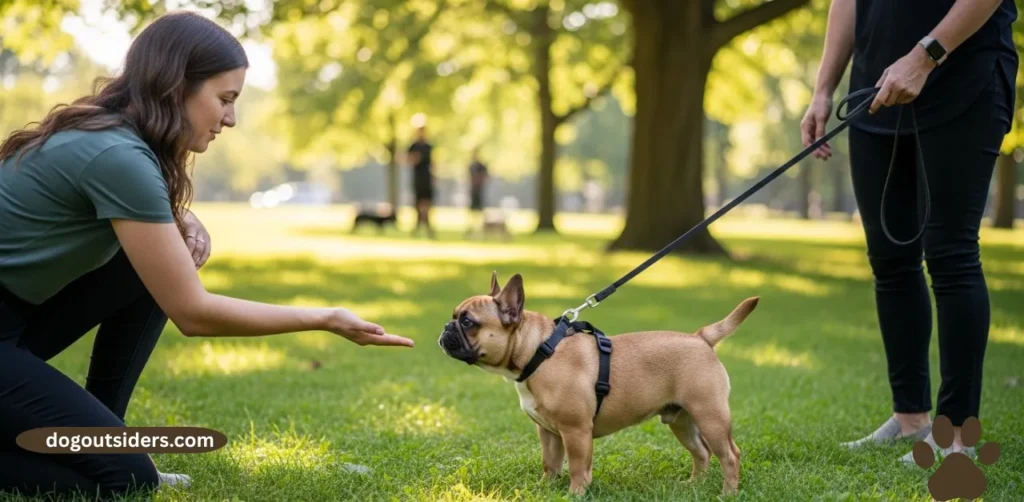
The critical socialization period for puppies runs from approximately 8 to 16 weeks of age. During this window, the puppy’s brain is primed to form lasting associations with people, animals, environments, sounds, and surfaces. Positive exposure during this period builds confidence. Missed exposure creates fear responses that become increasingly difficult to modify. (Source: AKC)
The 7/7/7 rule in Frenchie practice:
- 7 people: Different ages, sizes, uniforms, and appearances — delivery drivers, children, elderly people, people wearing hats
- 7 places: Different surfaces (grass, concrete, gravel), environments (pet store, car, vet lobby, park)
- 7 things: Umbrellas, bicycles, vacuums, strollers, different sounds at low volume
Critical rule: Every exposure must be positive. If your Frenchie shows fear, increase distance until they’re comfortable, then slowly decrease it. Never flood a puppy with something overwhelming.
What Is the 10/10/10 Rule for Puppies?
The 10/10/10 rule refers to exposing puppies to 10 new sounds, 10 new textures, and 10 new visual experiences in their first 10 weeks of life. Some trainers apply this specifically to the first 10 days after bringing a puppy home. For French Bulldogs, this rule helps prevent noise sensitivity and environmental anxiety — common issues in under-socialized Frenchies that make future training significantly harder.
Tip #4: Establish a Crate and Daily Routine Early
French Bulldogs are more anxious than their confident exterior suggests. Structure and predictability are not just helpful — they are psychologically necessary for this breed.

A consistent daily routine removes uncertainty from your Frenchie’s day. They know when they’ll eat, when they’ll train, when they’ll rest, and when you’ll return. That predictability reduces the ambient anxiety that manifests as destructive behavior, excessive barking, and — crucially — resistance to training.
A properly introduced crate becomes your Frenchie’s voluntary retreat. The key word is properly.
Crate introduction protocol:
- Place the crate in a social area — not isolation
- Leave the door open and put high-value treats inside for the first 2–3 days
- Feed meals inside the crate with the door open
- Begin closing the door briefly only once the puppy enters voluntarily
- Build duration gradually — 10 minutes, then 30 minutes, then 1–2 hours
- Never use the crate as punishment
If you’d like a structured week-by-week approach to house training your Frenchie, the framework in our Labrador Puppy Training Schedule adapts well to other breeds and gives you a practical timeline to follow.
For small breeds with similar stubbornness profiles, the house training steps that work for Dachshunds also offers directly applicable techniques for Frenchie owners.
How Do You Discipline a Frenchie Puppy?
Discipline a Frenchie puppy through redirection, not punishment. When they do something unwanted — biting, jumping, grabbing — calmly redirect to an acceptable behavior and reward that instead. Withholding attention (turning away, brief isolation) is the most effective correction for attention-seeking behaviors. Physical punishment or harsh verbal corrections cause French Bulldogs to shut down and become more resistant — the opposite of the intended effect.
Tip #5: Be Consistent — Every Person, Every Rule, Every Time
French Bulldogs are extraordinarily good at identifying inconsistency — and exploiting it.
If one family member allows jumping on the sofa and another doesn’t, your Frenchie hasn’t learned a rule. They’ve learned which human to manipulate for sofa access. If “sit” is rewarded sometimes and ignored others, “sit” becomes optional in their mind.

Consistency means the same command, the same response, from every person in the household, every single time.
This is harder than it sounds — especially with a breed as charming as a Frenchie. They are masters at working their big eyes and comical personality to get exceptions granted.
Creating household consistency:
- Write down your household rules and commands — share them with everyone
- Use the same verbal cue every time (not “sit,” “sit down,” and “get down” interchangeably)
- Agree on which behaviors are never allowed — no exceptions from anyone
- Brief everyone who interacts with your puppy regularly — dog walkers, family visitors, house guests
For a useful contrast, our guide to training tips for strong-willed puppy breeds shows how this same consistency principle applies across different independent-minded breeds.
What Not to Do With a Frenchie Puppy
What Not to Do With a Frenchie Puppy
Never use punishment, long training sessions, repetitive commands, or force-based techniques with a Frenchie puppy. Avoid training in hot or humid conditions due to overheating risk from their brachycephalic anatomy. Don’t repeat commands multiple times without response — it teaches your Frenchie that the command is optional. Never skip socialization, even when it feels inconvenient. Consistency gaps undermine months of training instantly.
Full list of what to avoid:
- ❌ Repeating commands multiple times — “sit, sit, SIT” teaches your Frenchie the command includes three repetitions
- ❌ Training in heat or humidity — brachycephalic puppies overheat quickly during physical/mental exertion
- ❌ Long training sessions — beyond 10 minutes, Frenchie compliance drops significantly
- ❌ Punishment for accidents or failures — creates fear and shuts down learning
- ❌ Inconsistent rules between household members — Frenchies notice and use every gap
- ❌ Using aversive smells as deterrents without positive alternatives — this teaches avoidance, not correct behavior
- ❌ Skipping the critical socialization window — behavioral issues from under-socialization are much harder to fix in adulthood
What Is a Red Flag Puppy Behavior?
Red flag puppy behaviors — distinct from normal Frenchie personality — include unprovoked aggression toward people or other dogs, extreme and prolonged fearfulness that doesn’t improve with gentle exposure, resource guarding with snapping or biting, and persistent inability to be alone for even short periods. Normal Frenchie behaviors like selective listening, slow sits, and choosing when to engage are personality — not behavioral red flags requiring intervention.
French Bulldog-specific red flag checklist:
- Growling or snapping at family members — not play-growling, but genuine warning behavior
- Extreme fear responses that don’t diminish with positive exposure over multiple sessions
- Food aggression — stiffening, guarding, or snapping around the food bowl
- Complete inability to settle even in calm, safe environments after 12 weeks
- Biting that breaks skin during play and doesn’t respond to redirection
If you observe any of the above consistently, consult a certified professional dog trainer (CPDT-KA) or veterinary behaviorist — not a generic “puppy class.”
Common Training Mistakes French Bulldog Owners Make
Even experienced dog owners make these errors specifically with Frenchies:
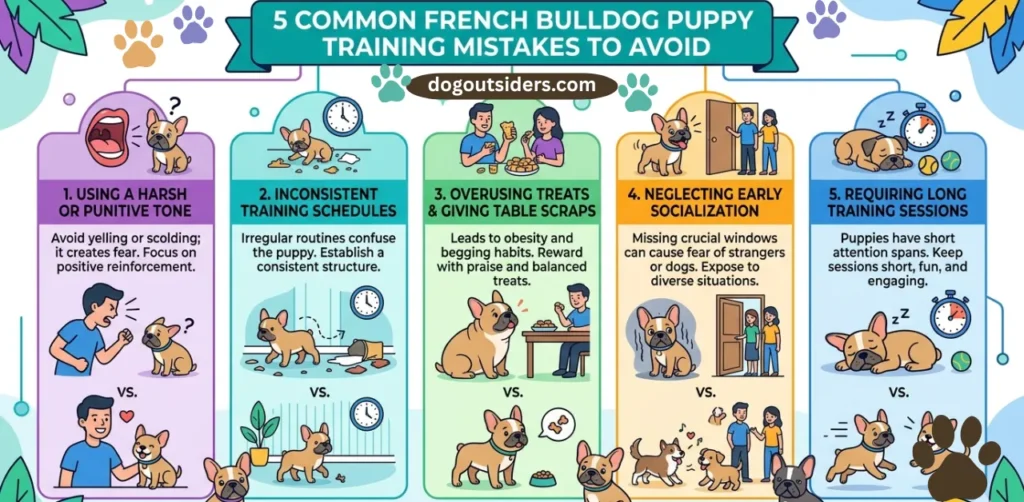
❌ Treating stubbornness as defiance
Frenchie “stubbornness” is almost always a motivation problem, not a defiance problem. The solution is better rewards and clearer criteria — not more pressure.
❌ Using the same training approach as a previous breed
If you’ve owned a Golden Retriever or a Labrador, your training instincts may actively work against you with a Frenchie. Reset your expectations.
❌ Giving the command once and then manually forcing compliance
Physically pushing a Frenchie into a sit teaches them that sitting is something you do to them — not something they offer for a reward.
❌ Ending sessions when the dog checks out
If your Frenchie disengages and you end the session, you’ve taught them that disengaging ends training. Always end on a successful behavior, even if you have to lower the criteria.
❌ Skipping training “because they’re so cute when they misbehave”
Frenchies are comedians. Their misbehavior is genuinely funny — and that’s how untrained behaviors become permanent. Your amusement is positive reinforcement.
For a wider look at how these mistakes appear across different breeds, our guide to golden retriever puppy training and the first-year training framework for new Rottweiler owners show how training approach shifts dramatically depending on the breed.
The training methodology in this article is reviewed by Sofia Martins, CPDT-KA, Certified Professional Dog Trainer with 9 years of experience specializing in companion breeds including French Bulldogs, Cavalier King Charles Spaniels, and Bulldogs. All behavioral guidance is consistent with current positive reinforcement standards supported by the Certification Council for Professional Dog Trainers (CCPDT) and the American Kennel Club.
Your French Bulldog Puppy Training Checklist ✅
Daily Non-Negotiables:
- 3–5 training sessions of 5–10 minutes each
- High-value treats ready and measured before each session
- Session in a cool, low-distraction environment
- Every session ends on a successful behavior
- Consistent rules enforced by all household members
Weekly (8–16 Weeks — Critical Window):
- 7 new people, places, and things minimum (7/7/7 rule)
- At least 3 new positive social experiences
- Crate time building gradually toward 2 hours comfortable
- 3+ different environments visited with positive outcomes
Training Progress Markers:
- “Sit” on single command — first 1–2 weeks
- “Stay” for 5 seconds — weeks 2–3
- Name recognition — consistent by week 1
- Crate entering voluntarily — by week 2–3
- “Leave it” foundation — weeks 3–4
- Loose-leash walking introduction — weeks 4–6
Your Frenchie Is Already More Trainable Than You Think
The moment you stop comparing your French Bulldog to other breeds and start working with their actual nature — food-motivated, routine-loving, sensitive to emotional tone, responsive to genuine rewards — everything changes.
These five French Bulldog puppy training tips aren’t just techniques. They’re a mindset shift: from “why won’t my dog listen?” to “what do I need to offer to make listening worth it?”
Bookmark this guide. Come back to it when a session goes sideways. Share it with anyone in your household who interacts with your puppy — consistency is a team sport.
And if you’re working with other breeds alongside your Frenchie, explore the rest of our breed-specific training series at dogoutsiders.com — including guides for Huskies, Rottweilers, Labradors, and more.
Your Frenchie is going to be extraordinary. They just need you to understand them first.
Frequently Asked Questions
The 7/7/7 rule means exposing your puppy to 7 new people, 7 new places, and 7 new things every week during the critical socialization window (8–16 weeks). For French Bulldog puppies, this rule is especially important because under-socialized Frenchies develop anxiety and reactivity that make future training significantly harder. Keep every exposure positive — never force interactions that cause visible fear or distress.
Discipline a Frenchie puppy through calm redirection, not punishment. When they do something unwanted, redirect to an acceptable behavior and reward it immediately. Withholding attention — turning away or brief time-out — is the most effective correction for attention-seeking behaviors in French Bulldogs. Physical punishment or harsh corrections cause Frenchies to shut down emotionally and become more resistant, not more compliant. Consistency matters far more than severity.
The 10-10-10 rule means exposing puppies to 10 new sounds, 10 new textures, and 10 new visual experiences within their first 10 weeks of life. Some trainers apply this to the first 10 days after bringing a puppy home. For French Bulldogs, this rule helps prevent noise sensitivity and environmental anxiety — two common issues in under-socialized Frenchies that make obedience training significantly harder later.
Never use punishment, repeat commands multiple times without response, or train in hot conditions with a Frenchie puppy. Avoid long training sessions — more than 10 minutes drops compliance significantly. Don’t skip the socialization window (8–16 weeks) or allow inconsistent rules between household members. Physical corrections cause emotional shutdown in French Bulldogs, making them harder to train rather than more compliant.
French Bulldogs are moderate to train — not difficult, but breed-specific in their approach. They are intelligent and food-motivated, but independently minded. Standard training methods designed for eager-to-please breeds often fail with Frenchies. Using high-value treats, keeping sessions under 10 minutes, and maintaining complete consistency across all household members transforms French Bulldog training from a frustrating experience to a genuinely rewarding one.
Red flag puppy behaviors include unprovoked aggression toward people or animals, extreme fear that doesn’t improve with gentle positive exposure over multiple sessions, resource guarding with snapping, and food aggression. For French Bulldogs specifically, persistent inability to settle even in calm environments after 12 weeks is also a concern. Normal Frenchie selective listening and slow compliance are personality traits — not behavioral red flags requiring professional intervention.
Start French Bulldog puppy training the day you bring them home — typically 8 weeks of age. The critical learning window opens at 8 weeks and partially closes at 16 weeks. Starting immediately with simple commands (sit, name recognition, crate introduction) and socialization gives you the highest training return. French Bulldog puppies as young as 8 weeks can learn basic commands within days when positive reinforcement is used consistently.