You brought home a German Shepherd puppy, and now you’re staring at this tiny, intelligent creature thinking — “How do I not mess this up?”
That thought alone tells you something important: you’re already approaching this the right way.
German Shepherd puppies are brilliant, sensitive, and intensely loyal. But that intelligence is a double-edged sword. Train them well in those early weeks, and you’ll raise a confident, steady companion. Miss those critical windows, and anxiety or behavioral problems can take root fast.
According to the American Kennel Club, German Shepherds are among the most trainable breeds in the world — but they also have specific developmental needs that generic puppy advice simply doesn’t cover. (Source: AKC)
This guide gives you 8 proven German Shepherd puppy training tips that are breed-specific, confidence-focused, and actually actionable — starting from day one.
For even more breed-specific strategies, check out these deeper German Shepherd training strategies that experienced GSD owners swear by.
8 German Shepherd Puppy Training Tips to Raise a Confident Pup
Here are 8 essential German Shepherd puppy training tips every owner should follow:
- Start training the day you bring them home
- Use positive reinforcement every single time
- Socialize using the 7-7-7 rule before 12 weeks
- Keep training sessions under 5–10 minutes
- Crate train from night one to prevent anxiety
- Teach impulse control before advanced commands
- Build the handler bond through structured daily play
- Stay consistent — German Shepherds thrive on routine
Each tip below includes exactly how to apply it, how long it takes, and what to watch for.
Tip #1: Start Training the Day You Bring Them Home
Many owners wait until puppies are 12–16 weeks old to start training. That’s a costly mistake.
German Shepherd puppies can begin learning basic cues — sit, name recognition, eye contact — from 8 weeks old. Their brains are literally wired for learning during this period. The socialization window (3–12 weeks) is the most influential developmental phase in a dog’s entire life, according to research from the American Veterinary Medical Association. (Source: AVMA.org)
Start simple:
- Say your puppy’s name → reward eye contact immediately
- Practice “sit” for 30 seconds before every meal
- Introduce the leash in the house before going outside
You don’t need a training class on day one. You need 5 consistent minutes of calm, positive interaction.
Tip #2: Use Positive Reinforcement Every Single Time
Positive reinforcement is not a “soft” approach. It is the most scientifically supported training method for dogs, especially for a sensitive, intelligent breed like the GSD.
The principle is simple: behavior that gets rewarded gets repeated.
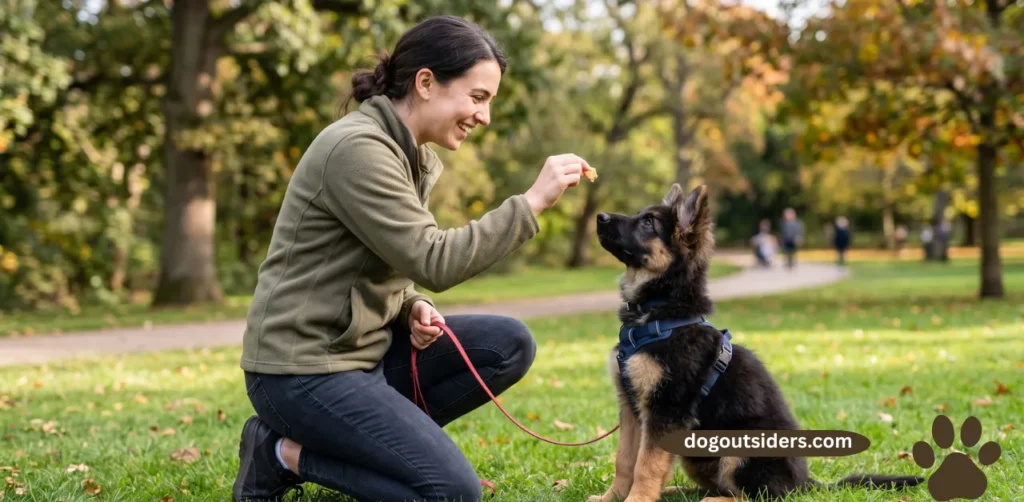
Use small, high-value treats your puppy goes wild for. Mark the correct behavior immediately — either with a clicker or a sharp verbal “yes!” — then reward within 2 seconds.
For the right tools to support this, the essential gear every GSD owner needs includes a solid starter kit for reward-based training.
Reward timing matters more than anything else:
- Correct → mark → reward within 2 seconds
- Never reward after 5 seconds — the association breaks
- Keep rewards unpredictable to maintain motivation
Tip #3: Socialize Using the 7-7-7 Rule
What is the 7-7-7 rule for puppies?
The 7-7-7 rule means exposing your puppy to 7 new people, 7 new places, and 7 new experiences every week for the first 7 weeks in your home. For German Shepherd puppies, this is essential during the socialization window (3–12 weeks) to prevent fear-based behavior and build a stable, confident temperament.
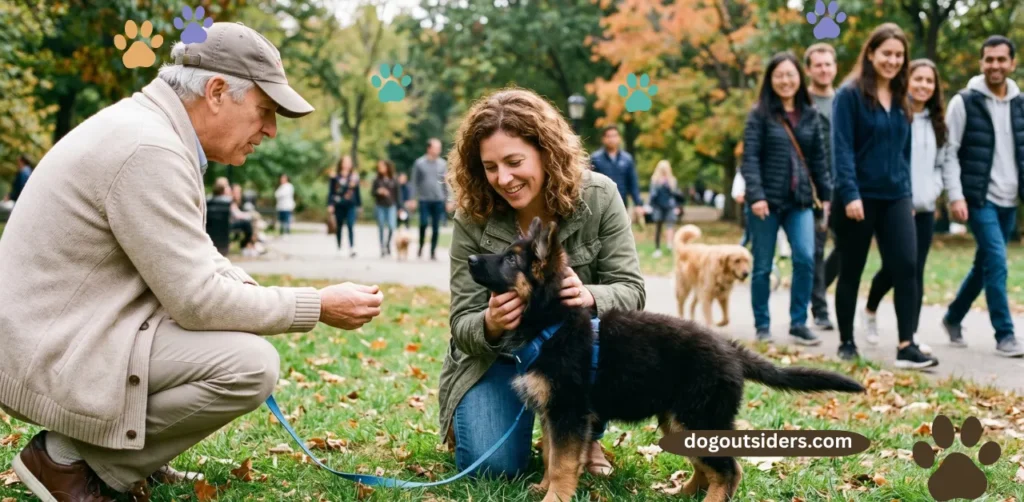
German Shepherds have two known fear imprint periods: 8–11 weeks and again around 6–8 months. Negative experiences during these windows can have lasting effects. Positive, controlled exposures during these periods build resilience instead.
What to include in your GSD puppy’s 7-7-7 plan:
- Different surfaces: grass, gravel, hardwood, tile, carpet
- Different sounds: traffic, children playing, vacuum, TV
- Different people: men with beards, hats, glasses, uniforms
- Different animals: other dogs (vaccinated), cats, birds
- Different environments: car rides, pet stores, parks
You don’t need to overwhelm your puppy. Short, positive exposures are the goal — never force interaction with something that causes fear.
Tip #4: Keep Sessions Short and Sweet
A German Shepherd puppy’s attention span at 8 weeks is about 5 minutes. By 12 weeks, it stretches to 7–10 minutes. Pushing beyond that creates frustration on both ends — and frustrated puppies stop learning.
Age-based training session guide:
| Age | Session Length | Sessions Per Day |
|---|---|---|
| 8–10 weeks | 3–5 minutes | 3–4 times |
| 10–16 weeks | 5–10 minutes | 2–3 times |
| 4–6 months | 10–15 minutes | 2 times |
| 6+ months | 15–20 minutes | 1–2 times |
Always end sessions on a success. If your puppy is struggling with a new command, go back to something they already know — reward it — then end the session. That positive end creates eagerness for the next session.
Tip #5: Crate Train From Night One
The crate is not a punishment. When introduced properly, it becomes your puppy’s safe den — a place they choose to rest and decompress.
Crate training prevents destructive behavior, speeds up house training, and dramatically reduces separation anxiety in adult GSDs.
How to introduce the crate:
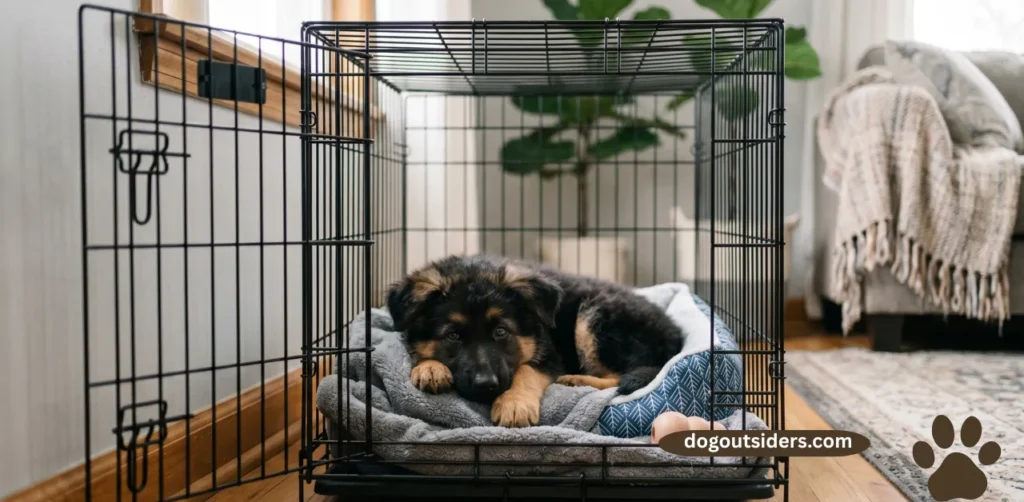
- Place the crate in a visible, social area — not isolated
- Leave the door open with a treat or toy inside
- Feed meals near, then inside, the crate
- Close the door for 30 seconds → reward → open
- Gradually increase duration over 7–10 days
Never use the crate as punishment. Never let your puppy out when they are crying — wait for a moment of quiet, then release.
Tip #6: Teach Impulse Control Early
Impulse control is the foundation of every advanced behavior your GSD will ever learn.
Without it, your puppy jumps on guests, bolts out doors, and can’t focus during training. With it, they become the steady, focused dog that makes GSD owners proud.
Start with “wait”:
- Hold a treat in a closed fist
- Wait for your puppy to stop pawing and sniffing
- The moment they pull back or make eye contact → open your hand
- Build from 2 seconds to 10 seconds over 2 weeks
Then add door impulse control:
- Open the door slightly → if puppy moves forward → close it
- Repeat until they sit or wait automatically
- Mark and reward the wait — then release with “okay”
Tip #7: Build the Bond Through Daily Play
German Shepherds are working dogs. They bond most deeply with the person who engages them mentally and physically — not just the person who feeds them.
Daily structured play (not just free-running in the yard) builds the handler bond that makes all future training easier. Tug, hide-and-seek, and controlled fetch are excellent choices for GSD puppies.
If you’ve ever wondered whether your GSD is truly connecting with you, these signs your GSD isn’t responding well to training can help you spot communication breakdowns early.
Play rules for training benefit:
- You control when play starts and ends
- Use a release word (“game over”) to end sessions
- Mix 30 seconds of play with 30 seconds of a known command
- Play before training = higher engagement and faster learning
Tip #8: Stay Consistent — German Shepherds Thrive on Routine
German Shepherds don’t handle inconsistency well. If “off the couch” means sometimes yes and sometimes no, your puppy learns that rules are negotiable — and they’ll test every boundary with gusto.
Consistency means:
- Same commands used by everyone in the household
- Same daily schedule for meals, play, training, and sleep
- Same rules applied every single time — no exceptions
Write the rules down and share them with every family member. The puppy doesn’t know who the “soft” one is — until they do. And then they’ll use that information brilliantly.
How Do You Build Confidence in a German Shepherd Puppy?
Building confidence in a German Shepherd puppy starts with controlled socialization and positive exposure. Introduce your puppy to new sights, sounds, and surfaces gradually — never force interactions. Reward calm, curious behavior with treats and praise. Short, successful training sessions also build confidence because they show your puppy it can succeed.
Confidence-building exercises for GSD puppies:
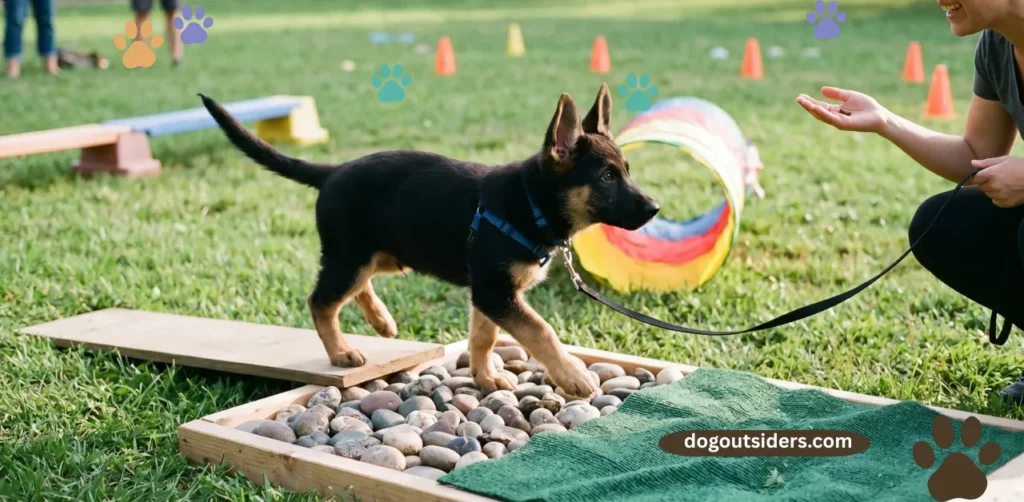
- Walk on different textures (bubble wrap, rubber mat, wobble board)
- Introduce your puppy to a mirror — reward curiosity, not barking
- Play “find it” — hide treats around the room for nose work
- Practice “look at that” — reward calm observation of novel things
- Short off-leash exploration in a safe, enclosed area
The goal is a puppy that says “I don’t know what that is — but I’m going to check it out” rather than “I don’t know what that is — I need to run or bark.”
What Should You NOT Do With a German Shepherd Puppy?
Never use physical punishment, yelling, or alpha-roll techniques on a German Shepherd puppy. These methods damage trust and can create fear-based aggression in an already sensitive breed. Avoid long training sessions over 10 minutes, skipping socialization, and ignoring early problem behaviors. Consistency and patience outperform any dominance-based approach with this breed.
Understanding the training mistakes that hold GSDs back gives you a detailed breakdown of what derails progress even in otherwise committed owners.
Positive Reinforcement vs. Punishment: What Actually Works
| Method | Short-Term Effect | Long-Term Effect | GSD Suitability |
|---|---|---|---|
| Positive reinforcement | Builds engagement | Strong, reliable behavior | ✅ Excellent |
| Marker/clicker training | Precise timing | Faster learning curve | ✅ Excellent |
| Verbal correction (calm “no”) | Interrupts behavior | Neutral if brief | ✅ Acceptable |
| Leash corrections | Suppresses behavior | Damages trust long-term | ⚠️ Use with caution |
| Physical punishment | Fear response | Anxiety, aggression | ❌ Never recommended |
| Alpha-roll / dominance | Submission | Fear-based shutdown | ❌ Debunked — avoid |
Research published by the Journal of Veterinary Behavior confirms that aversive training methods increase anxiety and aggression risk in dogs, particularly sensitive working breeds. (Source: ScienceDirect — Journal of Veterinary Behavior)
What Are Red Flag Behaviors in a German Shepherd Puppy?
Red flag behaviors in a GSD puppy include excessive cowering, unprovoked aggression, resource guarding food or toys before 10 weeks, extreme noise sensitivity, or inability to recover from mild stress. These signs suggest a socialization deficit or possible genetic temperament issue. Consult a certified professional dog trainer or behaviorist if you notice these behaviors early.
Red flags that warrant professional attention:
- Growling or snapping at family members before 10 weeks
- Complete shutdown (won’t eat, move, or engage) in new environments
- Extreme predatory fixation on small animals or children
- Inability to be touched anywhere on the body without panic
- Aggressive resource guarding that escalates despite redirection
These behaviors are not “normal puppy stuff.” Early intervention with a certified trainer changes outcomes significantly.
Where Should a German Shepherd Puppy Sleep at Night?
A German Shepherd puppy should sleep in a crate in or near your bedroom for the first few weeks. This reduces anxiety, aids crate training, and builds the handler bond without encouraging co-sleeping dependency. Once reliable in the crate, you can gradually move it further from your bed if needed.
Why the bedroom matters for training:
- Your scent nearby reduces cortisol (stress hormone) in puppies
- Overnight crying is shorter when the puppy senses your presence
- The handler bond deepens through nighttime proximity
- You can hear and respond to “I need to go outside” signals
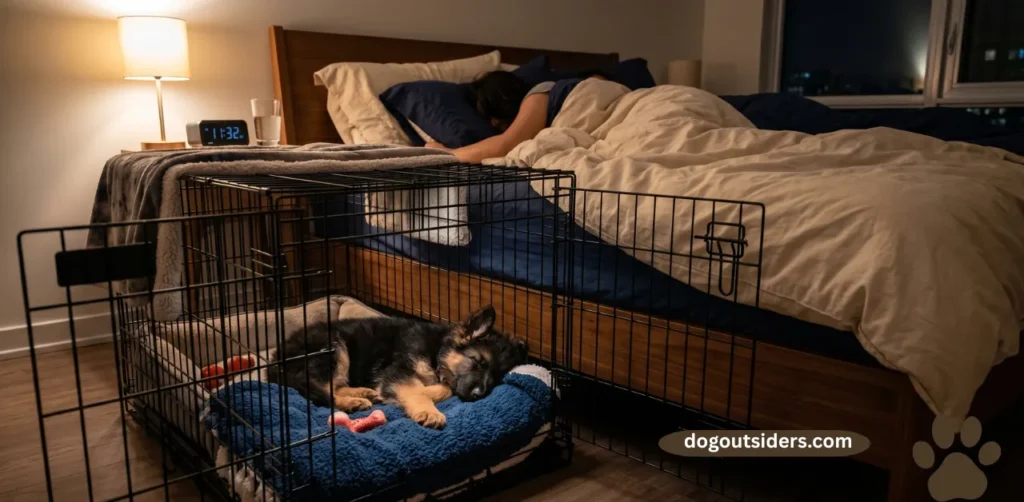
Avoid two extremes: co-sleeping in your bed (creates boundary confusion and separation anxiety) and isolated sleeping in another room (creates panic, extended crying, and a weakened bond).
How Do German Shepherds Pick Their Favorite Person?
German Shepherds bond most strongly with the person who provides consistent feeding, training, and positive interaction during the imprinting window (3–12 weeks). It is not always the main handler — it is the person who spends the most calm, structured time with the puppy. Daily training sessions accelerate and deepen this bond significantly.
This bonding mechanism is precisely why training together — not just living together — builds the deepest GSD loyalty. If your puppy seems indifferent or distant, the signs your GSD isn’t happy with you are worth reviewing before that gap widens.
Keeping your GSD healthy during this bonding phase also matters — common German Shepherd health issues and prevention tips covers what to watch for in puppyhood.
Training Checklist: Are You on Track?
Use this checklist weekly to assess your puppy’s progress:
Foundation (Weeks 1–4 at home):
- Puppy knows their name and responds consistently
- “Sit” on command without hand signal
- Crate sleeping through the night with minimal fuss
- 3–5 new socialization experiences per week logged
- No food aggression or resource guarding observed
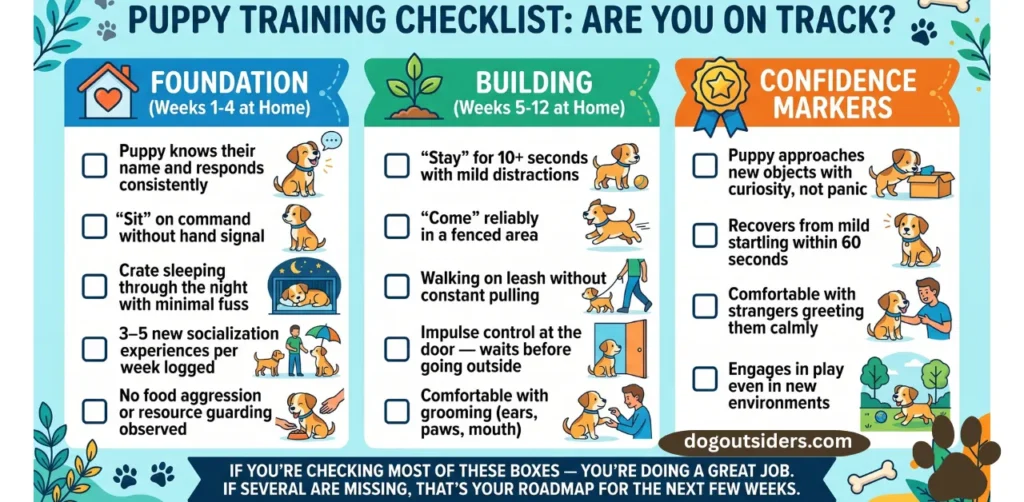
Building (Weeks 5–12 at home):
- “Stay” for 10+ seconds with mild distractions
- “Come” reliably in a fenced area
- Walking on leash without constant pulling
- Impulse control at the door — waits before going outside
- Comfortable with grooming (ears, paws, mouth)
Confidence Markers:
- Puppy approaches new objects with curiosity, not panic
- Recovers from mild startling within 60 seconds
- Comfortable with strangers greeting them calmly
- Engages in play even in new environments
If you’re checking most of these boxes — you’re doing a great job. If several are missing, that’s your roadmap for the next few weeks.
Your Confident GSD Starts Right Now
Raising a German Shepherd puppy is one of the most rewarding things a dog owner can do — and one of the most intimidating. But here’s what confident GSD owners know that anxious ones don’t: you don’t need to be perfect, you need to be consistent.
Start with the 8 tips in this guide. Pick two or three for this week. Watch your puppy respond. Adjust. Repeat.
If you found this guide useful, bookmark it and share it with a fellow GSD owner who’s just getting started. And when you’re ready to go deeper, the 7 German Shepherd training secrets on DogOutsiders are your next stop.
You’ve got this — and so does your pup. 🐾
Frequently Asked Questions About German Shepherd Puppy Training
Building confidence starts with controlled socialization and rewarding curiosity. Introduce your GSD puppy to new textures, sounds, people, and environments gradually — never force it. Reward calm, exploratory behavior immediately with high-value treats. Short, successful training sessions also build confidence by showing your puppy it can succeed at challenges.
The 7-7-7 rule means exposing your puppy to 7 new people, 7 new places, and 7 new experiences every week for the first 7 weeks in your home. For German Shepherd puppies, this is critical before 12 weeks to prevent fear-based behavior. Keep each exposure short, positive, and reward-based for the best results.
Red flags include unprovoked growling or snapping, extreme cowering in new environments, resource guarding before 10 weeks, or inability to recover from mild stress within minutes. These suggest a socialization deficit or temperament concern. Consult a certified professional dog trainer or veterinary behaviorist as early as possible for assessment and a tailored plan.
Never use physical punishment, alpha-roll techniques, or prolonged isolation. These damage trust and can trigger anxiety or aggression in a breed that is already highly sensitive to its handler’s behavior. Avoid long training sessions, skipping socialization, or inconsistent rules. German Shepherds thrive on calm, clear, consistent positive reinforcement — not fear or dominance.
Your GSD puppy should sleep in a crate placed near your bedroom. Your scent reduces stress hormones overnight, reduces crying, and accelerates crate training success. Avoid co-sleeping in your bed (creates dependency) or isolated sleeping in a separate room (creates panic). Near your bed — but in the crate — is the proven sweet spot for GSD puppies.
German Shepherds bond most with the person who engages them consistently through feeding, training, and calm structured interaction — especially during the 3–12 week imprinting window. It is not always the person who plays the most — it is the one who provides reliable, positive structure. Daily training sessions are the fastest way to become a GSD’s favorite person.
Start training the day your puppy comes home — typically at 8 weeks old. German Shepherd puppies can learn name recognition, eye contact, and basic commands like “sit” immediately. The 8–12 week window is the most influential developmental period. Waiting until 6 months wastes the most impactful learning window this breed has.