You’ve just brought home a Labrador Retriever puppy.
She’s eight weeks old, impossibly soft, and currently peeing on your rug while simultaneously chewing your shoelace and ignoring the sound of her own name.
You open Google. You type: “Labrador puppy training schedule.”
And you get hit with 47 million results — YouTube trainers contradicting each other, Reddit threads that spiral into arguments about dominance theory, and Instagram Reels showing perfectly trained 10-week-old Labs that make you feel like you’re already three weeks behind.
I know this feeling. I’ve watched hundreds of new Lab parents live it.
As a certified professional dog trainer with over 13 years of experience — and Labrador Retrievers being the breed I work with more than any other — I’ve developed a week-by-week labrador puppy training schedule that I hand to every single new client. It’s pinned to refrigerators. It’s screenshotted onto phones. One client laminated it.
Today, I’m giving it to you.
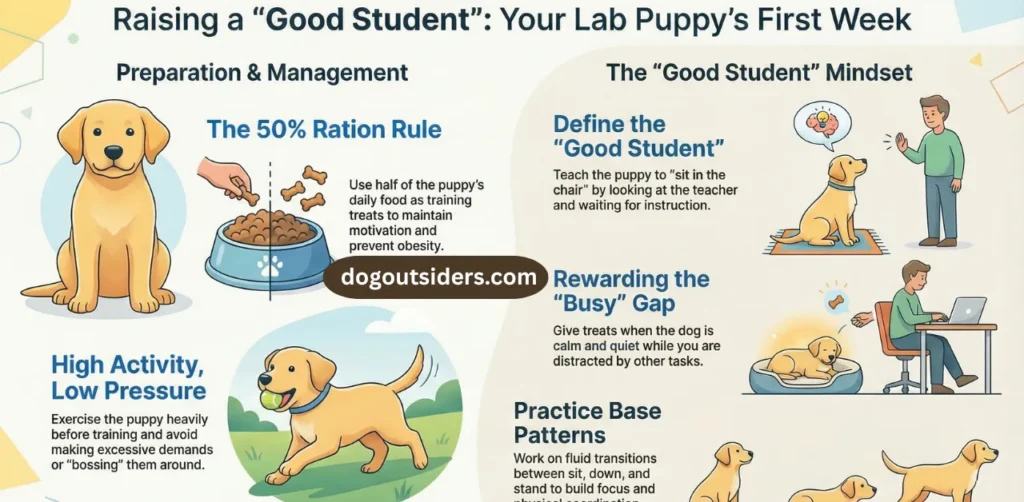
This is the complete Labrador Retriever puppy training schedule from 8 weeks to 12 months — organized by developmental phase, broken down week by week, and built specifically for the Labrador brain. Not a generic puppy plan with a Lab photo slapped on top. A breed-specific, science-backed, field-tested roadmap.
Here’s what it covers:
- Exactly what to train at each age
- Why certain skills must come before others
- How long each session should be
- What to expect (including the setbacks — because they will happen)
No guessing. No guilt. Just clarity.
Let’s build your Lab’s best first year.
How to Use This Labrador Puppy Training Schedule
Before we dive into the week-by-week breakdown, let me set you up for success with two critical frameworks.
Understanding Your Lab’s Developmental Stages
Labrador Retriever puppies move through distinct puppy developmental stages that directly determine what they’re capable of learning at each age. Training against developmental biology is like teaching calculus to a first-grader — it doesn’t work and it frustrates everyone.
According to the American Veterinary Society of Animal Behavior (AVSAB), the critical learning periods in puppy development include:
- Neonatal period (0–2 weeks): Sensory development only
- Transitional period (2–4 weeks): Eyes/ears open, early motor skills
- Socialization period (3–14 weeks): THE most critical window for behavioral development
- Juvenile period (3–6 months): Rapid learning, teething, first fear period
- Adolescence (6–18 months): Testing boundaries, hormonal shifts, regression
This schedule is designed to work with these stages — not against them.
Training Session Guidelines (Duration, Frequency, Tools)
- Duration: 3–5 minutes per session for puppies 8–12 weeks. Gradually increase to 10–15 minutes by 6 months. Never exceed 15 minutes.
- Frequency: 3–5 short sessions per day beats one long session. Scatter training throughout the day — before meals, after naps, during play.
- Tools: High-value training treats (small, soft, smelly), a 6-foot leash, a properly-sized crate, a flat collar or harness, and a marker word (“yes!”) or clicker.
- Method: Positive reinforcement only. Every technique in this schedule uses reward-based training. No corrections, no prong collars, no dominance-based methods.
Related reading: 9 Essential Commands to Teach Your Labrador Retriever First
Phase 1 — Weeks 8–10: The First Days Home (Foundation)
This is survival mode — and that’s perfectly okay.
Your only goals during weeks 8–10 are: bond with your puppy, establish a routine, begin house training, and introduce the crate. That’s it. If you accomplish nothing else, you’re right on track.
Week 8–9: Settling In, Bonding & Survival Mode
Your labrador puppy’s first week home is not about commands. It’s about trust.
This week, focus on:
- House training basics. Take your puppy outside every 30–45 minutes, after meals, after naps, and after play. Go to the same spot each time. When she goes outside, say “yes!” and reward immediately. At 8 weeks, bladder control is minimal — accidents are guaranteed, not failures.
- Crate training introduction. Feed meals inside the crate. Toss treats in. Let her explore it with the door open. Close the door for 10 seconds, reward, open. Gradually build to 5 minutes, then 10. The crate should be a den, not a cell. A proper crate training schedule at this age means never leaving a puppy crated for more than 1–2 hours during the day (overnight is different — most puppies can hold it 3–4 hours).
- Name recognition. Say your puppy’s name. The moment she looks at you, say “yes!” and treat. Repeat 20–30 times per day. Within 3–5 days, she’ll snap her head toward you at the sound of her name.
- Handling & touch conditioning. Gently handle paws, ears, mouth, tail, belly — every day. Pair each touch with a treat. This prevents future vet visit stress, grooming anxiety, and nail-trimming battles. Start now; it’s 100x harder at 6 months.
Real example: When my own Lab, Tucker, came home at 8 weeks, we did zero formal commands for the first 5 days. Just bonding, routine, and crate games. By day 6, he was voluntarily walking into his crate for naps and responding to his name across the room. That foundation made everything that followed dramatically easier.
Week 10: First Commands & Routine Building
Now that your puppy is settling in, introduce her first command: “sit.”
- Use a treat lure (hold at nose, raise above head, mark when rear touches floor)
- Practice 5 repetitions, 3 times per day
- Add the word “sit” once she’s reliably offering the behavior
Also during week 10:
- Reinforce puppy proofing. By now you’ve identified what she targets — shoes, cords, table legs. Redirect consistently to appropriate chew toys.
- Establish a puppy nap schedule. Puppies need 18–20 hours of sleep daily. Enforce naps in the crate after every 45–60 minutes of awake time. An overtired Lab puppy is a bitey, destructive Lab puppy.
Related reading: How to Potty Train a Labrador Puppy in 7 Days
Phase 2 — Weeks 10–12: Building Basic Skills
Your puppy is now getting comfortable, and her brain is a sponge. This is when basic command training accelerates — but socialization also becomes urgent.
Weeks 10–11: Core Commands + Socialization Kickoff
New commands to introduce:
- “Down” — Lure from sit position, treat to floor between paws. Mark when elbows touch. 5 reps, 3x daily.
- “Stay” (introduction only) — After a sit, hold palm out, wait 1 second, “yes!” and treat. Build to 3 seconds by end of week 11. Don’t rush this.
Socialization — START NOW:
The puppy socialization period is the single most important developmental window in your Labrador’s life. The AVSAB’s position statement on socialization states that the benefits of early socialization far outweigh the risks of limited disease exposure, and that puppies should begin socialization before the vaccine series is complete.
This week’s socialization goals:
- 3 new people per day (different ages, genders, appearances)
- 2 new surfaces (grass, tile, gravel, metal, carpet)
- 1 new sound per day (vacuum, blender, TV, music, door knock)
- 1 new environment per day (carry puppy — don’t set on ground in public until vaccinated)
Bite inhibition training begins: When your Lab puppy bites too hard during play, let out a brief “ouch,” withdraw attention for 10 seconds, then re-engage. This mimics how littermates teach mouth pressure. Puppy bite inhibition is taught during this narrow window — after 16 weeks, it becomes exponentially harder.
Week 12: Vet Visit Prep & Public Exposure
This week adds:
- Handling for vet visits. Practice mock exams: lift lips to check teeth, look in ears, touch paw pads, hold body still for 5 seconds and reward. This pays massive dividends for a lifetime of stress-free vet visits.
- Car ride conditioning. Short 5-minute drives with treats. Go somewhere fun (not just the vet). Labs who aren’t conditioned to cars early often develop car anxiety.
- Sound desensitization. Use a puppy sound app (Sound Proof Puppy Training is excellent and free) at low volume during meals. Gradually increase volume over days.
Related reading: Labrador Puppy Socialization Checklist: The Complete Week-by-Week Guide
Phase 3 — Weeks 12–16: The Critical Socialization Window
This is the phase most owners underestimate — and the one that matters most.
Between weeks 12 and 16, the socialization window begins to close. After 16 weeks, new experiences become harder for your Lab to process without fear. Everything you expose your puppy to positively during this period shapes her temperament for life.
Weeks 12–14: Socialization Intensive
The 100-in-100 Challenge: Expose your Lab puppy to 100 different people, places, sounds, surfaces, and experiences in 100 days (starting from when you brought her home). Keep a written list. It’s not about quantity alone — every exposure must be positive (paired with treats and calm energy).
Puppy kindergarten enrollment: If you haven’t already, enroll in a positive-reinforcement puppy kindergarten class by week 12. The American Kennel Club recommends group classes starting at 10–12 weeks with proof of first vaccination. These classes provide controlled socialization with other puppies — something you can’t replicate at home.
Recall (“come”) training starts: Begin formal recall training this week. Say your puppy’s name + “come!” in an excited voice. Back up as she approaches. Jackpot reward (3–4 treats + praise) when she reaches you. Practice 10–15 times daily indoors first, then move to a fenced yard.
Real example: A client, Jessica, adopted a yellow Lab named Biscuit at 8 weeks. By week 12, Jessica had logged 67 socialization exposures on her checklist — including 4 puppy playdates, trips to Home Depot (carried), visits from 11 different people, and 3 puppy kindergarten classes. At 18 months, Biscuit was the calmest, most confident Lab in my advanced group class. The foundation was laid between weeks 8 and 16.
Weeks 14–16: Leash Introduction & Expanding Commands
New skills this phase:
- First leash walks. Start with the leash dragging indoors (supervised) so she gets used to the sensation. Then short 5-minute leash walks in quiet areas. Don’t worry about heel position yet — just reward her for walking near you without pulling. This is leash training at its most foundational level.
- “Leave It” + “Drop It.” Critical commands for a mouthy breed. “Leave it” = don’t touch that thing. “Drop it” = release what’s in your mouth. Teach as separate commands.
- Impulse control games. “It’s Your Choice” game: hold treats in closed fist. Wait for puppy to stop pawing/nosing. When she backs off, mark and reward. This builds the impulse control exercises your Lab desperately needs for every future command.
Related reading: 9 Essential Commands to Teach Your Labrador Retriever First
Phase 4 — Months 4–6: Adolescence Begins (Brace Yourself)
Welcome to the teenage phase. Your sweet, eager-to-please puppy is about to become a boundary-testing, selective-hearing, counter-surfing tornado. This is completely normal. It’s also where many owners give up or think training “isn’t working.”
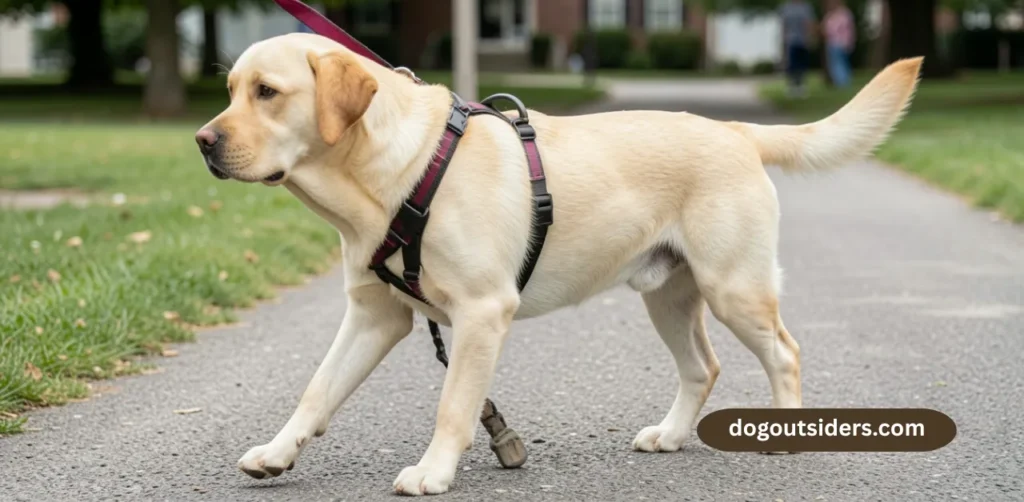
It’s working. Your Lab is just testing.
Month 4: Teething, Testing & the First Fear Period
Teething management: Your Lab’s labrador teething timeline peaks between 4–6 months. She’ll chew everything — furniture, shoes, hands, walls. Provide frozen Kongs, rubber chew toys, frozen washcloths, and bully sticks. Don’t punish chewing — redirect it.
The first fear period: Somewhere between 8–11 weeks and again around 4–5 months, many Labs go through a puppy fear period where previously-neutral things suddenly become scary. A trash can she walked past 100 times may suddenly terrify her.
How to handle it:
- Don’t force exposure. Let her observe from a distance.
- Don’t coddle excessively (“Oh poor baby!”) — this validates the fear.
- Pair the scary thing with treats at whatever distance she’s comfortable.
- The fear period typically passes in 1–3 weeks.
Training focus: Proof existing commands in mildly distracting environments. Practice “sit” in the backyard. Practice “come” in the front yard. Add one level of difficulty at a time.
Months 5–6: Intermediate Commands & Leash Manners
New commands:
- “Heel” — Structured walking at your side. Start with 5-step sequences indoors. Reward at hip level. Gradually increase steps before rewarding.
- “Wait” — A short-duration pause. Use at doorways, before meals, before car exits.
- “Place” — Go to your designated bed/mat and stay there. Begin with 10-second durations and build to 1–2 minutes.
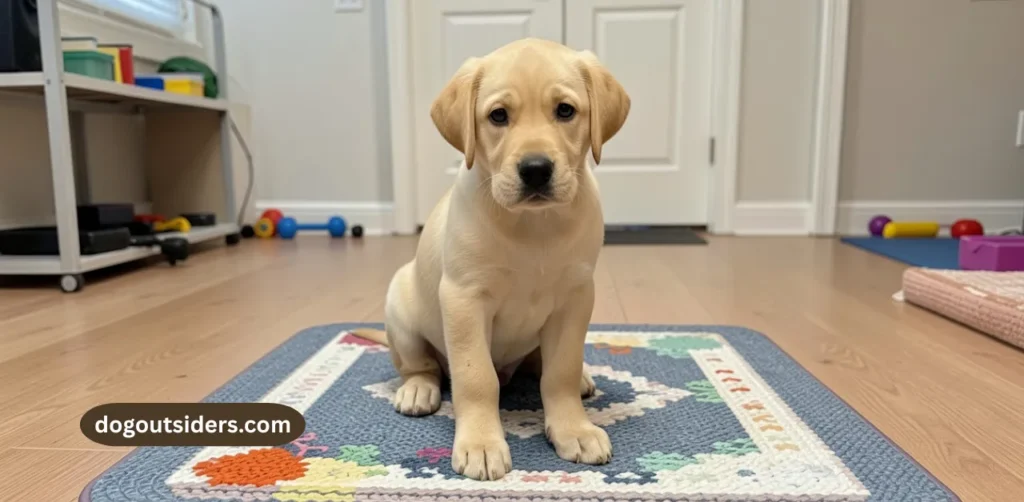
Extended stays: Push “stay” duration to 30 seconds, then 1 minute, then 2 minutes. Add distance (step back, then across the room) but only after duration is solid.
Loose leash walking practice: Your Lab is now big enough that pulling is genuinely problematic. Use a front-clip harness. Stop walking when she pulls. Resume when the leash is slack. Be prepared for walks to be very slow for a few weeks. That’s normal. This is the process.
According to a study in the Journal of Veterinary Behavior, dogs trained with positive reinforcement during this adolescent period showed significantly better long-term obedience outcomes compared to dogs trained with aversive methods. The teenage phase is precisely when patience and positive methods matter most.
Related reading: How to Stop Your Labrador From Pulling on the Leash (5 Proven Methods)
Phase 5 — Months 6–9: The Teenage Tornado
If month 4 was the preview, months 6–9 are the main event. This is the hardest period of Lab ownership — and it’s temporary.
Months 6–7: Regression Is Normal (Don’t Panic)
Around 6–7 months, many Lab owners panic because their puppy suddenly seems to “forget” commands she knew perfectly at 4 months. She won’t come when called. She blows past “stay.” She acts like she’s never heard the word “sit” in her life.
This is training regression in puppies — and it’s completely normal.
What’s happening: your Lab’s brain is undergoing massive hormonal and neurological changes. According to a 2019 study published in the journal Biology Letters, dogs at the onset of puberty (around 6–9 months) temporarily showed decreased responsiveness to commands from their owners — similar to the pattern seen in human teenagers. The study found this was most pronounced in dogs with insecure attachments, reinforcing that relationship-based, positive training is the antidote.
Your response: Don’t add new commands. Go back to basics. Re-train “sit,” “down,” “come” in low-distraction settings as if she’s hearing them for the first time. Reward generously. Be patient. The regression passes — usually by month 8–9.
The second fear period: Some Labs experience another puppy fear period between 6–14 months. Handle it the same way: don’t force, pair with treats, give space, be patient.
Months 8–9: Real-World Proofing
Once regression stabilizes, it’s time to proof commands in increasingly challenging environments:
- Park: Practice sit, down, stay, come with other dogs visible at a distance
- Pet store: Practice loose leash walking with smells and distractions everywhere
- Outdoor café: Practice “place” on a mat while you sit and eat
- Neighborhood walks: Practice “heel” for 30-second stretches, then release to sniff
Off-leash recall development: If you have access to a securely fenced area, begin off-leash recall practice. Use a 30-foot long line first as a safety net. Recall should be at 90%+ reliability on the long line before you remove it.
Group class or CGC prep: Consider enrolling in an intermediate group class or preparing for the AKC Canine Good Citizen (CGC) test. The CGC evaluates 10 skills including sitting politely for petting, walking through a crowd, and staying in place — all of which your Lab should be working toward by this age.
Related reading: 7 Labrador Behavior Problems and How to Fix Them
Phase 6 — Months 9–12: Maturity & Refinement
The chaos is fading. Your Lab is starting to show glimpses of the well-trained adult dog she’s becoming. Months 9–12 are about polishing, proofing, and integrating training into real life.
Months 9–10: Advanced Impulse Control
Training focus:
- Duration stays in public. 5-minute down-stays at outdoor cafés, in veterinary waiting rooms, at the park. This is where “place” training pays off massively.
- Greeting manners. No jumping on people. Four paws on the floor = attention. Jumping = person turns away. Consistent practice with friends and family who follow the rules.
- Threshold training. Automatic “wait” at every door, car exit, and before crossing streets. This should be becoming habitual by now, not requiring a cue every time.
Months 11–12: Integration & Lifestyle Training
This phase is about making obedience part of your life rather than a separate “training time” activity.
- Café/restaurant behavior. Bring a mat. Practice “place” while you eat. Start with quiet spots and build to busier environments.
- Trail and hiking manners. Recall around wildlife, loose-leash walking on uneven terrain, sitting when passing other hikers.
- Continued socialization maintenance. Socialization doesn’t end at 16 weeks — it’s lifelong. Continue exposing your Lab to new people, dogs, environments, and experiences throughout the first year and beyond.
Real example: My client David had a black Lab named Ziggy. At 6 months, David almost rehomed Ziggy because the adolescent regression was so severe — counter-surfing, zero recall, pulling so hard David’s shoulder was injured. We went back to the schedule. Re-trained basics. Focused heavily on impulse control games and structured “place” training. By month 11, Ziggy earned his Canine Good Citizen certification. David told me: “The schedule works. The regression was the test. Sticking with it was the answer.”
Complete Labrador Puppy Training Milestone Chart
| Age | Training Focus | Key Commands | Daily Session Time |
|---|---|---|---|
| 8–10 weeks | Bonding, crate, potty training, name | Name, Sit (intro) | 3–5 min, 3–5x/day |
| 10–12 weeks | Core commands, socialization, bite inhibition | Sit, Down, Stay (intro) | 3–5 min, 3–5x/day |
| 12–16 weeks | Socialization intensive, recall, leash intro | Come, Leave It, Drop It | 5–8 min, 3–4x/day |
| 4–6 months | Intermediate commands, teething, impulse control | Heel, Wait, Place | 8–12 min, 3x/day |
| 6–9 months | Regression management, real-world proofing | All commands in distracting environments | 10–15 min, 2–3x/day |
| 9–12 months | Advanced impulse control, lifestyle integration | Duration stays, greeting manners, off-leash | 10–15 min, 2–3x/day |
Note: These are guidelines. Every Lab develops at a slightly different pace. If your puppy isn’t hitting a milestone exactly “on schedule,” that’s normal — adjust, don’t stress.
5 Training Mistakes That Derail Your Lab’s Progress
After 13 years of training Labs, these are the mistakes I see sabotage even the most dedicated owners:
- Skipping socialization because you’re “waiting for vaccines.” The AVSAB’s official position is clear: the behavioral risks of inadequate socialization far outweigh the disease risks when socialization is done safely (carrying puppy, controlled environments, vaccinated dogs). Waiting until 16 weeks to begin socialization means the window is already closing.
- Training only when things go wrong. Training should be proactive, not reactive. If you only train after your Lab jumps on someone, steals food, or pulls on the leash, you’re always playing catch-up. Use the schedule. Train before problems develop.
- Expecting linear progress. Puppy training is not a straight line. It’s an upward-trending zigzag. Your Lab will have great days, terrible days, and days where she randomly perfects a command you haven’t practiced in two weeks. The overall trajectory matters — not any single session.
- Inconsistency between family members. Everyone in the household must use the same cue words, the same rules, and the same rewards. If Mom says “down” and Dad says “lie down” and the kids say nothing because they let the dog jump on them, your Lab doesn’t have one set of rules — she has three. The result is confusion, not disobedience.
- Giving up during adolescence. Months 6–9 are when I get the most panicked calls. “She’s gotten worse.” “Training isn’t working.” “I think something is wrong.” Nothing is wrong. Your Lab is a teenager. Stay the course. The regression is temporary. Your consistency isn’t.
What Happens After Month 12?
Training doesn’t stop at 12 months. Labrador Retrievers don’t reach full behavioral maturity until 2–3 years of age, according to research on large-breed dog development.
After year one, focus on:
- Continued proofing in new environments
- Maintenance training — practice commands weekly to prevent backsliding
- Advanced activities — dock diving, agility, scent work, therapy dog training (Labs excel at all of these)
- Ongoing socialization — new experiences, new dogs, new people throughout life
Your Lab’s labrador exercise by age needs also increase significantly after 12 months, as growth plates close and structured exercise becomes safe. The 5-minute-per-month rule relaxes, and your adult Lab can enjoy full hikes, runs, and swimming sessions.
Final Thoughts — Trust the Schedule, Trust Your Lab 💛
Raising a Labrador Retriever through the first year is one of the most demanding, chaotic, tear-your-hair-out, wouldn’t-trade-it-for-anything experiences you’ll ever have.
There will be days when your puppy nails a 2-minute stay and you feel like a genius. And there will be days when she pees on the floor, eats a sock, and ignores her name — all before 9 AM.
Both days are part of the journey.
This week-by-week schedule is your anchor. When you feel lost, come back to it. Find your puppy’s age. See what you should be working on. Do that one thing today. That’s enough.
You don’t need to be perfect. You need to be consistent.
If this training schedule gave you the clarity you’ve been searching for, please save it on Pinterest so other Lab parents can find it too. And if you’re currently in the trenches — week 8, month 6, the teenage tornado — drop a comment on dogoutsiders.com and tell me where you are. I’ll meet you there. 🐾

Jahanzaib:
Jahanzaib is a dedicated dog care researcher and content creator specializing in dog training, behavior correction, and pet wellness. As the founder of DogOutsiders.com, he focuses on creating evidence-based, experience-driven content that helps dog owners solve real problems—from training stubborn dogs to avoiding critical health and behavior mistakes. His mission is to make expert-level dog care knowledge simple and accessible for every pet owner.
Frequently Asked Questions — Labrador Puppy Training Schedule
The best Labrador puppy training follows a week-by-week schedule:
8–10 weeks: Bonding, house & crate training, name recognition.
10–12 weeks: Introduce sit and down, start socialization.
12–16 weeks: Intensive socialization, begin recall, teach leave it & drop it.
4–6 months: Add heel, wait, place, manage teething and fear periods.
6–9 months: Handle adolescent regression, proof commands in distractions.
9–12 months: Advanced impulse control, greeting manners, daily-life integration.
Use short, positive reinforcement sessions throughout. 🐶✅
By 3 months (12 weeks), a Labrador puppy should:
Recognize her name
Respond to sit and down commands
Begin stay for 1–3 seconds
Show progress in house and crate training
Have multiple socialization exposures
Start bite inhibition during play
She won’t be perfect, but the foundations of training should be well established. 🐶✅
Train a Labrador puppy in short, frequent sessions:
8–12 weeks: 3–5 minutes, 3–5 times/day
3–6 months: 5–10 minutes, 3–4 times/day
6–12 months: 10–15 minutes, 2–3 times/day
Short sessions work best because puppies have limited attention spans, and daily reinforcement during walks, meals, and play boosts learning. 🐶⏱️
Labrador Retrievers reach behavioral maturity at 2–3 years, but most know all essential commands by 12 months. Training after that focuses on consistency, impulse control, and reliability in new or distracting situations. A Lab is often considered well-trained by 18 months with consistent practice. Training is ongoing — even adult Labs benefit from regular practice, new challenges, and socialization. 🐕📘
The first thing to teach a Labrador puppy is name recognition — getting her to turn toward you when she hears her name. Reward immediately with a treat and praise. After 3–5 days, once this is reliable, start the first command: sit, which is natural for Labs and builds the foundation for all future training. 🐶✅
A well-structured Labrador puppy training day follows a repeating cycle of activity, training, and rest throughout the day. Here’s a sample daily structure for a 12-week-old Lab:
7:00 AM — Wake up, potty break outside, breakfast
7:30 AM — 5-minute training session (sit, down practice)
8:00 AM — Supervised play (15–20 minutes), socialization exposure
8:30 AM — Enforced nap in crate (1.5–2 hours)
10:30 AM — Potty break, 5-minute training session (name recall)
11:00 AM — Supervised exploration, handling practice
11:30 AM — Nap in crate (1.5–2 hours)
1:30 PM — Potty break, lunch, 5-minute training session
2:00 PM — Play, socialization
2:30 PM — Nap in crate (1.5–2 hours)
4:30 PM — Potty break, short walk or yard time
5:00 PM — Dinner, 5-minute training session
5:30 PM — Calm family time, chew toy
7:00 PM — Final potty break, settle in crate for evening/bedtime
The key principle: puppies need 18–20 hours of sleep. Most behavioral problems (biting, hyperactivity, destructiveness) are symptoms of overtiredness. Enforced naps are your most underrated training tool.