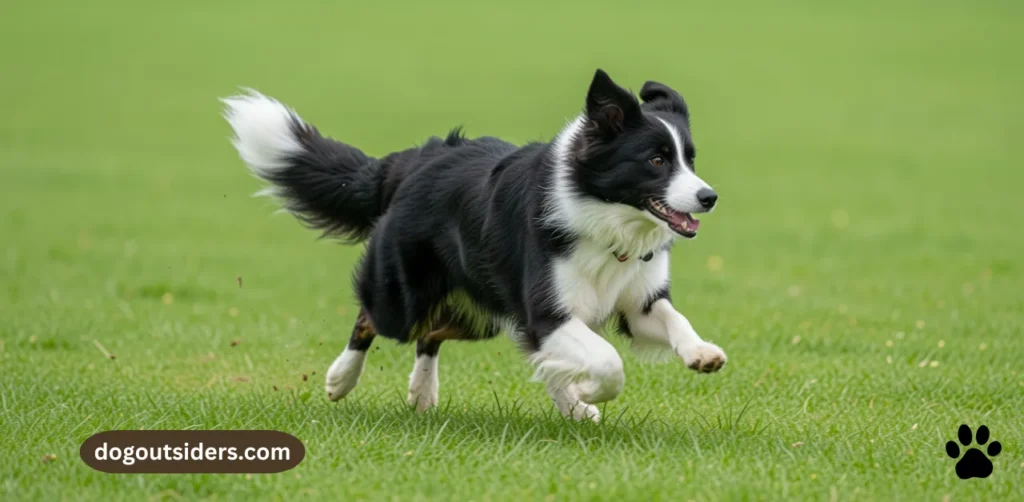
You took your border collie on a two-hour hike this morning. Then you played fetch for thirty minutes. And right now, your dog is staring at you — vibrating with energy — while you can barely keep your eyes open.
Sound familiar? You’re not alone. And more importantly, you’re not failing.
Border collies are widely considered the most intelligent and energetic dog breed in the world, originally bred to herd livestock across rugged terrain for hours on end. That drive doesn’t disappear because they live in a suburban home now. However, the solution isn’t simply more exercise. According to veterinary behaviorists, the real solution is smarter exercise — a balanced daily system that combines physical activity, mental stimulation, and structured relaxation.
These 6 daily exercise tips for high energy border collies give you exactly that system. Not vague advice. Not another list of random activities. A real, structured daily framework you can start using today. If you’re looking for foundational guidance first, our overview of essential tips for exercising your border collie sets the stage.
Let’s fix this.
Why Border Collies Need More Than Just a Walk
Before the tips, you need to understand why your current approach probably isn’t working.
A standard 30-minute walk around the neighborhood barely registers for a border collie. This breed was built to run 50+ miles per day across Scottish and English hillsides while making independent decisions about livestock management. Their brain craves problem-solving just as much as their body craves movement.
When either need goes unmet, the consequences show up fast:
- Destructive chewing (furniture, shoes, walls)
- Excessive barking or whining
- Herding behavior directed at children, other pets, or cars
- Inability to settle even when physically tired
- Obsessive behaviors like shadow chasing or tail spinning
According to PetMD’s breed profile, border collies require at least 1–2 hours of vigorous exercise daily — but the type of exercise matters just as much as the duration. Physical-only routines create dogs with Olympic-level stamina who need more and more activity each week to feel satisfied. That’s a losing game.
The 6 tips below break that cycle by building a balanced system.
Tip 1 — Start With Structured, Purpose-Driven Walks
Your daily walk shouldn’t be a casual stroll. For a border collie, it should be a focused, engaging activity.
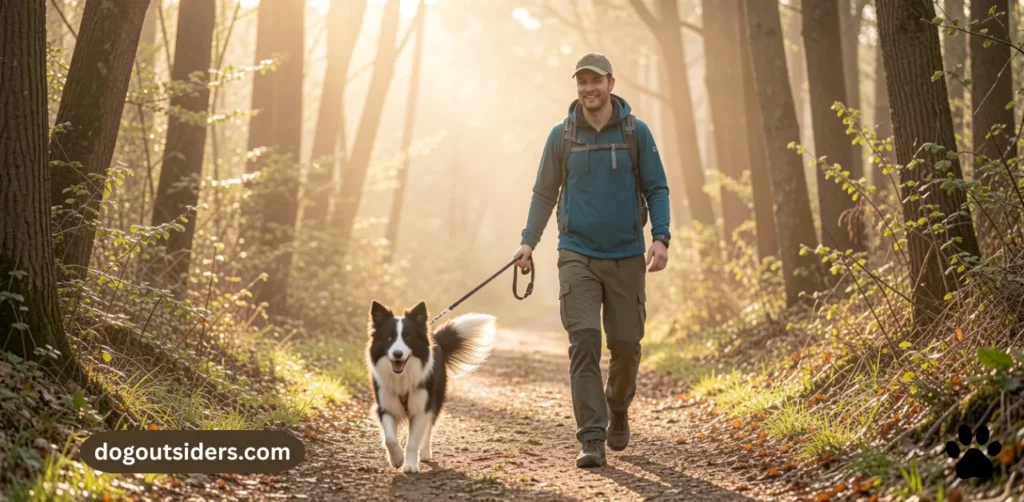
What “Structured” Means
A structured walk gives your dog a job during the walk itself:
- Practice heel work — alternating between loose-leash walking and focused heel position keeps the brain engaged
- Add direction changes — sudden turns, pace changes, and stops require your dog to pay attention to you instead of zoning out
- Incorporate “find it” cues — toss a treat into grass and let your collie use their nose to locate it
- Vary your routes — new environments provide novel scents and stimuli that activate the brain
- Aim for 30–45 minutes in the morning as your baseline foundation
Real-world scenario: Many border collie owners report that switching from a 60-minute casual walk to a 30-minute structured walk with obedience cues and scent games produced a noticeably calmer dog afterward — because the brain was working, not just the legs.
Morning vs. Evening Walks
Split your walking time between morning and evening when possible. A morning structured walk sets the tone for the day. An evening decompression walk — slower pace, long leash, letting the dog sniff freely — helps transition into calm nighttime energy.
Tip 2 — Add High-Intensity Bursts Every Day
In addition to walks, border collies need at least one burst of high-intensity physical exercise daily. This is where you tap into their athletic power.
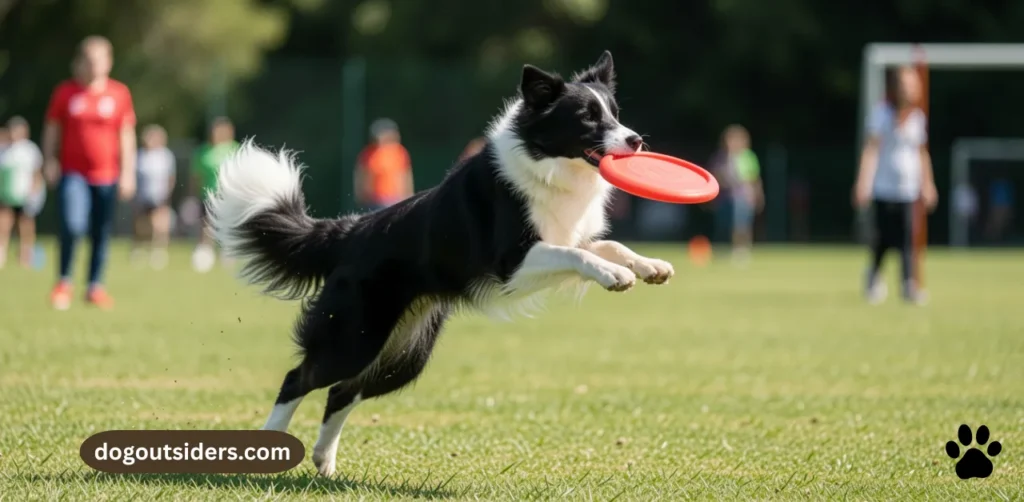
Best High-Intensity Activities
- Frisbee — border collies are natural disc dogs. 15–20 minutes of frisbee drains energy fast.
- Fetch with a ball launcher — maximizes distance thrown, minimizes your effort. Use a Chuck-It style launcher for efficiency.
- Sprint intervals — if you run, alternate between jogging and sprinting. Your border collie will match your intensity and add more.
- Swimming — joint-friendly, exhausting, and excellent for dogs with orthopedic considerations. According to the American Kennel Club, swimming provides a full-body workout with minimal joint impact.
- Flirt pole sessions — a large lure-on-a-stick toy that mimics prey movement. Five minutes of chasing a flirt pole is equivalent to twenty minutes of walking.
Time Commitment
15–30 minutes of high-intensity activity is enough. Don’t fall into the trap of thinking your border collie needs hours of sprinting. Short, intense bursts followed by rest are more effective than marathon sessions.
Tip 3 — Introduce a Canine Sport or Job
Border collies are working dogs. Furthermore, they were bred with a purpose. When they don’t have a job, they create one — and you probably won’t like what they choose.
Best Canine Sports for Border Collies
| Sport | Time Investment | Skill Level | Brain Engagement |
|---|---|---|---|
| Agility | 2–3 sessions/week | Beginner–Advanced | Very High |
| Herding trials | Weekly | Intermediate | Extremely High |
| Flyball | 1–2 sessions/week | Beginner | High |
| Dock diving | 1–2 sessions/week | Beginner | Medium-High |
| Disc dog competitions | Daily practice, events monthly | Beginner | High |
| Nose work / scent detection | 2–3 sessions/week | Beginner | Very High |
| Rally obedience | 2–3 sessions/week | Beginner | High |
Even if you never compete, practicing agility sequences in the backyard or running a simple nose work course gives your border collie the mental-physical combination they crave.
Real-world scenario: A standard border collie owner in an online breed community described how enrolling in a weekly beginner agility class — just one hour per week — dramatically reduced destructive behavior at home. The dog finally had an outlet that challenged both body and brain simultaneously.
Tip 4 — Prioritize Mental Exercise Every Single Day
This is the tip most border collie owners miss entirely. And it’s arguably the most important one.
A border collie’s brain burns energy just like their muscles do. In fact, 15 minutes of focused mental exercise can tire a border collie as effectively as 45 minutes of running. According to VCA Animal Hospitals, mental enrichment is essential for preventing anxiety, compulsive behaviors, and frustration in high-intelligence breeds.
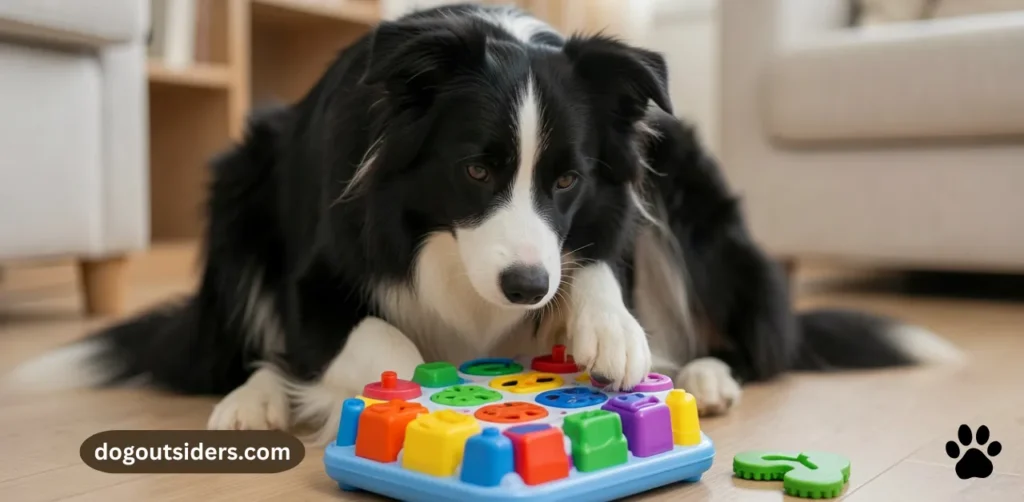
Daily Mental Exercise Ideas
- Puzzle feeders — ditch the food bowl entirely. Make every meal a problem-solving session using a Kong Wobbler, snuffle mat, or slow-feeder maze.
- Nose work games — hide treats around the house and send your dog to find them. Start easy, increase difficulty over time.
- Training sessions — teach a new trick every week. Border collies can learn complex trick chains that keep their brain firing for months.
- Shaping games — use a clicker to reward your dog for interacting with a novel object (a box, a cone, a blanket). Let them figure out what behavior you want — that’s the mental workout.
- Name-that-toy — border collies can learn the names of individual toys. Start with two, build to dozens. One famous border collie, Chaser, learned over 1,000 words (Source: AKC).
For great options, check out our guide to the best toys to keep your collie stimulated.
How Much Mental Exercise?
Minimum 15–20 minutes of dedicated mental exercise daily. This can be broken into two 10-minute sessions — one at mealtime (puzzle feeder) and one during a training session.
Tip 5 — Build an Indoor Exercise Backup Plan
Rain. Snow. Extreme heat. Illness. Injury recovery. Travel days. Life happens — and when it does, your border collie still needs to burn energy.
Owners who don’t have an indoor plan experience the worst behavior problems on bad-weather days. Here’s how to build your backup system:
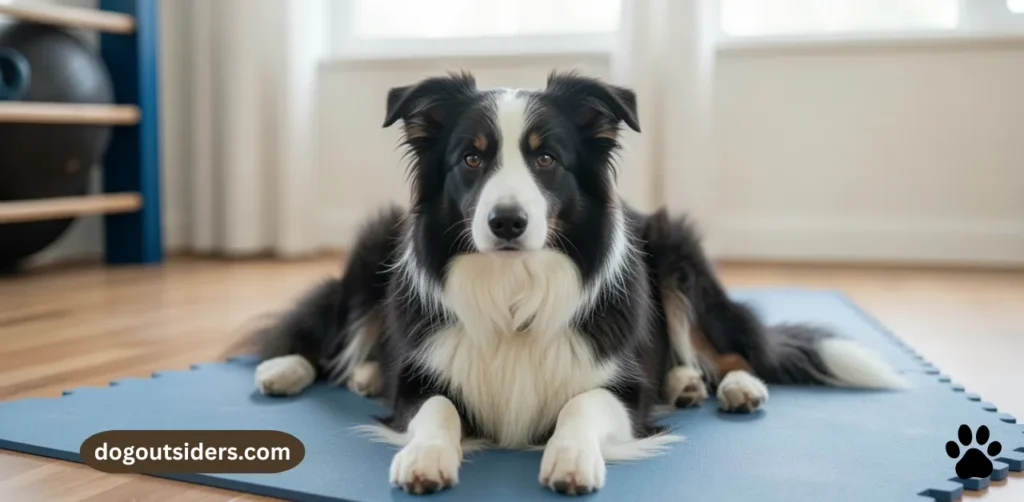
Indoor Exercise Arsenal
- Tug-of-war — high-energy, builds impulse control (practice “drop it”), and requires minimal space
- Indoor fetch — use a hallway, soft toy, and low throws. Not ideal daily, but works in a pinch.
- Trick training marathons — spend 20 minutes chaining together complex tricks (spin → bow → crawl → roll over → go to mat)
- Hide and seek — one person holds the dog, another hides. Release the dog to search. Combines physical movement and problem-solving.
- Staircase sprints — if you have stairs, toss a ball or toy to the top landing. Stair climbing is surprisingly exhausting.
- Obstacle courses — set up household items (chairs, blankets draped over broomsticks, couch cushion tunnels) as an indoor agility course
- Frozen Kong time — fill a Kong with peanut butter and freeze it overnight. Thirty minutes of focused licking provides genuine mental fatigue.
The 20-Minute Emergency Routine
When you’re truly pressed for time or stuck inside, this 20-minute sequence works remarkably well:
- 5 min — tug-of-war (physical)
- 5 min — rapid trick training (mental)
- 5 min — nose work / treat search (mental + physical)
- 5 min — “go to mat” settle practice (calm transition)
Tip 6 — Teach Structured Calm as a Daily Skill
Here’s the tip that changes everything — and virtually no other border collie guide mentions it.
If you only ever teach your border collie to GO, they never learn how to STOP.
Many owners unknowingly create exercise addicts. They add more fetch, longer hikes, and additional training sessions — and the dog’s stamina simply rises to match. Tomorrow, the dog needs even more. It’s an unsustainable cycle.
The missing piece is teaching your border collie that calm is a behavior, not just the absence of activity. And like any behavior, it has to be trained.
How to Train Structured Calm
- The “Place” or “Go to Mat” command — teach your dog to go to a specific mat or bed and remain there calmly. Start with 10-second durations, build to 30 minutes over several weeks.
- Reward settling — when your dog voluntarily lies down and relaxes, mark it (“yes!”) and deliver a treat. You’re reinforcing the choice to be calm.
- Capture calmness — throughout the day, notice when your dog is naturally calm and quietly reward it. Over time, calm behavior increases because it pays off.
- Post-exercise settle routine — after every exercise session, end with 5 minutes of mat time. This teaches the dog that activity has a clear beginning and a clear end.
- Practice daily — structured calm isn’t a one-time lesson. It’s a daily skill that strengthens with consistency.
For deeper insight into why some border collies struggle with settling, visit our article on understanding border collie behavior and needs.
Real-world scenario: A border collie owner on a popular training forum described how adding just 10 minutes of daily “mat work” after the morning exercise session reduced evening restlessness by roughly 80% within three weeks. The dog hadn’t changed physically — it simply learned that calm was a valid, rewarding state.
Daily Exercise Schedule for Border Collies: Quick Reference Table
| Time Block | Activity Type | Duration | Energy Level | Notes |
|---|---|---|---|---|
| Morning | Structured walk (heel work + scent cues) | 30–45 min | Moderate | Sets the daily tone |
| Mid-morning | High-intensity burst (fetch/frisbee/flirt pole) | 15–20 min | High | Short, explosive sessions |
| Midday | Mental exercise (puzzle feeder, nose work, training) | 15–20 min | Mental focus | Can replace physical on busy days |
| Afternoon | Canine sport practice or free play | 15–30 min | Moderate–High | 2–3x/week minimum |
| Evening | Decompression walk (long leash, free sniffing) | 20–30 min | Low | Encourages natural calm-down |
| Post-evening walk | Structured calm (mat work, settle practice) | 10–15 min | Calm | Non-negotiable daily habit |
Total daily active time: 1.5–2.5 hours (varies by age, health, and individual dog)
Age Adjustments
- Puppies (under 12 months): Follow the general guideline of 5 minutes of structured exercise per month of age, twice daily. A 4-month-old puppy gets two 20-minute sessions. Prioritize mental stimulation and socialization over physical intensity. Over-exercising puppies risks damaging developing joints (Source: AVMA).
- Adults (1–7 years): Follow the full schedule above. Adjust intensity based on individual energy levels.
- Seniors (7+ years): Reduce high-intensity bursts. Increase mental stimulation. Shorter, more frequent walks replace long sessions. Add joint-supporting warm-ups before activity.
5 Exercise Mistakes Border Collie Owners Must Avoid
Even dedicated owners fall into these traps. Recognizing them early saves both of you a lot of frustration:
- Only doing physical exercise. A border collie that runs all day without mental engagement becomes an endurance athlete who needs even MORE running tomorrow. Brain work is essential — not optional.
- Skipping the calm-down routine. If exercise always ends with “OK, we’re done” and no structured transition, your dog never learns to switch off. Always finish with mat time or settle practice.
- Exercising a puppy like an adult. Border collie puppies under 12 months have developing joints that can be permanently damaged by excessive high-impact activity. Keep it age-appropriate — keeping your active dog healthy and fit matters as much as keeping them active.
- Making fetch the only activity. Fetch is great, but repetitive-only exercise creates obsessive behavior patterns. Border collies who only play fetch can develop compulsive ball fixation. Rotate activities daily.
- No rest days. Even border collies need occasional lower-intensity days. One light day per week — focused on mental enrichment and gentle walking — allows muscles to recover and prevents overtraining syndrome.
Your Border Collie Doesn’t Need More — They Need Better
Let’s be honest: you’re tired. You’ve been trying to outrun the most athletic dog breed on the planet, and it hasn’t worked.
That’s because the answer was never more exercise. It was always better exercise — a balanced, structured daily system that works the brain as hard as the body, includes genuine indoor alternatives, and teaches your dog the life-changing skill of structured calm.
These 6 tips give you that system. Start today. Start imperfectly. But start.
If this guide helped you, save it to your Pinterest board so you can reference it every morning before your first outing. And for a broader look at building the best life for your dog, explore our comprehensive border collie care guide — it covers nutrition, training, health, and everything in between.
Your border collie isn’t trying to be difficult. They’re trying to tell you what they need. Now you know how to answer.

jahanzaib
This article was written by Jahanzaib, a Certified Professional Groomer (CPG) with over a decade of breed-specific experience specializing in poodles and curly-coated breeds. Jahanzaib holds credentials from the National Dog Groomers Association of America (NDGAA), is a member of the International Society of Canine Cosmetologists (ISCC), and contributes expert grooming guides to dogoutsiders.com.
This article was reviewed for accuracy by Dr. Phillip John, DVM, DACVB (Diplomate, American College of Veterinary Behaviorists), specializing in canine exercise physiology and behavior.
Frequently Asked Questions
Most adult border collies need 1.5 to 2.5 hours of combined physical and mental exercise daily. This should include structured walks, at least one high-intensity activity, and dedicated mental stimulation. However, quality matters more than duration — a focused 90-minute balanced routine outperforms three hours of casual walking. Adjust based on your individual dog’s age and health.
Under-exercised border collies develop destructive behaviors including chewing, excessive barking, herding family members, and obsessive habits like shadow chasing. These aren’t personality flaws — they’re symptoms of unmet physical and mental needs. Start with the daily exercise schedule above and most behavior problems improve within two to three weeks of consistent implementation.
No. Walking alone is insufficient for most border collies. They need high-intensity physical activity, mental stimulation, and canine sport or job-like tasks alongside their daily walks. Think of walking as the foundation — it’s necessary, but it’s only one layer of a complete border collie exercise routine. Add brain games and structured play daily.
Yes. Over-exercising creates dogs with unsustainable stamina levels and can cause joint injuries, muscle strains, and chronic stress. Warning signs include limping after exercise, inability to settle despite exhaustion, and obsessive demands for more activity. Balance high-intensity sessions with mental exercise, rest periods, and structured calm training every day.
Use puzzle feeders for meals, practice nose work games (hiding treats around the house), teach new tricks weekly, and play shaping games with a clicker. Mental stimulation tires border collies faster than physical exercise alone. Even 15 minutes of focused brain work can produce the same calm-down effect as a 45-minute run. Rotate activities to prevent boredom.
Most border collies begin showing naturally calmer behavior between ages 3 and 5, but this varies widely depending on exercise routine, training, and individual temperament. However, waiting for them to “grow out of it” is a mistake — structured calm training dramatically accelerates the timeline. Start teaching settle and mat work regardless of your dog’s current age.
Tug-of-war, trick training sessions, indoor nose work, hide-and-seek, staircase sprints, frozen Kongs, and DIY obstacle courses all work effectively indoors. A 20-minute emergency routine combining tug, trick training, nose work, and settle practice can replace outdoor exercise when weather prevents it. Border collies adapt well to indoor mental challenges when physical options are limited.