You just brought home your Rottweiler puppy — and now you’re standing in your living room wondering if you’ve completely underestimated what you signed up for.
That big, clumsy ball of fur is adorable. But you’ve heard the stories. You know this breed grows fast, thinks fast, and tests limits even faster. And the pressure to “get training right” is already sitting heavy on your shoulders.
Here’s the truth: the first year is the most important training window of your Rottweiler’s life. What you teach now — and just as importantly, what you allow now — shapes the dog you’ll live with for the next decade.
This guide gives you 8 first year training tips for new Rottweiler owners, built around the specific temperament, instincts, and developmental stages of this breed. No vague advice. No fear-mongering. Just a clear roadmap you can start using today.
Many first-time large-breed owners also find it helpful to compare training approaches across breeds — if you’re curious about how Rottweiler training differs from other dogs, our guide on Golden Retriever puppy training tips every new owner should know is a great reference point.
Why the First Year Is Make-or-Break for Rottweilers
The Developmental Window Most Owners Miss
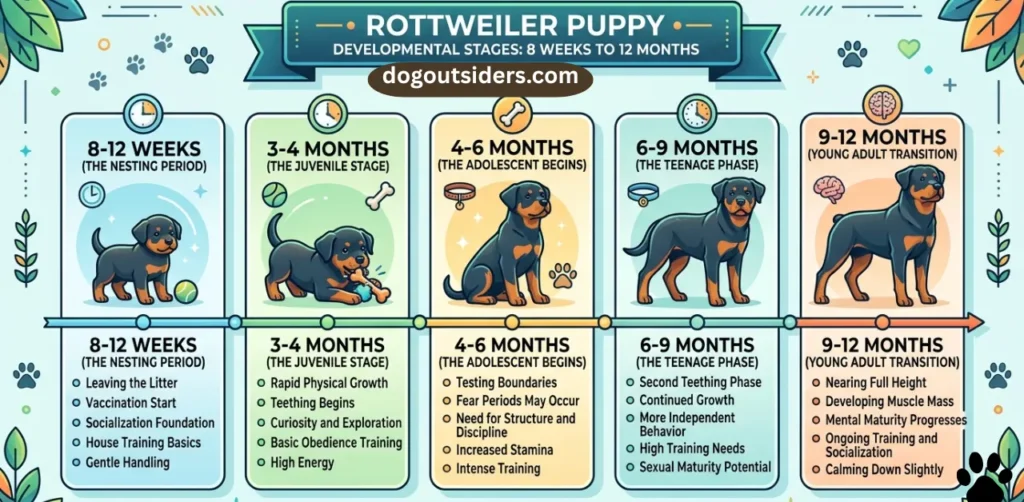
Rottweilers go through their most critical learning phases in the first 12 months. Between 8 and 16 weeks, their brains are like sponges — they absorb social information, form fear associations, and begin building the behavioral patterns they’ll carry for life.

After 6 months, those patterns start to solidify. That doesn’t mean training stops working — it means it gets harder and takes longer. Starting early isn’t just better. For this breed, it’s essential.
According to the American Kennel Club, early training and socialization are especially critical for working breeds like the Rottweiler, which are naturally confident, territorial, and highly intelligent (Source: AKC).
How Rottweiler Instincts Affect Training
Rottweilers were bred as herding and guarding dogs. That means two things:
- They’re highly motivated by work and purpose. Training sessions feel natural to them — they actually enjoy having a job to do.
- They test authority. Not out of defiance, but because they’re wired to assess who’s in charge. Clear, consistent leadership reassures them.
This is very different from training a Golden Retriever, which tends to be people-pleasing by default. A Rottweiler needs to respect you before it fully cooperates — and you earn that through consistency, not force.
8 First Year Training Tips for New Rottweiler Owners
Tip 1: Start Training on Day One — Not Day 30
The biggest mistake new Rottweiler owners make is waiting. They think their puppy needs a “settling in” period before training begins.
In reality, your puppy starts learning the moment it walks through your door.
Day one training doesn’t mean formal sessions. It means:
- Not letting the puppy jump on people and laughing it off (at 10 lbs it’s cute — at 90 lbs it’s dangerous)
- Calling the puppy by its name consistently
- Rewarding calm behavior with a treat or praise
- Establishing where the puppy sleeps, eats, and plays
Even small puppies understand “yes” and “no” when those signals are consistent. The earlier you start, the less you’ll have to undo later.
What “Day One Training” Actually Looks Like
A realistic day-one routine looks like this:
- Morning: 5-minute name recognition and “sit” introduction
- Midday: Reward calm behavior during rest time
- Evening: Short leash introduction in the backyard
Keep sessions under 5 minutes for puppies under 10 weeks. Their attention spans are tiny — but the repetition is building real neural pathways.
Tip 2: Nail Socialization Before 16 Weeks
Socialization is the single most important thing you can do in your Rottweiler’s first year. It’s also the thing most owners do too little of — or skip entirely out of fear.
The socialization window for puppies is roughly 8 to 16 weeks. During this time, new experiences are processed as “normal.” After this window closes, new experiences are processed as potentially threatening.
A poorly socialized Rottweiler is a safety risk — not because the breed is inherently dangerous, but because a fearful, reactive 100-lb dog in any situation is unpredictable. The American Veterinary Medical Association emphasizes that inadequate socialization is one of the leading causes of behavior problems in adult dogs (Source: AVMA).
Safe Socialization During the Vaccine Window
Many owners avoid taking puppies out before all vaccinations are complete — around 16 weeks. But waiting means missing the socialization window almost entirely.
The solution: controlled, low-risk socialization.
- Carry your puppy to pet-friendly stores so their paws don’t touch public ground
- Invite vaccinated, calm adult dogs to your home for supervised visits
- Expose your puppy to different sounds, surfaces, people, and objects indoors
- Enroll in a puppy class where all dogs are required to be vaccinated
For more structured socialization guidance tailored to large breeds, check out our post on socialization tips for raising a well-behaved dog.
What should your Rottweiler puppy experience before 16 weeks? Here’s a quick checklist:
- ✅ At least 5 different people (men, women, children, hats, glasses)
- ✅ At least 3 different floor surfaces (grass, gravel, hardwood, carpet)
- ✅ Car rides
- ✅ Loud sounds (TV, vacuum, traffic)
- ✅ Gentle handling of paws, ears, and mouth
- ✅ Other calm, healthy, vaccinated dogs
Tip 3: Master These 5 Core Commands First
New owners often try to teach too many commands too fast. Instead, focus on five foundational commands that create safety and structure:
- Sit — the gateway command. Everything else builds from here.
- Stay — impulse control, critical for a powerful dog
- Come — recall can literally save your dog’s life
- Leave it — stops resource guarding and prevents dangerous ingestion
- Down — a calming command that reinforces your role as leader
The Command Priority Order for Rottweiler Puppies
Teach in this exact order. Each command builds on the one before it. Don’t move to “stay” until “sit” is reliable. Don’t attempt “leave it” until “down” is solid.
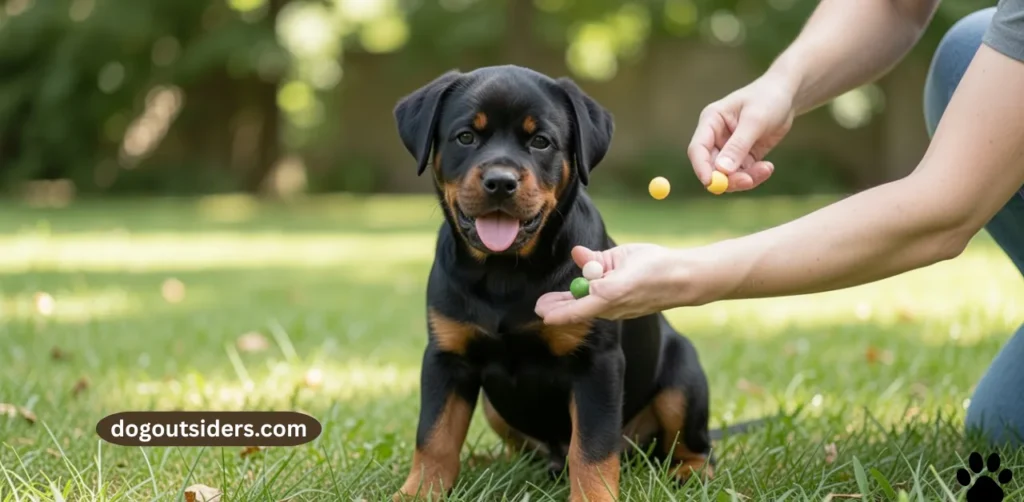
Use high-value treats like small pieces of chicken or cheese — Rottweilers are food-motivated, which makes this training style extremely effective. Keep sessions short: 3–5 repetitions per command, 2–3 sessions per day.
According to PetMD, short, reward-based training sessions produce faster and more lasting results in highly intelligent breeds than long correction-based sessions (Source: PetMD).
Tip 4: Use Positive Reinforcement — Every Single Time
This is non-negotiable for Rottweilers.
Punishment-based training — yanking the leash, alpha-rolling, yelling — does not work on this breed. It creates anxiety, shuts down learning, and in some cases triggers defensive aggression. A Rottweiler that shuts down during training isn’t submitting — it’s deciding not to trust you.
Why Punishment-Based Training Backfires With Rottweilers
Rottweilers are sensitive to their owner’s emotional state. They read energy very well. When training sessions feel tense or threatening, they associate training itself with negativity — and start resisting or avoiding it.
Positive reinforcement does the opposite:
- It makes your dog want to engage with you
- It speeds up learning because the dog is actively trying to earn the reward
- It builds the trust and bond that makes your Rottweiler want to listen
If your Rottweiler isn’t responding, the answer is never more pressure. It’s better communication, higher-value rewards, or shorter sessions.
Tip 5: Crate Train Consistently From Week One
A crate is not a punishment. For a Rottweiler puppy, it’s a safe den — a place that reduces anxiety, prevents destructive behavior, and sets the stage for solid housetraining.
The rule: Never use the crate as punishment. If the crate becomes associated with negative experiences, your dog will resist it — which defeats the entire purpose.
How to Make the Crate Feel Like a Safe Space
- Start by feeding all meals in or near the crate
- Put a worn t-shirt inside so the crate smells like you
- Never close the door until the puppy enters voluntarily
- Gradually increase crate time — start with 10 minutes, build to 2–3 hours over two weeks
A Rottweiler puppy shouldn’t be crated for more than their age in months plus one hour (e.g., a 3-month-old puppy = 4 hours maximum during the day).
Tip 6: Teach Bite Inhibition Early
Rottweiler puppies bite. All puppies do. But at 8 weeks, those little teeth become a serious concern if bite behavior isn’t addressed — because in four months, your puppy’s jaw strength will double.
Bite inhibition is the ability to control the force of a bite. Teaching it now prevents serious incidents later.
Step-by-Step Bite Inhibition for Rottweiler Puppies
- When the puppy bites too hard during play, let out a firm, short “ouch” and immediately stop playing
- Turn away, remove all attention for 30–60 seconds
- Resume play only when the puppy is calm
- Reward gentle mouthing or licking with praise
Repeat this process consistently. Your puppy will learn that biting hard = game over.
What NOT to do: Don’t flick the puppy’s nose, tap their muzzle, or alpha-roll. These techniques increase arousal and unpredictability, especially in guard breed puppies.
For important safety context around young children and large breeds in training, read our article on warning signs your dog may not be safe around a baby.
Tip 7: Build a Daily Training Routine
Consistency is not just helpful for Rottweilers — it’s the foundation everything else rests on. Dogs learn through repetition and predictability. When training happens at the same times each day, your Rottweiler begins to anticipate it — and shows up mentally ready.
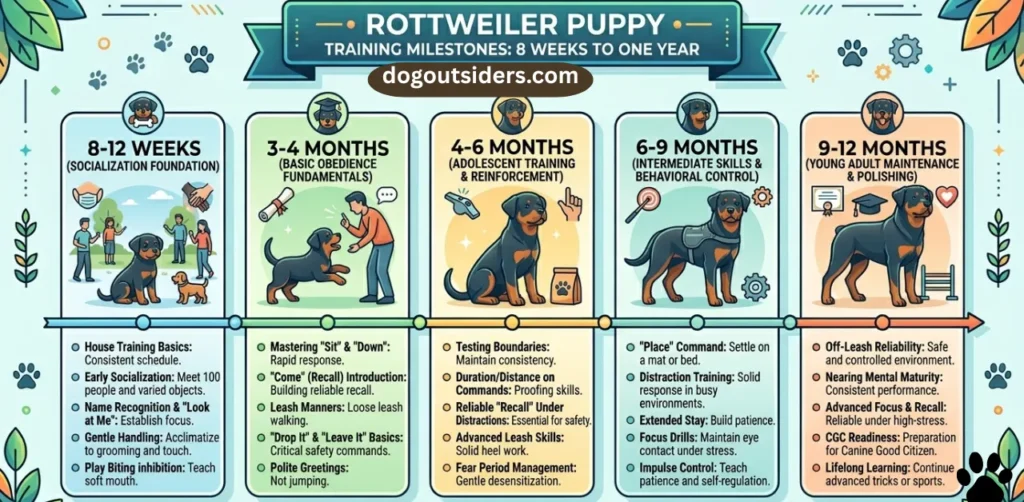
Sample Daily Training Schedule (8 Weeks to 12 Months)
| Age | Morning | Afternoon | Evening |
|---|---|---|---|
| 8–12 weeks | Name + Sit (5 min) | Crate rest + treat reward | Down + Come (5 min) |
| 3–4 months | Sit + Stay (7 min) | Leash intro (5 min) | Come + Leave it (7 min) |
| 5–6 months | Full command review (10 min) | Leash walk + distraction work | Impulse control games |
| 7–9 months | Advanced commands + duration | Off-leash recall (safe area) | Socialization outing |
| 10–12 months | Real-world proofing (busy streets, parks) | Scent or puzzle games | Confidence-building exercises |
This table gives you a progression — not a rigid schedule. Adjust based on your dog’s pace.
Tip 8: Train Through Regression Without Giving Up
Around 6–9 months, many Rottweiler owners hit a wall. The puppy who was making great progress suddenly seems to forget everything. Commands that worked perfectly last week are now being ignored. It feels like the training isn’t working.
This is normal. It’s called the adolescent regression phase.
Why Rottweilers Hit Training Walls and What to Do
During adolescence, a Rottweiler’s brain is flooded with hormones. Their focus drops. Their drive to test boundaries increases. This phase typically peaks between 6–9 months and levels out by 12–18 months.
What to do during regression:
- Drop back to basics — rebuild foundational commands with extra rewards
- Shorten sessions to 3–5 minutes to avoid frustration
- Don’t skip training — consistency during regression is what breaks through it
- Consider whether your dog needs more physical exercise (adolescent Rottweilers burn energy that shows up as stubbornness)
For additional perspective on how similar training slowdowns affect other intelligent breeds, our post on training mistakes that slow your dog’s progress is a helpful read.
Common Mistakes New Rottweiler Owners Make
Most training failures don’t come from bad dogs. They come from predictable, fixable owner mistakes.
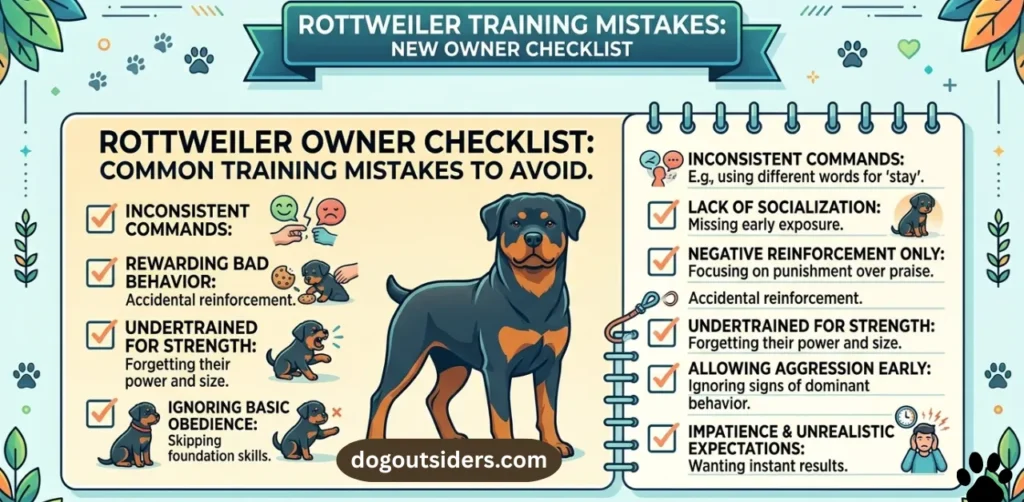
Here are the 6 most common ones:
- ❌ Waiting to start training — “He’s too young” is almost never true after 8 weeks
- ❌ Inconsistency between family members — if one person lets jumping slide, the training breaks down for everyone
- ❌ Using punishment as correction — this builds fear, not respect
- ❌ Skipping socialization — the window closes and cannot be fully reopened
- ❌ Expecting too much too fast — Rottweiler puppies are smart but still puppies; patience is part of training
- ❌ Rewarding excitement instead of calm — if you greet your Rottweiler when it’s jumping and barking, you’re reinforcing exactly what you don’t want
For a broader look at how these behavior patterns show up in other working breeds, our article on common behavior problems in large breeds and how to fix them is worth bookmarking.
First-Year Rottweiler Training Milestones at a Glance
Use this as your quick-reference benchmark. Every dog is different — but this gives you a realistic sense of where your Rottweiler should be at each stage.
| Milestone | Target Age |
|---|---|
| Responds to name | 8–10 weeks |
| Sits on command | 8–12 weeks |
| Basic crate comfort | 8–12 weeks |
| Walks calmly on leash | 3–4 months |
| Reliable “Come” recall | 4–5 months |
| “Stay” for 30+ seconds | 5–6 months |
| No biting during play | 4–5 months |
| Sits before meals, doors, greetings | 5–7 months |
| Performs commands with distractions | 8–10 months |
| Reliable off-leash recall in safe area | 10–12 months |
Research from veterinary behaviorists confirms that dogs who complete structured socialization and early obedience training are significantly less likely to develop aggression or anxiety-based behavior problems in adulthood (Source: American Veterinary Society of Animal Behavior, AVSAB).
You Can Do This — Final Thoughts
Training a Rottweiler in the first year is one of the most rewarding things you’ll do as a dog owner. Yes, it takes consistency. Yes, there will be frustrating days. But every session you put in is a direct investment in the loyal, calm, trustworthy companion this breed is capable of becoming.
You don’t have to be a professional dog trainer. You just have to show up — with patience, clear expectations, and a pocket full of good treats.
If this guide helped you, save this article to Pinterest so you can come back to it during those tricky weeks when you need a reset. And share it with a fellow Rottweiler owner who could use a solid starting point.
👉 For more practical dog training guides built for real owners, explore everything available at dogoutsiders.com.

Jahanzaib
Written by Jahanzaib, a Certified Professional Dog Trainer (CPDT-KA) and Karen Pryor Academy Certified Training Partner (KPA-CTP) with 14 years of experience specializing in German Shepherd and working breed training. Jahanzaib has trained GSDs for obedience, protection sport foundations, and behavior modification, and is a professional member of the Association of Professional Dog Trainers (APDT). They write regularly for dogoutsiders.com on breed-specific training, canine behavior, and working dog management.
This article was reviewed for accuracy by a Certified Professional Dog Trainer (CPDT-KA) specializing in large breed behavior.
Frequently Asked Questions
Start training on day one using positive reinforcement. Teach five core commands — sit, stay, come, leave it, and down — in short 3–5 minute sessions, two to three times daily. Use high-value treats, stay consistent, and involve every family member so the puppy receives the same signals from everyone. Early consistency is the foundation of everything.
Training begins the moment your Rottweiler puppy comes home, typically at 8 weeks old. The critical learning window runs from 8 to 16 weeks. During this period, puppies absorb new information faster than at any other life stage. Waiting until 4–6 months means missing the most impactful training window entirely.
Use the “ouch and disengage” method. When your puppy bites too hard, say “ouch” firmly, stop play immediately, and turn away for 30–60 seconds. Resume play only when the puppy is calm. Consistency is everything — every household member must respond the same way. Never tap the muzzle or alpha-roll, as this can increase defensive reactions.
Yes, with the right approach. Rottweilers are highly intelligent and food-motivated, which makes positive reinforcement training very effective. However, they also test boundaries, so consistency is non-negotiable. First-time owners who establish clear structure from day one typically see faster progress than they expect. Patience and a calm, confident manner go a long way.
Absolutely. Crate training reduces anxiety, prevents destructive behavior, and accelerates housetraining. The key is introducing the crate gradually and never using it as punishment. Feed meals near the crate first, then inside it. Build up crate time slowly over two weeks. A properly crate-trained Rottweiler sees it as a safe, comfortable den.
This is normal adolescent regression, typically peaking between 6 and 9 months. Hormonal changes reduce focus and increase boundary-testing behavior during this phase. The fix is returning to basics with extra rewards, keeping sessions very short, and maintaining daily consistency even when it’s frustrating. Most Rottweilers level out by 12–18 months.
Yes — and they actually train faster without it. Punishment-based methods trigger anxiety and defensive responses in Rottweilers, which shuts down learning. Positive reinforcement — rewarding desired behavior immediately with treats, praise, or play — produces more reliable and lasting results. It also builds the trust and bond that make your Rottweiler genuinely want to cooperate.