You’ve got a Labrador puppy. You’re thrilled — and completely exhausted.
Between the jumping, the mouthing, the zoomies at 6 a.m., and the puppy who has already discovered the TV remote is chewable, you’re probably wondering if you accidentally adopted a small tornado.
Here’s the thing: this is completely normal for Labs. According to the American Kennel Club, Labradors are one of the most exuberant, energetic, and food-motivated breeds in the world — and that same personality that makes them a handful as puppies makes them extraordinarily trainable when you know how to work with it. (Source: AKC)
This guide gives you 10 actionable Labrador puppy training tips that are breed-specific, confidence-building, and designed to work from week one.
Before you dive in, bookmark the full week-by-week Lab training schedule — it pairs perfectly with the tips in this guide and gives you a day-by-day roadmap.
10 Labrador Puppy Training Tips for a Happy, Obedient Dog
Here are 10 essential Labrador puppy training tips every owner should follow:
- Start training from day one — Labs learn fast early
- Use high-value treats to harness natural food motivation
- Apply the 5-minute exercise rule per month of age
- Teach “sit,” “stay,” “come,” and “leave it” first
- Socialize with 7 new people, places, and things weekly
- Crate train from the first night to prevent anxiety
- Stop jumping with a turn-away, not physical correction
- Redirect biting onto toys — never use hands as toys
- Add mental stimulation through puzzle feeders daily
- Stay consistent — one rule, same response, every time
Each tip below includes exactly how to apply it and what to watch for.
Tip #1: Start Training From Day One
Many new Lab owners wait until their puppy “settles in” before starting training. That’s understandable — but it’s also a missed opportunity.
Labrador puppies can begin learning basic cues from 8 weeks old. Name recognition, eye contact, and a simple “sit” are all achievable in the first week. The AVMA confirms that the critical socialization and learning window in puppies runs from 3 to 12 weeks — waiting costs you irreplaceable developmental time. (Source: AVMA.org)
Start simple on day one:
- Say your puppy’s name → reward eye contact immediately
- Lure “sit” before every meal with a treat above their nose
- Practice on a leash indoors before going outside
Keep the mood light and the sessions short. Your puppy’s first impression of training should be: this is fun.
Tip #2: Use Their Food Drive as Your Superpower
Labs are notoriously food-motivated. This isn’t a flaw — it’s your greatest training asset.
Most other breeds require significant effort to find a motivating reward. Labs? They’ll work enthusiastically for a piece of kibble. Channel this by using high-value treats (small pieces of chicken, cheese, or commercial training treats) for new behaviors and lower-value treats for known ones.
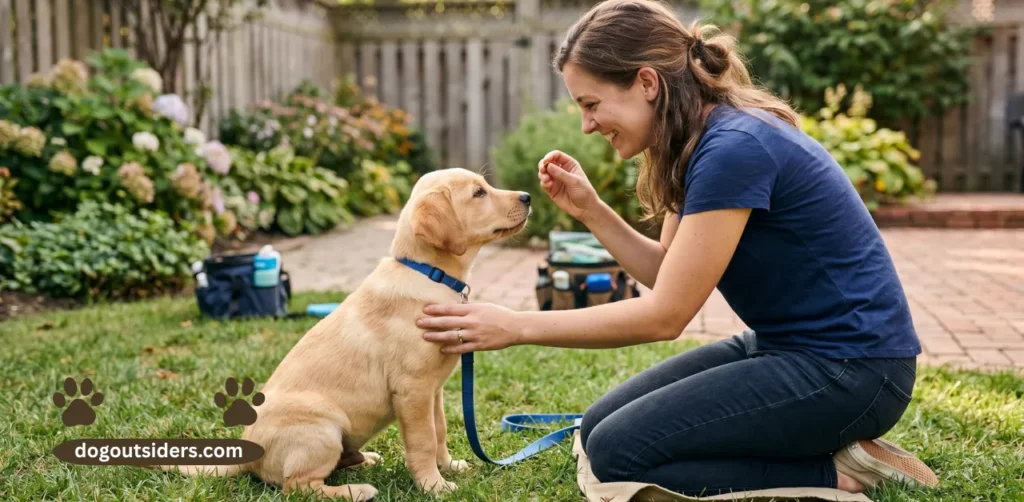
Reward hierarchy for Labs:
- New behavior / high distraction: High-value (chicken, cheese)
- Known behavior / low distraction: Regular treats or kibble
- Play reward: Tug or fetch (great for advanced recall training)
Never free-feed a Lab you’re actively training. A slightly hungry puppy is a focused puppy — and a focused Lab is a brilliant student.
Tip #3: Apply the 5-Minute Exercise Rule
What is the 5-minute rule for Labradors?
The 5-minute rule means giving your Labrador puppy no more than 5 minutes of formal exercise per month of age, twice daily. So an 8-week-old Lab gets 10 minutes; a 4-month-old gets 20 minutes. This protects developing joints from overuse injury. Mental stimulation — puzzle feeders, training games — fills the remaining energy gap safely.
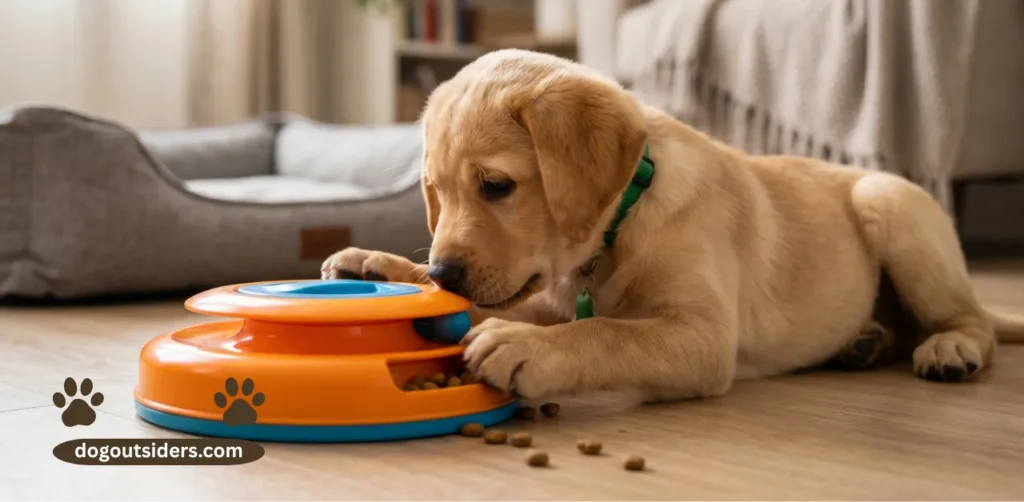
This rule exists because Labrador puppies’ growth plates don’t close until 12–18 months. Excessive running, jumping, or hard exercise before then increases the risk of hip dysplasia and other joint problems — a serious concern for this breed. (Source: VCA Animal Hospitals)
What to do with the remaining energy:
- Puzzle feeders and Kong-stuffing (5–10 minutes = exhausting for puppies)
- Short training sessions — mental work tires them faster than physical exercise
- “Find it” games — scatter kibble in the grass and let them sniff it out
- Leash walks on soft ground (grass, not concrete) within the time limit
The goal is a tired mind in a healthy body — not a tired body at the cost of their joints.
Tip #4: Teach the Big Four Commands First
Before anything else, your Lab puppy needs four commands as their foundation:
- Sit — The gateway behavior; teaches impulse control
- Stay — Builds patience and handler focus
- Come — The most important safety command they’ll ever learn
- Leave it — Protects them from eating everything they find, which Labs will absolutely try to do
For a complete guide to teaching each of these with step-by-step instructions, see the essential commands to teach your Lab Retriever first — it walks you through timing, progression, and common errors.
Sequence matters:
- Teach “sit” first — every other behavior builds on this one
- Add “stay” only once “sit” is reliable
- Practice “come” in a fenced area before working off-leash
- “Leave it” should be practiced from week one — Labs eat dangerous things
Tip #5: Socialize Like You Mean It
Socialization isn’t just about letting your puppy meet people. It’s about building a puppy who can handle the world without shutting down or acting out.
Labs are naturally social dogs, but under-socialization during the 3–12 week window can still create fear responses, reactivity, or anxiety in adulthood. Structured, positive exposure is what creates a stable adult Lab.
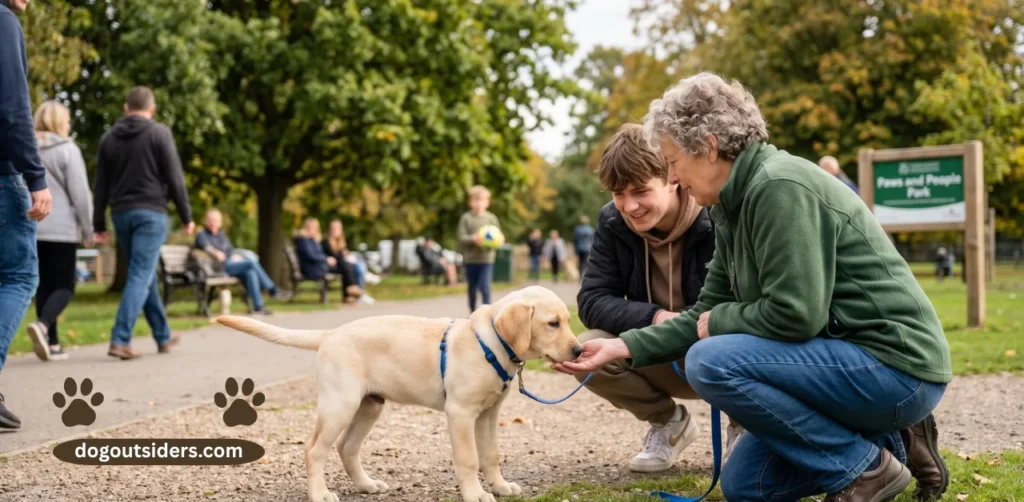
Use the 7-7-7 approach:
- 7 new people per week (different ages, clothing, appearances)
- 7 new places (car rides, pet stores, parks, pavements)
- 7 new experiences (sounds, textures, objects, animals)
Keep every exposure short and positive. If your puppy shows stress, increase the distance from the trigger — don’t push through it. One bad imprint experience can take weeks of positive work to undo.
Tip #6: Crate Train From Night One
The crate is not cruelty. Introduced correctly, it becomes the one place your Lab puppy feels completely safe and settled.
Crate training also directly supports house training, prevents destructive behavior when you can’t supervise, and significantly reduces separation anxiety in adult Labs — a breed that notoriously struggles with being left alone.
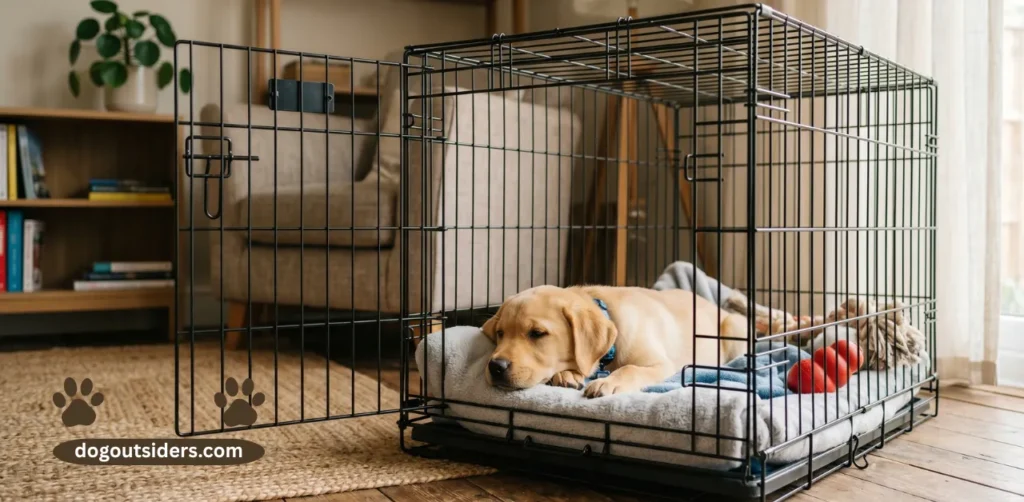
7-day crate introduction:
- Place the crate in a visible social area with the door open
- Toss treats inside — let your puppy explore freely
- Feed all meals inside the crate with the door open
- Close the door for 30 seconds → calm → open
- Build to 5 minutes, then 15, then 30 over the week
- Move to overnight once 30 minutes is comfortable
- Place the crate near your bedroom for the first few weeks
Never use the crate as punishment. Never release your puppy while they are crying — wait for 3–5 seconds of quiet, then open the door.
Tip #7: Stop Jumping the Right Way
Labrador puppies jump because it works. They jump, you react, they get attention — positive or negative, it doesn’t matter to them.
The fix is deceptively simple: remove the reward entirely.
- Turn your back completely the moment all four paws aren’t on the floor
- Fold your arms, look away, stay silent
- The moment four paws hit the ground → turn back → reward calmly
- Ask everyone in the house to do the same, every single time
The one mistake that keeps jumping alive? Reacting when your hands are full or you’re wearing good clothes. Inconsistency teaches your Lab that jumping sometimes works — which makes it persist much longer.
Tip #8: Redirect Biting — Never Punish It
Lab puppies bite. A lot. This is normal puppy behavior — they explore the world with their mouths — but it needs redirecting, not punishing.
Physical corrections for biting (pushing the nose, tapping the muzzle) can confuse a puppy who is simply playing. Worse, they can escalate the behavior in some puppies.
The redirect method:
- When teeth touch skin → yelp once (“ouch!”) → freeze
- Immediately offer a suitable chew toy as a redirect
- Reward calm chewing on the toy with quiet praise
- If biting continues → brief timeout (30 seconds in a playpen or behind a gate)
Never use your hands as toys. Wrestling and hand play teaches your puppy that hands are for biting — a lesson that’s very hard to undo as they grow into 30-plus kilograms of enthusiastic Lab.
Tip #9: Add Mental Stimulation Every Day
How do you mentally stimulate a Labrador puppy?
Mentally stimulate a Labrador puppy with nose work games, puzzle feeders, short obedience training sessions, and “find it” searches around the house. Labs were bred to use their nose and problem-solve, so mental challenges tire them out faster than physical exercise alone. Ten minutes of sniff games can equal 30 minutes of walking for mental tiredness.
This matters enormously for training. A mentally tired Lab is a calm, focused, cooperative Lab. A bored Lab is a destructive Lab.
Daily mental enrichment ideas:
- Scatter-feed breakfast in the grass (10 minutes of sniffing)
- Kong stuffed with frozen kibble + peanut butter (20–30 minutes of engagement)
- “Which hand?” — treat hidden in one fist, puppy sniffs to choose correctly
- Name the toy — teach puppy to retrieve specific named toys
- Short training sessions (5 minutes × 3 daily) — the mental workout Lab brains crave
Mental stimulation is not optional enrichment for Labs. It is a core part of their training plan.
Tip #10: Stay Consistent — Always
Labs are smart enough to find every loophole in an inconsistent rule system. If “off the couch” means sometimes yes, they’ll test it constantly until they find the pattern.
Consistency means:
- Same cue words used by every family member
- Same consequence for every behavior — every time
- Same schedule for meals, training, play, and rest
- Rules that apply even when you’re tired, busy, or distracted
Write the house rules on a whiteboard for the first month. Laminated cards on the fridge work for families with children. Labs don’t hold grudges — but they do hold onto patterns. Make sure the pattern is the one you want.
How Do You Train a Labrador Puppy to Be Obedient?
Train a Labrador to be obedient by using consistent positive reinforcement from 8 weeks old. Labs are highly food-motivated, which makes reward-based training extremely effective. Focus on four core commands first — sit, stay, come, and leave it. Keep sessions under 10 minutes, reward immediately, and practice in different locations to build reliable obedience.
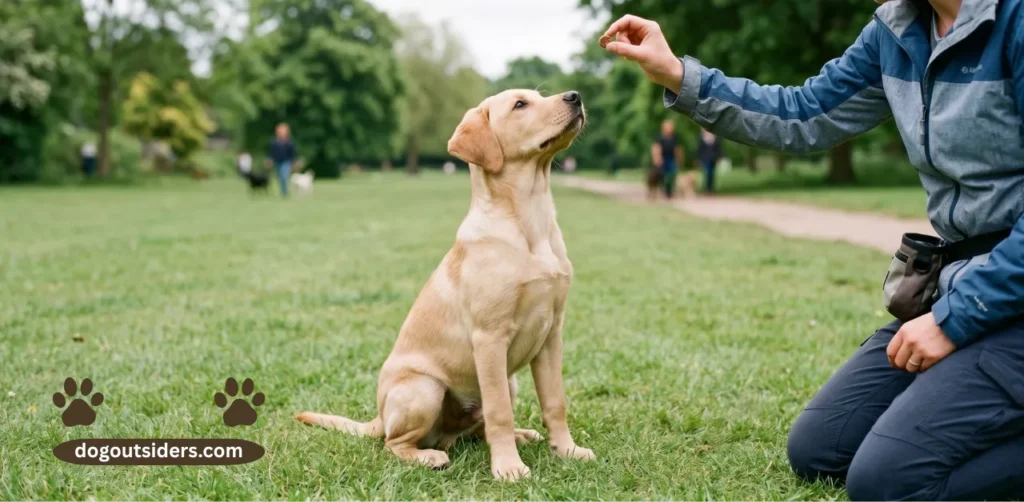
Obedience doesn’t come from dominance or correction. It comes from a puppy who trusts their owner, finds training rewarding, and has been given clear, consistent signals about what behavior earns good things.
Research published in the Journal of Veterinary Behavior confirms that dogs trained with positive reinforcement show higher obedience levels and lower anxiety than those trained with aversive methods — a finding especially relevant for sensitive, eager-to-please breeds like the Labrador. (Source: ScienceDirect — Journal of Veterinary Behavior)
The obedience formula for Labs:
- High-value reward + immediate timing + consistent cue = reliable behavior
- Practice in easy environments first → add distractions gradually
- Reward every correct response during the learning phase
- Shift to variable rewards (not every time) once behavior is reliable
What Is the Hardest Age for a Lab Puppy?
The hardest age for a Labrador puppy is typically between 8 and 18 months — the adolescent phase. During this period, Labs experience a surge in confidence and energy, often appearing to “forget” their training. They test boundaries, pull on the leash more, and become easily distracted. Consistent training during this phase is critical and pays off dramatically.
This phase frustrates almost every Lab owner. The sweet, attentive 10-week-old puppy who sat beautifully has been replaced by a boisterous adolescent who has apparently never heard the word “sit” in their life.
What’s actually happening:
- Hormonal changes affect impulse control and focus
- The adolescent brain is wiring new circuits — existing learning doesn’t disappear, it’s temporarily harder to access
- Labs hit this phase with full physical size but incomplete emotional maturity
How to survive Lab adolescence:
- Don’t punish regression — increase reward value and reduce session difficulty
- Add impulse control exercises back to the daily routine
- Shorten training sessions and end on success every time
- Remember: this phase ends. Consistent owners come out with an exceptional dog on the other side.
Which Color Lab Is the Calmest?
No scientific evidence confirms that coat color determines temperament in Labradors. Yellow, black, and chocolate Labs all share the same breed temperament traits. Individual personality, early socialization, and training consistency matter far more than color. Some breeders report anecdotally that yellows are calmer, but genetics and upbringing — not color — shape your Lab’s actual behavior.
What the evidence actually says:
| Lab Color | Anecdotal Reports | Scientific Evidence | What Actually Matters |
|---|---|---|---|
| Yellow | “Calmer, gentler” | None confirmed | Breeder line + socialization |
| Black | “More focused, working” | None confirmed | Training consistency |
| Chocolate | “More excitable, stubborn” | One small study — inconclusive | Early environment + genetics |
| Fox Red / White | “Similar to yellow” | No data | Same as above |
The takeaway: choose your Lab based on the breeder’s reputation and the puppy’s parents’ temperaments — not coat color.
Common Mistakes Labrador Owners Make
Even the most loving Lab owners make training errors that slow their puppy’s progress. Here are the most damaging ones — and exactly how to fix them.
Mistake #1: Letting jumping go “just this once”
Inconsistency is the #1 enemy of Lab training. If jumping gets a reaction even 20% of the time, the behavior persists indefinitely.
Mistake #2: Using punishment for biting
Physical corrections escalate biting in many puppies and damage the handler bond — the foundation of all future training.
Mistake #3: Too much exercise, not enough mental stimulation
Exhausting your Lab physically without mental enrichment creates a frustrated, destructive dog. The brain needs as much exercise as the body.
Mistake #4: Training only at home
A Lab who sits perfectly in the kitchen and ignores you at the park has learned “sit in the kitchen” — not “sit.” Practice everywhere.
Mistake #5: Expecting too much too soon
Labs are smart, but they’re still puppies. Frustration from unrealistic expectations leads to punishment-based responses — the opposite of what this breed needs.
Positive Reinforcement vs. Other Methods: What Works for Labs
| Method | Short-Term Effect | Long-Term Effect | Lab Suitability |
|---|---|---|---|
| Positive reinforcement | Fast engagement | Reliable, happy obedience | ✅ Excellent |
| Clicker training | Precise marking | Faster learning | ✅ Excellent |
| Verbal redirection (“no”) | Interrupts behavior | Neutral if calm and brief | ✅ Acceptable |
| Leash corrections | Suppresses behavior | Reduces trust and engagement | ⚠️ Use with caution |
| Alpha/dominance methods | Fear compliance | Anxiety, learned helplessness | ❌ Avoid entirely |
| Punishment for food seeking | Temporary suppression | Increases anxiety around food | ❌ Never — Labs are food-driven |
How Do You Say “I Love You” in Dog Language?
You say “I love you” to your dog through slow, soft eye contact, calm body language, and predictable routines. For Labradors, this also means engaging in play, training sessions where they succeed, and gentle physical contact they initiate. These interactions — not just cuddles — build deep trust and make your Lab more receptive to training.
This matters more than most owners realize. A Lab who trusts their owner completely is a Lab who wants to work with them — not away from them.
How to communicate love in Lab language:
- Slow blink during calm moments (reduces stress hormones in dogs — confirmed by research at the University of Lincoln)
- Get down to their level for greetings — crouching is less threatening than looming
- Respect their “I need space” signals — a dog who trusts you to read them is a dog who stays close to you
- Train them well — every successful training session tells your Lab “I believe you can do this”
If your Golden Retriever puppy is in the mix as well, these bonding principles apply equally — retriever breeds share many of the same communication needs.
The greatest thing you can give your Lab is not treats or toys — it’s a clear, consistent, loving structure they can rely on.
Training Checklist: Is Your Lab Puppy on Track?
Use this checklist at the end of each month to track your puppy’s progress:
Month 1 (8–12 Weeks):
- Responds to their name reliably indoors
- Sits on cue without a lure (hand signal only)
- Crate sleeping through the night with minimal fussing
- 3–5 new socialization experiences per week logged
- No resource guarding of food bowl observed
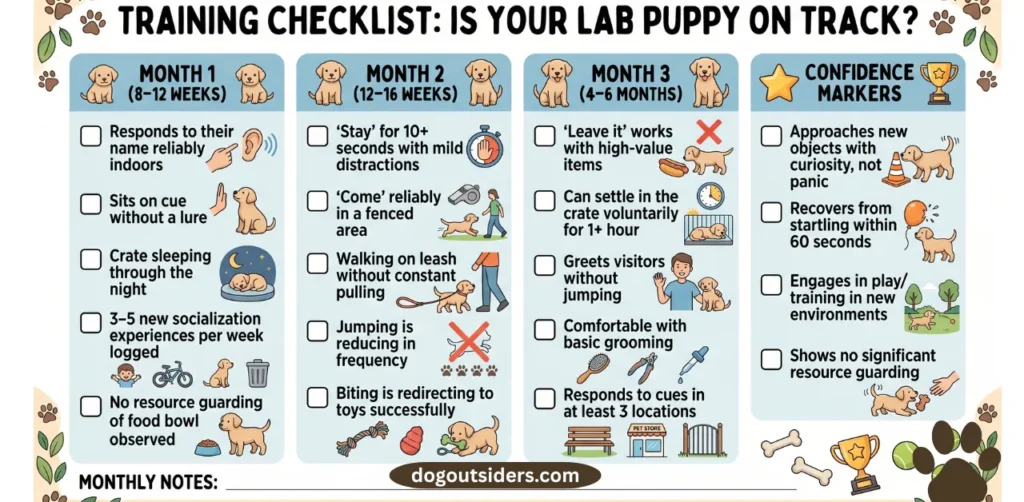
Month 2 (12–16 Weeks):
- “Stay” for 10+ seconds with mild distractions
- “Come” reliably in a fenced area
- Walking on leash without constant pulling
- Jumping is reducing in frequency
- Biting is redirecting to toys successfully
Month 3 (4–6 Months):
- “Leave it” works with high-value items nearby
- Can settle in the crate voluntarily for 1+ hour
- Greets visitors without jumping
- Comfortable with basic grooming (paws, ears, mouth)
- Responds to cues in at least 3 different locations
Confidence Markers:
- Approaches new objects with curiosity, not panic
- Recovers from startling within 60 seconds
- Engages in play and training in new environments
- Shows no significant resource guarding
If you’re ticking most of these boxes — you’re doing a genuinely great job. If several are missing, that’s your focused training plan for the next few weeks.
Your Happy, Obedient Lab Starts Right Now
Labrador puppies are a lot. They’re loud, they’re bouncy, they’re relentless — and they are also some of the most loving, loyal, and trainable dogs on the planet.
The 10 tips in this guide aren’t complicated. They’re consistent. And consistency, more than any technique or tool, is what turns a wild Lab puppy into the dog everyone at the park wishes they had.
Save this article. Share it with whoever is helping you raise your Lab. And when you’re ready to build on these foundations, the full week-by-week Lab puppy training schedule at DogOutsiders gives you the complete day-by-day roadmap.
You’ve got this — and your Lab already knows it. 🐾
Reviewed by the DogOutsiders Editorial Team | Based on AKC & AVMA Guidelines | Last Updated: April 2026
Behavioral disclaimer (light): “If your Lab puppy shows extreme fear responses, unprovoked aggression, or behaviors that feel unsafe, consult a certified professional dog trainer (CPDT-KA) or veterinary behaviorist for breed-appropriate assessment.”
Frequently Asked Questions About Labrador Puppy Training
Train a Labrador to be obedient using consistent positive reinforcement from 8 weeks old. Labs are highly food-motivated, making reward-based training highly effective. Focus on sit, stay, come, and leave it as your foundation commands. Keep sessions under 10 minutes, reward correct behavior immediately, and practice in different locations to build reliable obedience that holds under distraction.
The hardest age for a Labrador is between 8 and 18 months — the adolescent phase. Labs become more distracted, test boundaries more, and may appear to forget learned commands during this period. This is hormonal and developmental — not a training failure. Maintain consistency, reduce session difficulty temporarily, and increase reward value. This phase always passes with patient, consistent training.
The 5-minute rule means no more than 5 minutes of formal exercise per month of your Lab puppy’s age, given twice daily. An 8-week-old Lab gets 10 minutes total; a 4-month-old gets 20 minutes. This protects developing joints from injury. Use puzzle feeders, sniff games, and training sessions to channel remaining energy without stressing growth plates.
Mentally stimulate a Lab puppy through puzzle feeders, sniff games, “find it” searches, and short training sessions. Labs were bred to use their nose and problem-solve — ten minutes of mental work tires them as much as a thirty-minute walk. Scatter-feed breakfast in the grass, stuff Kongs with frozen kibble, and practice obedience games indoors for daily enrichment.
Tell your dog “I love you” through slow eye contact, calm body language, predictable routines, and engaging in activities they enjoy. For Labradors specifically, successful training sessions, structured play, and respecting their stress signals communicate love most powerfully. Dogs bond most deeply with people who are consistent, calm, and make them feel capable — not just people who cuddle them.
No scientific evidence confirms any Lab color is consistently calmer than another. Yellow, black, and chocolate Labradors all share the same breed temperament. Individual personality, breeder line genetics, early socialization, and training consistency are the real determinants of a calm adult Lab. When choosing a puppy, evaluate the parents’ temperament and the breeder’s practices — not coat color.
Start training your Labrador puppy the day they arrive home — typically at 8 weeks old. Labs can learn name recognition, eye contact, and “sit” immediately. The 8–12 week socialization window is the most influential developmental period of their life. Waiting until 6 months wastes irreplaceable learning time and allows unwanted habits — jumping, biting, pulling — to become deeply established.